

Desert Online General Trading LLC
Dubai, United Arab Emirates
Desert Online General Trading LLC
Dubai, United Arab Emirates
Full description not available
J**E
An older book on Quantum Physics that is very informative.
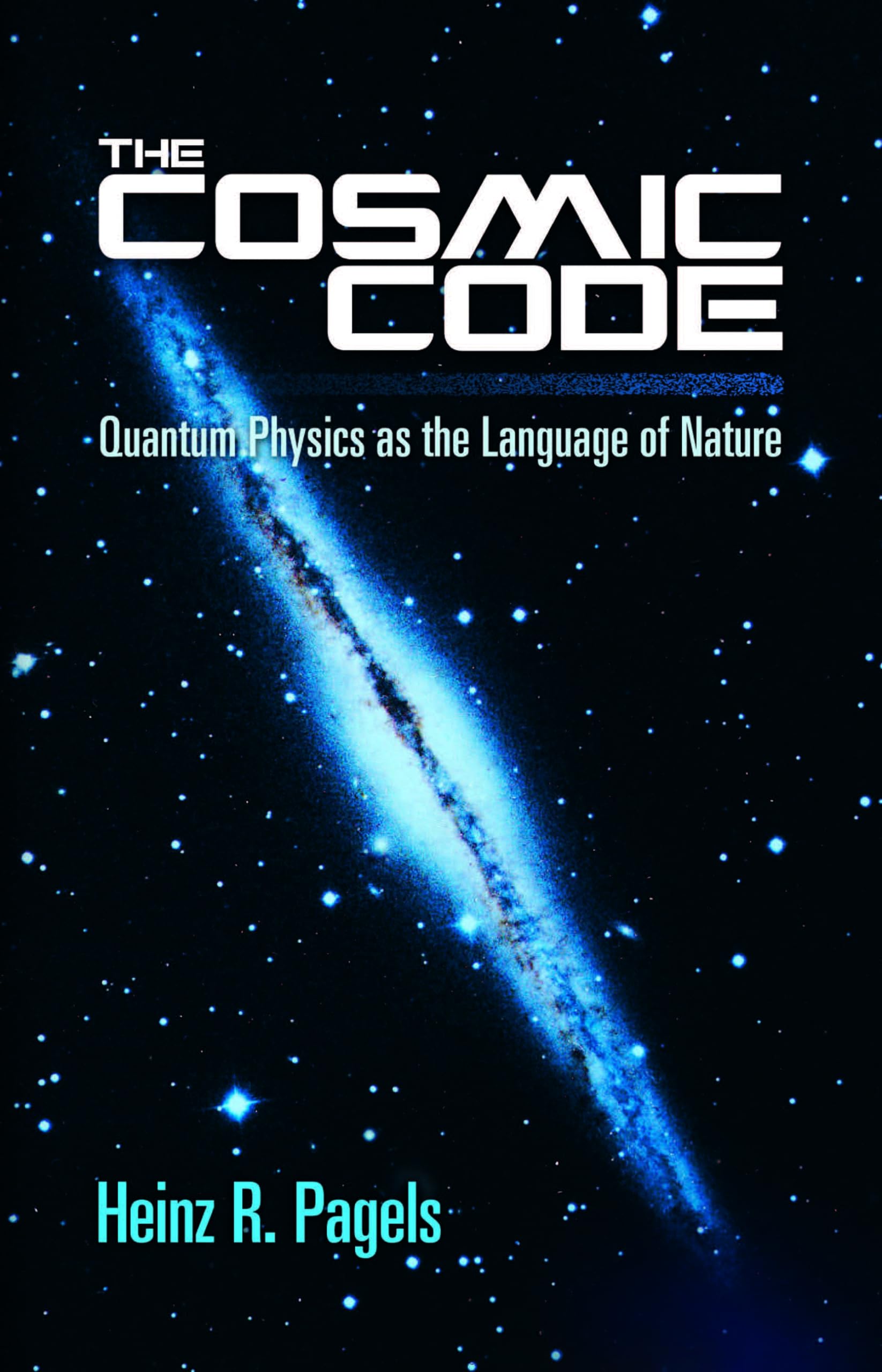
As a person who has had a voracious appetite to learn everything I could about the mysteries of the cosmos for more than 7 decades I am always searching for old and new science texts on everything to do with astronomy, cosmology, quantum physics and related topics. This is why when I saw this 370-page hardcover book on Amazon, (The cosmic code: Quantum physics the language of nature by Heinz R. Pagels) I decided to purchase it. Even though this book was published in 1982, which makes it somewhat dated; nevertheless, I really enjoyed and learned a lot reading this excellent book.This well researched volume explores the historical aspects of the development of physics and relates the role the early scientists played in the various theories of the how the universe began and other related issues.This book is organized into three detailed parts. Part one (The road to quantum reality) covers “the last classical physicist, inventing general relativity, the first quantum physicists, Heisenberg on Helgoland, randomness” and many other topics. Part two (the voyage into matter) deals with “the matter microscopes, molecules, atoms, and nuclei, the riddle of the hadrons, Quarks, the quantum and the cosmos” and other issues. The final part summarizes with “laying down the law and the cosmic code.”In conclusion, as mentioned previously this is one of the earlier books on the history and development of quantum physics, which makes it somewhat of an old classic. It even has a few black and white photographs of the early pioneers of quantum physics etc.Rating: 5 Stars. Joseph J. Truncale (Author: Tactical principles of the most effective combative systems).
V**N
Excellent classic work that I discovered only recently
Excellent classic work that I discovered only recently. It remains highly relevant today taking into account that 'dark energy' and 'dark matter' where not mainstream considerations in 1980. I have found that reading older texts sometimes helps the layman or beginner understand highly abstract and difficult concepts in science, notably relativity and quantum mechanics. We tend to run to the latest books thinking that "they know best," but the truth is that quantum mechanics is no better understood today than 1970, and some would say even 1945. This book by Pagels helps non-professional physicists understand topics that real physicists are still grappling with, and I think it helps that it was written at a simpler time in physics.As an aside, academic physics is known for lineages where a famous teacher passes the baton to his later famous students. The most famous lineage includes Bohr, Wheeler, Feynman, and Everett. But I was pleasantly surprised to learn that Pagels in his shortened professional life taught and mentored Seth Lloyd who has certainly continued to carry the baton in "quantum computation" to this day. This knowledge makes me want to read the final work by Pagels, "The Computer and the Rise of the Science of Complexity," which was written in the pioneering days of 'natural computationalism' in physics and has clearly influenced the current work of Seth Lloyd.
D**N
Great Layman's Approach to Physics
Excellent laymans explanation of experimental and theoretical physics; excellent description of Bell's inequality. I didn't agree with the consequences of his interpretation; but did understand the physical mechanics of the experiment. Very worth the read. Too bad Heinz isn't around to update us for super string theory. Only wanted a little more math.
K**R
A useful introduction
The Cosmic Code (the book) provides a thorough introduction to the field of quantum physics by exploring its historical development over the course of the 20th century, key questions, experimental breakthroughs, most impactful contributing scientists, and future directions.Is it an easy book to read? While it's supposedly written for the lay person, it does contain a lot of scientific ideas and concepts, and it's not as easy to follow as say, your typical story book, self help book, or autobiography. But the challenge is rewarding.In all, I highly recommend this to anyone interested in the field.
G**L
Cosmic Code - Quantum Physics
This very readable book covers early physics concepts and follows advances in our understanding of the nature of the universe through the modern concepts of an experimentally supported theory called quantum physics.There is practically no use of detailed mathematics; the information is presented in such a way that the non-scientist, non-engineer, non-physicist, non-mathematician can understand the basic concepts involved.The purpose of the book is to give the lay reader a better understanding of the physical world in which we live. The author extends the discussion to his personal views about God and religion. Regardless of ones personal beliefs, the facts that seem to be supported by experimental data need to reconned with. Truth is truth, and an understanding of the physical world should only increase ones appreciation for both the spiritual and physical nature of our existance.
C**_
An extraordinary book... Highly recommended
I stumbled upon this book by accident while googling for an introductory Quantum Physics book. At first, I didn't want to read it because it was published in 1982 and I thought it must be hopelessly outdated.However, the book is superb- although the section on the Standard Model is outdated, the bulk of the book on Quantum Theory is just as correct today as when it was published 30 years ago. Pagels was a true rarity- a first-rate scientist, who was also a first-rate writer (in terms of clarity and writing style).The ending (which prefigures his death in 1989 from a mountain climbing accident) is truly poignant.Note: Cosmic Code starts with Einstein's Special and General Relativity. I doubt that anyone without prior exposure will be able to understand Relativity from Pagels' account. However, be aware that his main intent is to provide historical context of Relativity. The bulk of the book is on Quantum Physics, which he explains better than any book I've read.
Trustpilot
5 days ago
1 week ago