We remain fully operational. Our teams are working around the clock to ensure your deliveries continue safely.

DOWNLOAD THE APP


Customer Services
Copyright © 2025 Desertcart Holdings Limited
DOWNLOAD THE APP
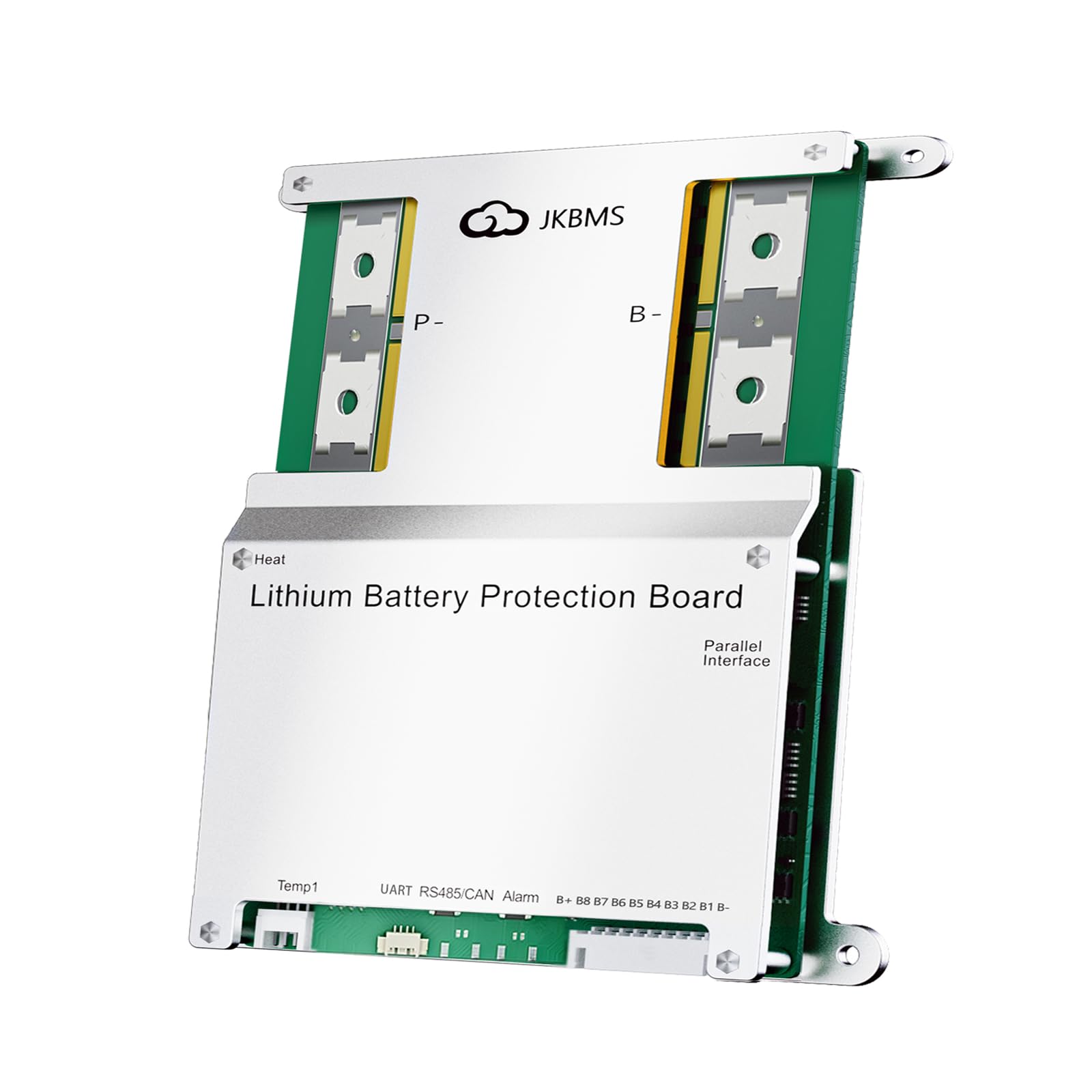
⚡ Power up smarter: Balance, protect, and control your battery like a pro!
The JKBMS Smart BMS 4S-8S 200A is a compact, high-performance battery management system featuring active cell balancing, built-in Bluetooth for real-time monitoring via mobile app, and robust multi-level protection. Compatible with Li-ion, LiFePO4, and LTO batteries, it’s ideal for RVs, solar power, and UPS applications. Designed for easy installation and enhanced battery longevity, it empowers users to reclaim capacity and maintain optimal battery health effortlessly.


| ASIN | B0D14FT2M5 |
| Best Sellers Rank | #29,747 in Tools & Home Improvement ( See Top 100 in Tools & Home Improvement ) #107 in Power Converters |
| Customer Reviews | 4.3 4.3 out of 5 stars (164) |
| Date First Available | April 8, 2024 |
| Item Weight | 12.3 ounces |
| Item model number | JK-B1A8S20P |
| Manufacturer | JKBMS |
| Product Dimensions | 6.02 x 4.96 x 0.69 inches |
N**R
Works great, no problems and smaller size.
This BMS has been preforming great for months now. Not one problem and it keeps the cells balanced. I like the small size and it still preforms as well as the larger BMS with the extra boards. Much easier to place in a battery build and has a screen to see what it’s doing, plus the app to view or change it all. I wondered about the smaller cables, and I wish they were a little longer. But it’s fine because I would always need to add more length anyway. And these never heat up. Great to also have 2 temp probes also. I liked this BMS so much I just bought another one for the next battery build. Great BMS!!
N**.
Easy to install, operate, and understand.
Update 2024-12-14: Actually looking like top balancing will recover 20% capacity. Heater puzzle solved. See below for info from JK BMS. The scene: After 6 years, converting two (24v) 8S 200Ah bottom balanced LFP cells to a single 16S 200Ah 52.1V battery. Installed BMS 6 days ago. The good: Super simple install. Connected to app immediately. Clear and easy to read manual (yes, really!) The great: Chugging away at top balancing the pack. At 2A, and as poorly balanced at the top these cells are, it’s made decent progress. Looking like I’ll be able to reclaim an easy 10% MORE capacity from these cells than I’ve ever had. The “Meh”: Can’t figure out WHEN the heater port will activate. CAN cable was missing. Only JK protocol supported CAN menu. Over All Grade: A+ Would I buy it again? Yep, as a matter I already have. If I figure out how to trigger the heater, I’ll update this. If I figure out how to get this to talk to my Victron gear, I’ll update this. I’ve played with pretty every setting. It works as documented. 2024-12-17 JK BMS sent info: Heating Function Activation Conditions: The heating function for charging will be activated when Condition 1 is met, along with Condition 2 or Condition 3. Condition 1: The battery temperature is below the charging low-temperature protection threshold. Condition 2: Heating is manually activated via the APP, without checking the charger status. Once the low-temperature condition is met, heating will begin, which will consume battery power. Condition 3: The charger is detected as being plugged in. This function is related to the hardware of the protection board and the charger, so please confirm the technical specifications before ordering. Heating Film Selection: Step 1: Determine the maximum battery pack voltage. For example, a 20-series LiFePO4 battery has a maximum voltage of 20 × 3.6V = 72V, while a 24-series LiFePO4 battery has a maximum voltage of 24 × 3.6V = 86.4V. Step 2: Calculate the resistance value of the heating film. The resistance value is calculated by dividing the maximum total voltage by the current: Resistance (Ω) = Maximum Total Voltage ÷ 3A. For example, 72V ÷ 3A = 24Ω. Based on this, select a heating film with a resistance close to this value. A suitable heating film specification would be 72V/24Ω/216W. Key Notes for Understanding: Condition 1 (Low-Temperature Protection): The heating function will only be triggered if the battery temperature drops below a certain threshold (often around 0°C to 5°C) to prevent damage to the battery and ensure it remains functional during cold weather conditions. Condition 2 (Manual Activation via APP): This condition allows the user to manually activate the heating function through an app, which will begin heating as soon as the low-temperature condition is met. However, this will drain battery power, which is important to consider in terms of overall efficiency. Condition 3 (Charger Detection): The heating function is also dependent on detecting whether the charger is plugged in. This ensures that the battery is being charged during the heating process, avoiding unnecessary power drain when not connected to a power source. Heating Film Specifications: The heating element (heating film) needs to be carefully selected based on the battery's total voltage and required current. The resistance of the heating film plays a key role in determining how efficiently the heat is generated without exceeding the system's power limits.
T**R
Great product
Fantastic product. Took me a while to build a battery and set up the BMS but worked like a charm and with the help of some great YouTube videos was able to complete the setting properly.
J**.
FAULTY BMS, FIRE !
***MUST READ REVIEW**: First time using the JKBMS. I have used many other BMS from various other companies. I Was very excited to use this one because it is rated highly by people in the field. Anecdotally, there's good feedback. My experience with it otherwise was extremely awful. Here's the story: I had just got done designing and building a 35ah, 72v battery out of 18650 cells. 210 cells, 21s/10p. I am no stranger to building batteries, I have a battery business building custom batteries for people, and tons of experience in this field. Once the battery was completed. It was time to put the BMS on. I made sure everything was perfect. Every balance lead went to the correct cell group, and the B- and p- we're connected appropriately. I then connected the app. And input the correct parameters, and everything was perfect. I turned charging on, and connected my charger, and charged it up to its maximum. After the charge I enabled the active balance feature. And I monitored it while it balanced. Everything was going fine for a few minutes... Then literally all of the sudden out of nowhere I got a notification for cell grouping 10 and 11 saying there was an error. Then literally the two balance wires started turning red hot, melted through the heat shrink and continued to heat up and within seconds the whole battery was on fire! It almost burned down my whole house. My dining room table is burnt, my hardwood floors are burnt. I had to act fast so I had no choice but to pick up the flaming battery and run outside with it, and I extinguish the fire outside in the grass. Fast forward to the next morning, I go to check out the battery, I took what was left of the heat shrink off and all the other electrical insulation and tape I had had on for safety (thank God). I fully inspected the battery very thoroughly. And could not find any human error on my part that was evident or could be linked to why this fire broke out. It would seem, or I would guess -that the balance leads in theory would have had to have been arcing with something which would have made the glowing red hot wires that resulted in the fire - (my educated guess?) There was no human error. In conclusion this was a faulty BMS, and it almost burnt down my house. Now, I'm not one to leave bad reviews. But this is all just the facts and the truth of the matter and I feel it was necessary to share this. As an experienced professional in battery manufacturing, I can't say that I would recommend this product just based off my experience. I would like for the company to make it right. I would suggest for the creators of the JK BMS to establish better QC within their company. As this was clearly a faulty BMS with something wrong with it. I am out $1,000 for the battery cells alone. Not to mention all the time and work I put into this battery. I've tried reaching out to them with no answer. So I have explained it to Amazon customer service, and I have initiated a refund. I've sent it back, even in it's damaged State, as per Amazon's instructions and I hope at the very least I get my refund for this experience. I would be willing to try jkbms again based off of all the success lots of others have had with it. But I am hesitant. I'd be scared to get another faulty BMS from them. So I don't know what I'll do from here. Most likely get another BMS from a different company. I don't know. Anyways I just wanted everybody to hear this story and be cautious when using this BMS. I'm sure there are other faulty ones out there that are going to go out to customers and them have the same experience. I wish this on one! Be safe make sure to electrically insulate everything always.
C**D
Great BMS
I've now used a number of these to set up 24v LFP batteries. The work well and the Bluetooth function is very helpful. The equalization works well. I don't imagine I've tried to run them at 200A discharge. It would be helpful to have a slightly longer pigtail for the leads though. Since that length is so short, I run the pigtails into Anderson SB120 connectors that can run up to 240A static with the proper inserts. That gives me much more flexibility in mounting. Another feature I like are the readily available displays - from small summary displays to large 4+ inch displays that will also indicate individual cell voltages. Overall, great units.
B**N
Works good so far only time will tell.
Trustpilot
2 weeks ago
2 weeks ago