

Desert Online General Trading LLC
Dubai, United Arab Emirates
Desert Online General Trading LLC
Dubai, United Arab Emirates
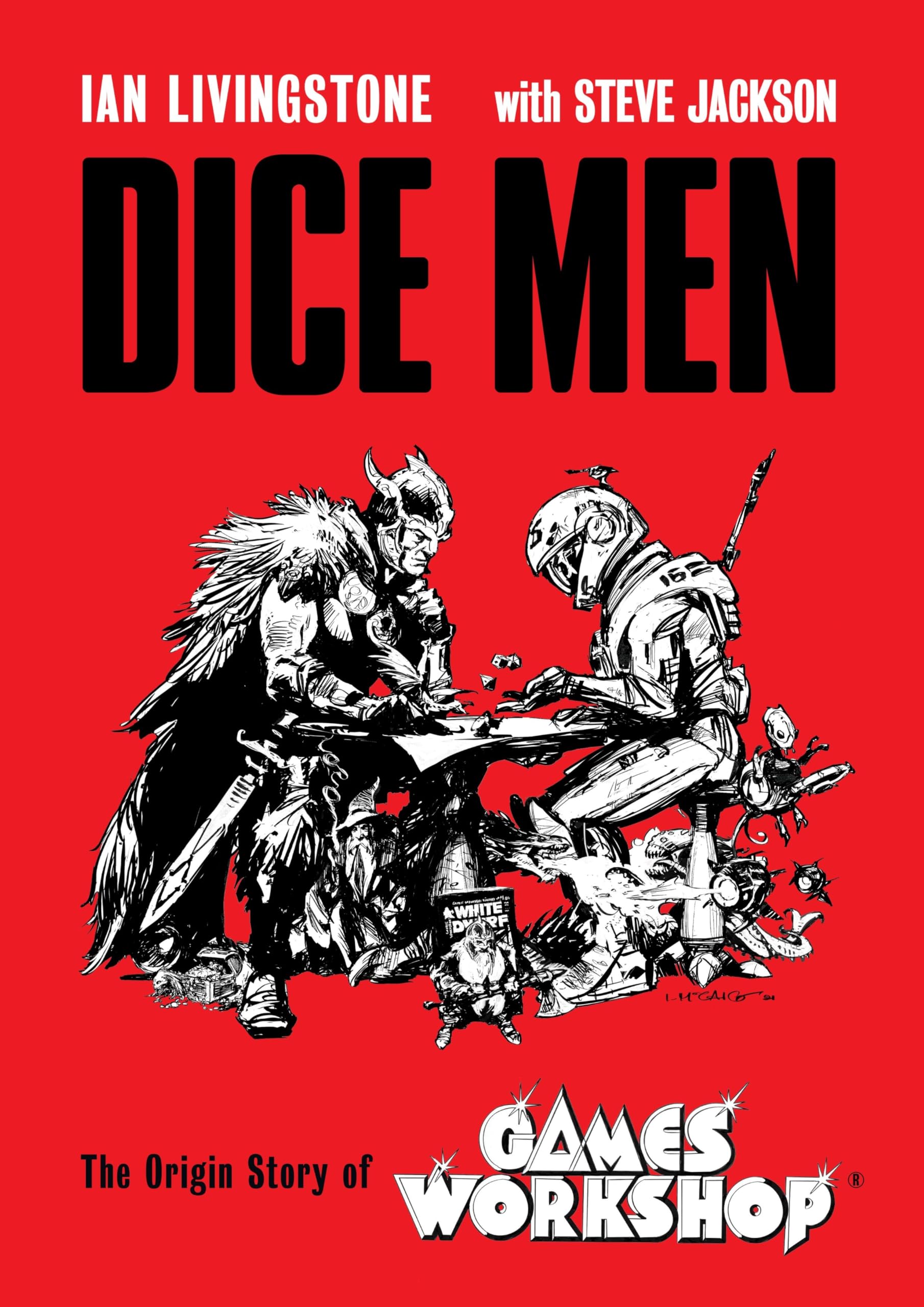
Dice Men: The Origin Story of Games Workshop
A**A
Ian Livingstone auto-biography. The spirit of early gamingand how GW started
The first thing that strikes you about Dice Men is its bold, iconic presence. The bright-red hardcover is impossible to ignore, with the title emblazoned in black block letters and Ian McCaig’s stylized artwork of two figures—a nostalgic wink to a specific drawing on a bag, drawn a long time ago and now an icon of the fantasy culture that would soon define Games Workshop. It is the perfect “portal” into a book that is not just history, but also scrapbook, memoir, and love letter to the early days of tabletop gaming.Inside, the book is lavishly illustrated. Rare archival photographs, doodles from the earliest Warhammer days, campaign flyers, covers of Owl & Weasel and White Dwarf and lovingly painted Citadel miniatures spill across the pages. It’s visually immersive, almost cinematic; you don’t so much read this book as you experience it…live it.Ian Livingstone’s narrative is not strictly linear. Instead, he weaves together overlapping themes: the passion of student days for boardgames and the circle of gamer friends, the scrappy origins of Owl & Weasel, the discovery of Dungeons & Dragons and the life-changing road trip to USA and the distribution deal with Gary Gygax, the launch of Games Workshop’s first shop in 1977, the founding of White Dwarf magazine, and the eventual transformation of the company into a vertically integrated miniature powerhouse.The charm lies in the details. Shoestring operations meant pickled-lime sandwiches and typewriters patched with Letraset. There are anecdotes of cross-country road trips, quirky staff living arrangements, including Van Morrison (the name of the Van was Morrison), the first veryyy small Office and the expansion to bigger warehouse-office, and a memorable brush with Andrew Lloyd Webber over a failed Diplomacy project, among so many other fun recollections such as the quest for a gift from Ian to Steve. Livingstone does not shy away from the missteps: misguided investments in a couple of “universal” board games, the video game market crash of 1983, and the strain of rapid expansion. Yet these are recounted with honesty and good humor, making the story as much about resilience as triumph.The book also tracks the creative explosions that made GW unique. The launch of White Dwarf was a gamble that paid off massively, shaping an entire hobby community. The co-creation of the Fighting Fantasy gamebooks, beginning with The Warlock of Firetop Mountain in 1982, brought interactive fiction to millions. The acquisition and merger with Citadel Miniatures under Bryan Ansell’s leadership brought not just stability, but also vision: the bold decision to turn Warhammer from a handful of skirmish rules into a full-fledged game in its own right, forever changing tabletop culture.Livingstone’s account wraps around the nineties, when he and Steve Jackson handed over their equity and stepped away from Games Workshop. Later ventures are mentioned in passing—the incredible success of Fighting Fantasy which continued after Ian and Steve left GW, Livingstone’s leadership at Eidos, and the launch of Tomb Raider and Deus Ex—but the heart of the book is firmly in the foundational years. And it is clear those years are remembered with affection.This is no dry corporate history. It is a memoir filled with warmth, candour, and the sparkle of nostalgia. Yes, memories sometimes differ between those involved, but that is the nature of recollection four or five decades later. What matters is the spirit: the creative hustle, the sense of adventure, the sheer joy of building something new from nothing more than dice, imagination, and stubborn determination.For anyone who ever rolled a twenty-sided die, painted a miniature, or cracked open White Dwarf, played Talisman, Blood Bowl or Warhammer, Dice Men is a treasure. It is a vivid reminder of how an improvised hobby and extra job became an empire, and how the spirit of those early years still resonates today.I was fortunate enough to read a signed copy, and like Ian, I felt the tug of nostalgia on every page. This is an extraordinary, intellectually honest autobiography that celebrates both the triumphs and the missteps, giving us not just a history of Games Workshop, but also a heartfelt chronicle of the birth of modern gaming culture.
R**R
Fun, informative, key history for the Games Workshop and Role-playing Fan
This is a wonderful, oversized, beautifully illustrated book that lovingly walks the reader through the history of role-playing games and how two friends, Sir Ian Livingstone and Steve Jackson, came to found Games Workshop and bring role-playing into the mainstream in Europe.The book is logically laid out and starts at the beginning of things when Ian and Steve were fans just like everyone else, but they always had a penchant for writing and sharing their experiences.That creative spark is what ultimately led them to found Games Workshop (GW). Initially, it was a distributor for the role-playing games from the US, principally Dungeons and Dragons and Runequest.Then, they started publishing their own games magazine, White Dwarf, that was similar to Dragon magazine at the time in that it was full of role-playing articles and scenarios.They started dabbling in inventing their own games too including the Warhammer Fantasy Role-playing Game. They expanded to include miniatures rules and eventually they started to expand horizontally into designing and manufacturing miniatures.In the early days, the 1980-1990s, there was a subscription service where GW would send you a game a month, and it was heavenly. Like a box of chocolates, you never knew what kind of game would come whether it was Bloodbowl with a cover featuring fantasy characters looking very much like Ronald Regan and the Soviet premier or any number of science fiction based board games that ultimately morphed into Warhammer 40K.One of the big pushes in the 1990s was getting into publishing, and GW begat the Black Library.The book covers it all with personal insights from Ian and Steve.I love this book, and you will too.
S**Y
Good Book on the Early Days of Games Workshop
Format difficult to read on Kindle, but good material and an interesting memoir. Lots of good stories from the origins of Games Workshop.
B**N
An amazing book!
The reason I am gushing about this book are the amazing pictures of all the old stuff from the 70s. Stuff I love to pour over. Seeing first maps of dungeons. Seeing old photos of traveling to conventions. All kinds of neat ephemera. Jon Peterson's book is incredible (Playing at the World), but this one is neat because it's got quite a few cool pictures. What's sad is TSR/Wotc/Hasbro have never brought this to the fans of D&D/AD&D.I've seen there atempts and they pale to this book.Please read the other comments to get another telling of the naming of the company, as he would truly know.Love their take on Fantasy Roleplaying. Love this book!
W**O
Fantastic book
Great trip down GW memory lane with tons of classic pics and interviews.
M**Y
Cannot Easily be Read on a Kindle
This book has interesting content, but the Kindle edition is a static scan (read like PDF) with zero Kindle features. The only place it could be read is on an iPad. It is too bad this is such a shoddy version of a decent book.
A**R
Cool book
This book is a bargain for 20$ it was over 50$ when it first came out
Trustpilot
1 month ago
2 months ago
2 weeks ago
2 months ago