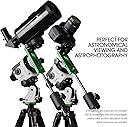
I'm predicting my review of this Skywatcher camera equatorial mount, based on my several years of service as the Chairman of the Instrument Committee of an Ohio Astronomical Society. I maintained our many telescopes and helped many folks with their personal telescopes. I've built telescopes. I bought this little mount for my Sony a7rV camera and various lenses, the heaviest being the Tamron 150-500mm telephoto. First, and foremost, this mount is NOT meant for a telescope; it's meant for astrophotography with a camera. Many moons ago, the only way to take a decent photo of a deepsky faint fuzzy, was with a large computerized telescope and CCD camera. Way back in tbe days of the dinosaurs (back in the 80's - 90's) we still used old SLR cameras, lenses, and 35mm film. One photo took hours (I'm not exaggerating). Now phones do what couldn't be done back then. Telescopes and those CCD cameras cost several thousand dollars. My first CCD was a whopping 480 x 720 pixel. We've come a long way! Telescopee mounts should be very substantial, and capable of tracking for long periods. For a first telescope, I still recommend a reflector on a dobsonian base, preferably 6 or 8" primary mirror. The name of the game is to get much light to your eye as possible. Having said that, the camera works on accumulative light; that's why it'll pick up details that you'll never see. My interest is to be able to track for up to 30 minutes without having to make a correction. I'm sure this unit has that capability. For ANY mount to work properly, it absolutely MUST be balanced (not slightly balanced; not almost balanced). I had to buy a second weight for the mount to balance the Sony with the Tamron big boy with a total weight of 6 pounds. You have to be able to move your camera at any angle without the weight(s) or camera making a counter movements. When I balance my camera, I move it back and forth, correcting the weight as needed, until I get zero movement backlash; then I test it again. This way, you won't tear up the mount axis', and your tracking will be much more accurate. If you change your lens, you must repeat balancing. I've put the mount on an Innorel carbon fiber Tripod with a fluid pan head capable of pointing straight up or down (most pan heads won't go 90° straight up; the Innorel does. It pivots +/- 90°. Photo #3). I prefer pan heads over ball head mounts. But, either type will work, as long as they support the total weight of the mount, camera, lens, and any other accessories. I prefer components that will support 2-3x the weight. The Innorel GT344C mount won't flex even if I lean my 200 pounds on it; it has a load capacity of 25kg (55 lbs) The Innorel F20 fluid pan head, with its 90° movement, has an 11kg load capacity [23 pounds]; it easily handles the weight of my camera with the heaviest lens (96oz = 6lbs) + Skywatcher mount (4 pounds). The weights are for balancing, which when in balance, means zero wear on any mount. The Innorel mount and tripods are available here on Amazon. I've bought 2 of each, because I was so impressed with them. I keep the Skywatcher on one of them permanently. It's important to download the app on your Computer and/or phone, or at least, use an app to find the accurate position of polaris, based on time, date, and location. Polaris actually circles the north celestial pole. I've tested the app and it works perfectly on my Samsung phone and Windows 11 computer. Note that the app is not for slewing (moving the camera fast), but it will correct nicely. I connected the mount via wifi. Please take note that the Skywatcher creates its own wifi Hotspot. You connect directly to the mount, not through your network. Neither my phone or the computer had any problems with connection, and I tested the connection for 2 hours on each. It never dropped. The tracking capability and accuracy predicates on how well you polar align the mount. The more experience you have, the easier this will be. Please don't get discouraged; polar alignment may take you a couple of tries, but like many hobbies, you'll get used to it and it'll come automatically. There are good instructions, and YouTube videos on polar alignment, which would mean more to you than my instructions, so I encourage you to check them out. View several videos until you find one that clicks with you. To polar align this (or any mount) you need to be able to readily see through the the polar finder scope, and adjust the mount accordingly. That means getting that polar aligment scope high enough so you can easily see through it and make adjustments, without undo pain. I say that, because I'm a disabled veteran, and a plate in my neck, and apparatus in my spine, limit my movement. But, the Skywatcher makes polar alignment as easy as I've ever seen. Once you get going on your target, it'll track. It has an outlet for a autotracking, a nice plus. I bought the total package, including polar alignment base/scope for $359 here on Amazon. So with the cost of tripod/pan head, and Skywatcher, I've invested ~ $500-/550, which I consider to be a good investment for astrophotography. I've also tested it using a power supply that i bought here on Amazon, and it works perfectly. I'll submit photographic results of deepsky photos as the weather permits. Solar Eclipse 2024 taken with Panasonic Lumix FZ2500 bridge camera using optical zoom 20x, with Thousand Oaks solar filter media over lens, available here on Amazon.