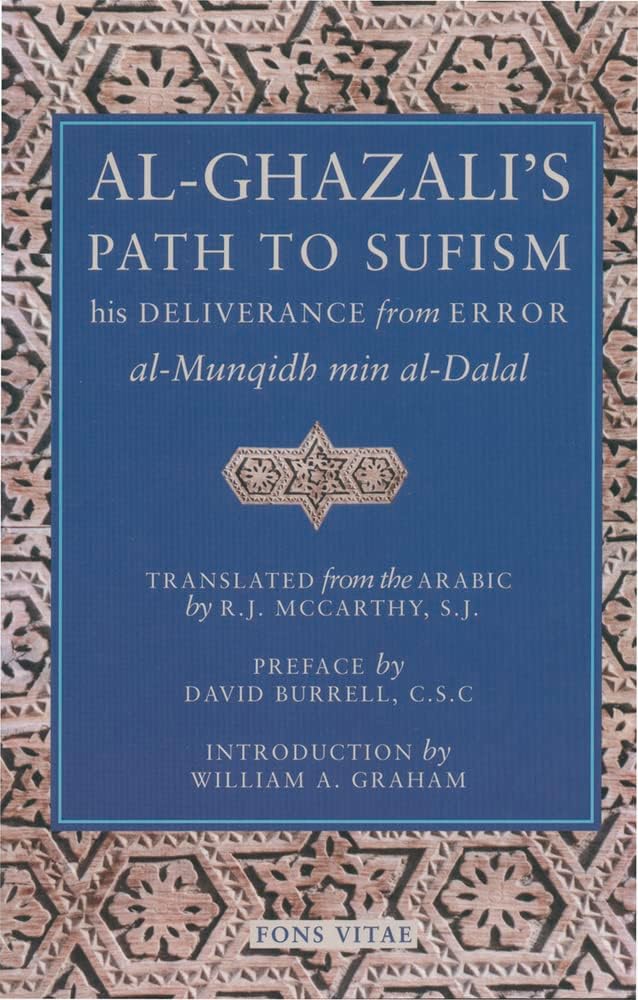
Al-Ghazali's Path to Sufism: His Deliverance from Error (al-Munqidh min al-Dalal)
Product ID: 4213294
⭐Top-rated with 4.7/5 stars
📚Classic spiritual autobiography
🕯️Deep mystical insight
Desertcart purchases this item on your behalf and handles shipping, customs, and support to Argentina.
📖 Unlock the secrets of spiritual enlightenment with Al-Ghazali’s timeless classic!
Al-Ghazali's Path to Sufism is a revered spiritual autobiography that chronicles the intellectual and mystical journey of one of Islam’s greatest thinkers. This used book in good condition offers a concise yet profound exploration of knowledge, faith, and inner peace, enriched by scholarly notes and praised for its insightful narrative. With a 4.7-star rating and top rankings in Sufism and religious philosophy, it’s an essential read for anyone drawn to spiritual depth and historical wisdom.
| Best Sellers Rank | #147,390 in Books ( See Top 100 in Books ) #39 in Sufism (Books) #436 in Religion & Philosophy (Books) |
| Customer Reviews | 4.7 out of 5 stars 158 Reviews |
J**Y
Enjoyable, Informative, Insightful, although Incomplete
I love Ghazali and find his writing (paired with this particular translation's style) incredibly exciting to read. His insight and systematization of thought and differing opinions is very useful. Much of this book works as a short autobiographical work. As well, as a non-Muslim and someone not qualified as a scholar of Islamic theology (especially not historically), this work introduced me to lots of new and specialized terms important for both orthodox and heterodox Islamic theology (particularly in the Medieval/Scholastic era). Of course I beg forgiveness if I say anything not worthy of respect in regards to this wonderful man. The only thing missing in the work is a sense that the author never offers a fully workable answer to his own inquiries. Instead, one enjoys seeing his questioning, his experimentation and exploration, and then the fact that he finds sufficient reason for his own answers. His answers, however, are insufficient outside the realm of subjective conviction (not belief, but conviction). Instead of a well worked philosophical answer, he provides his account of an experience of illumination, fully acceptable within mystical thought but not within theological inquiry. All in all I give the book a 5/5 for many reasons. It is more than worth the read and at the end you will almost certainly want to read and study it more in depth. It is inspiring as well to the mystic who has unresolved questions of religious import. Read it and see for yourself :)!
S**R
Astonishing!!
Astonishing and superlative. This is a must read if you are into spirituality and theology. I cannot believe how I haven't read this book all this time. I completed the book on one sitting soon after it was delivered. It's like poetry but logic, storytelling but references from Ibn-sina like scholars. Very direct but he translation was riveting. It is a short read but it does impact you with some analogies and references. The extensive notes was also helpful to understand the context. The book isn't really about Islam as much as it's about "learning" and "knowledge", it asks for you to... Well, I won't spoil the suspense!! :) Super read, best I"be read in recent time!!
T**B
A sincere and competent truth seeker
I forgot how sincere Al Ghazali appears in his writings. It is refreshing to read this work. The translation is accessible and elegant, the book itself is nicely formatted and printed, and the content is exciting to read and contemplate. As a scholar of the Islamic classical tradition, and a teacher at a Western classical eduction school, there is a lot that books like this can bring to the great conversation.
A**H
Good read
Great read and full of information
I**N
Warning: Incorrect description!
[The description mentions "and Five Key Texts", however, these were not included in the edition I was shipped. It only contained the matter of the al-Munqidh min al-Dalal. That is why I am giving this 4 stars instead of 5] Al-Ghazali (or Algazel, as he is known in the West) was an illustrious individual that lived nearly a millennium ago but whose writings are almost always intriguingly timeless. A short review on Amazon cannot do justice to this great man's contributions to world civilization, from his unique unparalleled treatments of the Greek philosophers, to his introduction to the world of key philosophical concepts from the traditional Islamic worldview (occasionalism, for example). Such was his influence that one sees his work mirrored for hundreds of years after by great thinkers such as St. Thomas Aquinas and Dante (the former even admitting his indebtedness to Al-Ghazali). A reading of the book at hand, his short spiritual autobiography, makes one realize that even today Al-Ghazali is as relevant as ever and provides thought-provoking discussions of matters that modern man, in his hubris perhaps, believes were only broached after the "rational mindset" was established by the recent "enlightenment". Al-Ghazali maps out for the reader his quest for the truth, how he arrived at Sufism and what it provided him with. The narrative begins with Al-Ghazali describing his fame among people, his wide knowledge, and his material comfort. His spiritual side is suffering, however, as he realizes he does not have conviction in what he is teaching. He observes that he is Muslim with his particular theology, only due to his parents and upbringing, not unlike the situation of Jews, Christians or Zoroastrians. Why then should he so readily accept this doctrine that seems to be only one of chance, as true? He begins to question and through interesting deductive reasoning concludes in essence that nothing material can be verified as truth (cogito ergo sum?). His own senses cannot be trusted. What is evidence then and what is truth? Arriving at this conclusion makes him intensely sick for months. He finally recovers from his sickness and decides to find the truth by studying all those who claim to know the truth or claim to know the way to the truth: 1. The Logicians or those trained in Dialectic. 2. The Philosophers, i.e., natural philosophers (with the requisite Greek connection). 3. The Authoritarians, i.e., those that refer to some living absolute authority that would guide to the truth by no other means than themselves. 4. The Sufis. Al-Ghazali describes how he masters all these "paths" to the truth, at least outwardly, and proceeds to deconstruct them. The resulting discussion is absolutely exhilarating. There is something exciting about reading someone who lived a 1000 years ago refuting, in a more succinct and eloquent way than anyone else today, the "types" of people in the 21st century that claim to have a monopoly on truth/rationality/etc. In due course and with the occasional allegory, he addresses the militant atheist, the fanatic dogmatic theist, the "weak-minded" common man duped by sophistry, etc. The English subtitle of the book gives the plot away, however. The book concludes with Al-Ghazali discarding all other "paths" and arriving at the Sufis. The Sufis claim their is way correct and the way to see the truth is to experience it. Nothing can describe it and no "logic chopping" can replace it. It is it to see and hear, not to argue and debate. Al-Ghazali, after much deliberation and indecisiveness, decides to accept this option as his only way left of finding the truth, if indeed the truth can be found. He leaves his high post, his family, all his wealth and becomes a traveling ascetic. As a mendicant, he spends years in the Levant, in Damascus, in the Hijaz and finally returns to Baghdad. He speaks briefly of arriving at (some) truth, of his experiences in the "wild" and finally of his decision to return to Baghdad and to to his previous post as a teacher. As another reviewer mentions, one cannot but admire Al-Ghazali's intellectual courage in questioning everything and arriving at independent judgments and his honesty with himself as well as the reader. But above all the most striking and admirable trait is his sincerity in searching for the truth and his sincerity in conveying his experiences in the hope that someone else might benefit from it. Maybe that is why we are still reading him. Buy this book and read it, you will not regret it.
I**Z
and this is a good thing.
This is a new translation of al-Ghazali's "Al Munqid," which is essentially his intellectual autobiography. The interesting thing about this book is that it essentially parallels Descartes' "Discourse on Method" centuries before Descartes wrote it. Al-Ghazali actually experienced a crisis of faith, while Descartes did not; he simply intellectualized one, and followed the steps that he thought he would take in order to achieve a universal doubt -- concluding with the famous "I think, [therefore] I am." This, then, becomes the fundamental rock-solid principle on which he can build a system of knowledge. Al-Ghazali also gives his conclusion a religious tinge which it does not have in the formulation of Descartes. But basically the processes are the same. And it is not at all proven that Descartes had read al-Ghazali's book, though he had apparently read al-Ghazali's treatise on logic, which had been translated. Descartes' "I think, [therefore] I am" had, of course, been formulated by St. Augustine, one thousand years before. Augustine had imagined that someone argued against him, "What if you are mistaken?" And he had answered, "If I am mistaken, I am; for he who is not cannot be mistaken." This is essentially what Descartes said. So this new translations makes available al-Ghazali's book in an inexpensive edition, and this is a good thing.
S**A
Great book, and very enjoyable
Great book, and very enjoyable. However a word of caution, this edition only contains The Deliverance from Error (al-Munqidh min al-Dalal) ie his short autobiography. It does NOT contain the five key texts. If you want it to include the five key texts, it appears that you have to get the other edition with the same name. Look at the table of contents to verify that it has what you want. The other edition is about 200 pages longer and has those five texts.
R**Y
This discussion of Al-Ghazzali's growth into Sufism describes his investigation ...
This discussion of Al-Ghazzali's growth into Sufism describes his investigation of various belief paths before settling on the Sufi path. It is well reasoned and carefully explained. It is a worthy portion of the Al-Ghazzali corpus.
D**K
Fantastic
Excellent book. Really enjoying it and learning a lot from this.
R**I
Reaches the heart
Open your mind and heart, he was deep.
H**I
Five Stars
One of the best books ever written.
A**R
A must read!!
Al-Ghazzali's Munqid should be read by all Muslims and non-Muslims who want to make sense of existence. Though the title of the book (..path of Sufism) is bit misleading, and I believe the title Sufism sells and hence the name. The real title of the book is "Deliverance from the error", though the last chapter in the book is about Al-Ghazzalis approval of the ways of Sufis and the importance of their work on curing many spiritual illness of human soul. This book along with Alija Ali Itzbegovic's Islam between east and west and M. Iqbal's reconstruction of religious thoughts in Islam gives the foundational material for any student tackling the existential questions, atheism, scientism.....Personally as a student of philosophy these three books must be read in order for maximum benift ....
A**I
Great!
Amazing book, and nice translation (a little bit complex vocabulary, but it's mandatory to translate ancient books of wisdom)
Trustpilot
1 week ago
2 weeks ago