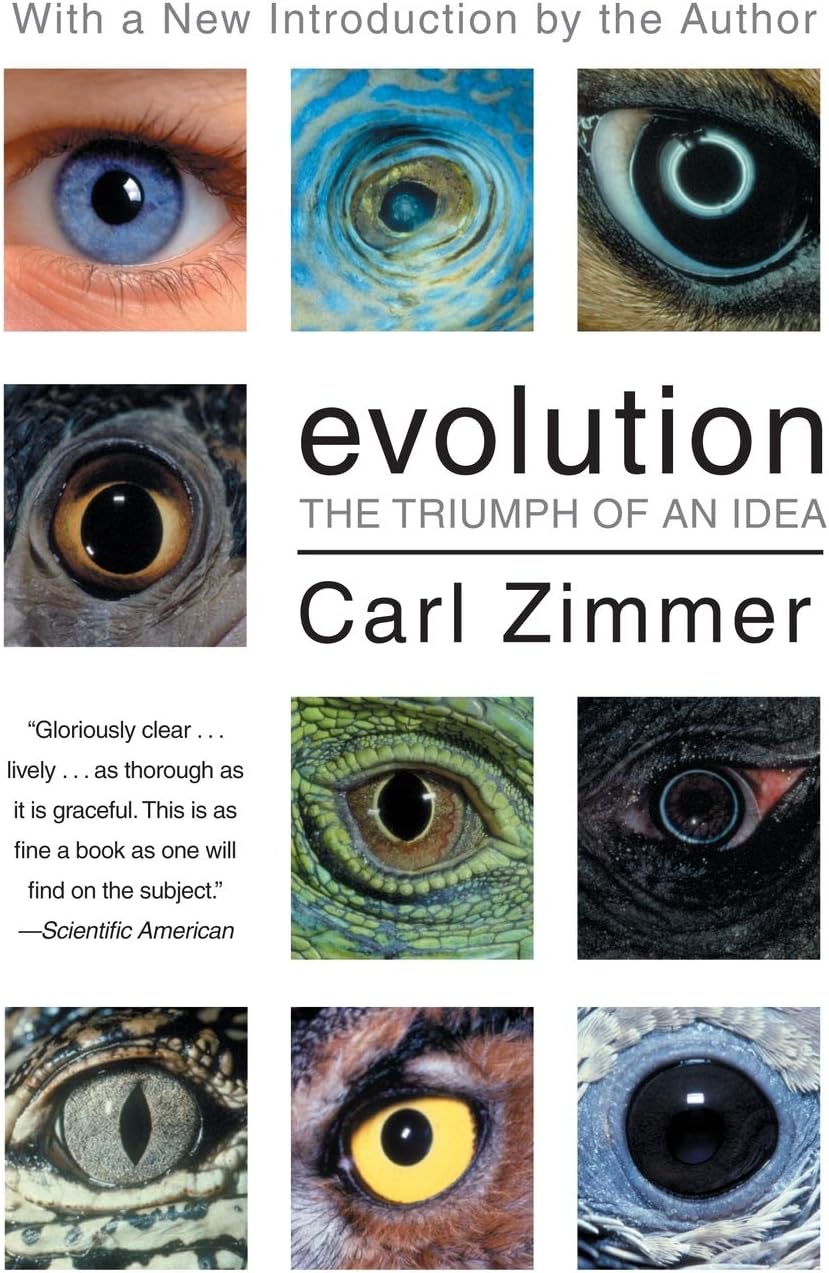

Buy Evolution: The Triumph of an Idea – From Darwin's Natural Selection to Modern Genetics: A Compelling Science Guide on desertcart.com ✓ FREE SHIPPING on qualified orders Review: Evolutionary Theory- an ongoing program - I first checked Zimmer's book out of the library and now I need to buy a copy. It is an excellent presentation of the history of evolutionary thought that is easily read and understood by almost anyone. I realize that many creationist will be put off and spend some time pointing out supposed "flaws" in the book and evolutionary theory generally. However, despite their difficulties and the lamentable inability of many Americans to take evolution and the concepts of deep time seriously, the idea has triumphed within the science of biology (and in much of the non-American world.) No amount of attempted suppression or "equal time" demands will change that and such attempts only make the proponents of "intelligent design" look foolish. It is possible that they will win out politically for a while, but so did Lysenko in the former Soviet Union until his ideas about "vernalization," among others, were later shown to be totally false. There was a huge cost to agriculture in the USSR because of Lysenko's ideas and we would face a similar cost in molecular biology, medicine, geology and similar fields if the creationists should "win," based on the weak "evidence" they currently present. If the "intelligent design" proponents want to discount biochemical, geological, anatomical, and even astronomical evidence, or discredit evolution by bringing up already discarded ideas and hoaxes (like Piltdown Man) as straw men, they are free to do so, but such perversity does not validate their argument. This is not to say that evolutionary theory is static or should be free from criticism- far from it! New ideas within the evolutionary framework are being proposed all the time. Gould and Eldredge some years ago brought up the punctuated equilibrium idea, expanding it somewhat on similar ideas of Mayr. More recently Margulis has proposed a symbiotic evolutionary mechanism. There is an ongoing argument over evolutionary psychology (well reviewed by Zimmer in this book!) and more and more discoveries in the areas of molecular biology, behavior, paleontology, geology, ecology and systematics are constantly altering and changing the landscape of evolutionary theory. This is in fact what distinguishes science from pseudo-science like "creationism" or "intelligent design." It is, despite individual scientist's egos and definite human flaws, a self-correcting system. If true empirical evidence for "intelligent design" should appear, eventually the scientific community would (perhaps after some time) accept it. Unfortunately, the same cannot be said for creationists, even in their new guise as practitioners of "intelligent design" theory. Science cannot deal with the supernatural explanations of the creationists, which are based on faith, because science has to be dedicated to the material world in order to function. Zimmer demonstrates these problems pretty graphically and I applaud for this magnificent effort! I recommend this book highly to anyone with an open mind. Review: Evolution: A Historical Fact - Evolution: The Triumph of an Idea by Carl Zimmer A thorough, well researched book that is broken out into four parts: Part One - Slow Victory: Darwin and the Rise of Darwinism, Part Two - Creation and Destruction, Part Three -Evolution's Dance, and Part Four - Humanity's Place in Evolution and: Evolution's Place In Humanity. Positives: 1. Accessible, well written book with an extensive bibliography. 2. Provides a lot more historical references than any other book I have read on the topic. It includes an excellent biography on the life of Darwin and how he came about the theory of evolution and his personal struggles to disclose his findings to the public. 3. Interesting history on the physics of how we determined the antiquity of Earth. Not to mention the order in which new life-forms appeared on Earth, and their actual dates in history. 4. A lot of interesting information regarding evolution: "A population of birds can evolve into its own species if it gets cut off from its neighbors". You will find out why. 5. The historical impact of germs...Napoleon found out the hard way. 6. Nothing like mutations to get evolution going. The genetic tool kit is explained in detail. 7. The origin of whales is one of the most interesting examples of evolution. And BTW a whale is no more a fish than a bat is a bird. 8. Everything you wanted to know about extinction and then some. 9. Interesting topics of the arms race between man versus bug, disease (great stuff on AIDS) and the evolution of sex. 10. My favorite chapters have to do with human evolution. Fascinating stuff and worth the price of the book (Kindle). Plenty of monkey business. It's the kind of stuff I go ape over. Negatives: 1. Less technical than other books on this topic. 2. The advancements of science is such that it is outdated in certain parts: genetics, and major recent findings (Tiktaalik comes to mind). That's what I get for waiting for the Kindle version. 3. It's an investment of time, a lot is covered. 4. Too politically correct if you ask me. Let loose a little Mr. Zimmer. In summary, a solid book on evolution that focuses on the history of the idea and how it succeeds to this day. I'm in awe of Darwin, science owes so much to his theory. Entire scientific fields are only possible with the understanding of evolution. Recommendations: Why Evolution is True" by Jerry Coyne, "The Greatest Show On Earth" by Richard Dawkins, "Your Inner Fish" by Neil B. Shubin, "What Evolution Is" by Ernst Mayr and "The Making of the Fittest" by Sean B. Carroll.
| Best Sellers Rank | #721,948 in Books ( See Top 100 in Books ) #8 in Genetics (Books) #767 in History & Philosophy of Science (Books) #1,089 in Ecology (Books) |
| Customer Reviews | 4.5 out of 5 stars 294 Reviews |
D**N
Evolutionary Theory- an ongoing program
I first checked Zimmer's book out of the library and now I need to buy a copy. It is an excellent presentation of the history of evolutionary thought that is easily read and understood by almost anyone. I realize that many creationist will be put off and spend some time pointing out supposed "flaws" in the book and evolutionary theory generally. However, despite their difficulties and the lamentable inability of many Americans to take evolution and the concepts of deep time seriously, the idea has triumphed within the science of biology (and in much of the non-American world.) No amount of attempted suppression or "equal time" demands will change that and such attempts only make the proponents of "intelligent design" look foolish. It is possible that they will win out politically for a while, but so did Lysenko in the former Soviet Union until his ideas about "vernalization," among others, were later shown to be totally false. There was a huge cost to agriculture in the USSR because of Lysenko's ideas and we would face a similar cost in molecular biology, medicine, geology and similar fields if the creationists should "win," based on the weak "evidence" they currently present. If the "intelligent design" proponents want to discount biochemical, geological, anatomical, and even astronomical evidence, or discredit evolution by bringing up already discarded ideas and hoaxes (like Piltdown Man) as straw men, they are free to do so, but such perversity does not validate their argument. This is not to say that evolutionary theory is static or should be free from criticism- far from it! New ideas within the evolutionary framework are being proposed all the time. Gould and Eldredge some years ago brought up the punctuated equilibrium idea, expanding it somewhat on similar ideas of Mayr. More recently Margulis has proposed a symbiotic evolutionary mechanism. There is an ongoing argument over evolutionary psychology (well reviewed by Zimmer in this book!) and more and more discoveries in the areas of molecular biology, behavior, paleontology, geology, ecology and systematics are constantly altering and changing the landscape of evolutionary theory. This is in fact what distinguishes science from pseudo-science like "creationism" or "intelligent design." It is, despite individual scientist's egos and definite human flaws, a self-correcting system. If true empirical evidence for "intelligent design" should appear, eventually the scientific community would (perhaps after some time) accept it. Unfortunately, the same cannot be said for creationists, even in their new guise as practitioners of "intelligent design" theory. Science cannot deal with the supernatural explanations of the creationists, which are based on faith, because science has to be dedicated to the material world in order to function. Zimmer demonstrates these problems pretty graphically and I applaud for this magnificent effort! I recommend this book highly to anyone with an open mind.
B**K
Evolution: A Historical Fact
Evolution: The Triumph of an Idea by Carl Zimmer A thorough, well researched book that is broken out into four parts: Part One - Slow Victory: Darwin and the Rise of Darwinism, Part Two - Creation and Destruction, Part Three -Evolution's Dance, and Part Four - Humanity's Place in Evolution and: Evolution's Place In Humanity. Positives: 1. Accessible, well written book with an extensive bibliography. 2. Provides a lot more historical references than any other book I have read on the topic. It includes an excellent biography on the life of Darwin and how he came about the theory of evolution and his personal struggles to disclose his findings to the public. 3. Interesting history on the physics of how we determined the antiquity of Earth. Not to mention the order in which new life-forms appeared on Earth, and their actual dates in history. 4. A lot of interesting information regarding evolution: "A population of birds can evolve into its own species if it gets cut off from its neighbors". You will find out why. 5. The historical impact of germs...Napoleon found out the hard way. 6. Nothing like mutations to get evolution going. The genetic tool kit is explained in detail. 7. The origin of whales is one of the most interesting examples of evolution. And BTW a whale is no more a fish than a bat is a bird. 8. Everything you wanted to know about extinction and then some. 9. Interesting topics of the arms race between man versus bug, disease (great stuff on AIDS) and the evolution of sex. 10. My favorite chapters have to do with human evolution. Fascinating stuff and worth the price of the book (Kindle). Plenty of monkey business. It's the kind of stuff I go ape over. Negatives: 1. Less technical than other books on this topic. 2. The advancements of science is such that it is outdated in certain parts: genetics, and major recent findings (Tiktaalik comes to mind). That's what I get for waiting for the Kindle version. 3. It's an investment of time, a lot is covered. 4. Too politically correct if you ask me. Let loose a little Mr. Zimmer. In summary, a solid book on evolution that focuses on the history of the idea and how it succeeds to this day. I'm in awe of Darwin, science owes so much to his theory. Entire scientific fields are only possible with the understanding of evolution. Recommendations: Why Evolution is True" by Jerry Coyne, "The Greatest Show On Earth" by Richard Dawkins, "Your Inner Fish" by Neil B. Shubin, "What Evolution Is" by Ernst Mayr and "The Making of the Fittest" by Sean B. Carroll.
L**A
Invader Zimmer
I don't believe I need to emphasize what a wonderful book this is due to the plethora of positive reviews it has received. However, I would like to mention that in searching for a perfect introduction to evolution to recommend to friends, theists, and the simply uninformed (I included the misinformed by listing the theists), Zimmer's book by far outshines my prior favorites: What Evolution Is (Mayr's too technical), The Blind Watchmaker (Dawkins is too blunt) and Evolution (Ridley's too advanced). Zimmer treats evolution as the story of an idea, and describes it beautifully and candidly. I must admit, I was extremely caught by surprise by the authors' elegance never having read any of his other publications. However, that will shortly be remedied, because after the impression he's made on me with this book, his others will soon be invading my bookshelf.
O**E
One of the best
Some books deserve more than five stars. Although to say this is a topic, in this particular case it is an act of justice. I have read several books about evolution by R. Dawkins, Matt Ridley, D. Dennett, and some others that are long to mention. So the basic idea here has nothing to do with how many books have you read about evolution but why this is different. And Carl Zimmer's Evolution, is different because of the quantity of issues and data that he embraces and the quality of the analysis that he draws from them. You don't have to grapple with the topics asking yourself what do they mean: Zimmer does it for you with elegance and clarity, aspects that don't fit well all of the time. That's because he doesn't want to convince you about evolutIon, he wants to give you instead a pondered account of what happen around us and how the theory explains what we see. The theory is beautiful, but you will discover this by yourself as long as you let you lead by Zimmer's narration. To me at least, this is a big difference with other authors. Here, you won't find ideology but science in state of purity. I mean, facts, order, tests, proofs, predictions, and so on and on. The best indication that of what I'm saying is true is the last chapter, "What about God?" Here, Zimmer deploys his skill as a writer and as a science divulgator, by giving you a lesson about how to talk about hot topics without being burnt, which means without offending and, at the same time, without betraying the wonderful lessons of the book. In sum, 400-odd pages full of data, insight and delicated equilibrium.
M**T
Detailed summary of the fact and elegance of evolution
Zimmer’s book added to my knowledge and love of evolution. He presents more details and evidence than anything else I have read on the subject. I only wish it was required reading for high school science classes, especially in places where creationism is taught as a valid alternative.
B**B
A good introduction and overview
This review is based on the currently in-print September 2006 paperback "revised" edition. The illustrations mentioned in reviews based on earlier editions are not a part of the 2006 paperback version; it is simply text. Also, though it is a "revised" edition, some opportunities for revision were missed (e.g., Orrorin Tugenesis is mentioned as the oldest known hominid ancestor, there is no reference to the 2001/2002 discovery of the older Sahelanthropus Tchadensis). The early chapters provide an excellent history of pre-Darwinian concepts of evolution and Darwin's own life and struggles. But, for a book that starts so strong with presenting the history of the development of evolutionary theory, after describing the mid-twentieth century New Synthesis (and some reference to Ernst Mayer's contributions to the field), the author fails to take the opportunity to continue on and describe post 1950's developments and refinements in the subject. I find it particularly ironic that there is no mention of the important concept of Punctuated Equilibrium, given that one of its promoters, Stephen Jay Gould, wrote the introduction. Of course, only so much can be put into an overview, but completing the history of the development of the Great Idea would have made this a stronger, more complete book. The author gets sidetracked and spends too much ink discussing extinction and man's involvement in screwing up the planet; less on those subjects would have provided the space to complete the historical overview and bring us up to date on the current scientific opinions regarding the Theory of Evolution. But these are small points, and should not deter someone from purchasing this good introduction to Evolution. As with all of Carl Zimmer's books, it is an interesting, engaging book to read. For a book that dives deeper into the subject, and from more of a paleontological rather than scientific journalist perspective, I highly, highly recommend Donald Prothero's book, Evolution: What the Fossils Say and Why It Matters .
M**.
Bravo for Zimmer, and WGBH/NOVA
Last May I was wandering through Down House, after 15 years, this time on the internet. There I found news about The Evolution Project and Zimmer's book. It was difficult to wait four months, but clearly worth it. Zimmer has done a masterful and original telling of the history, growth, and present applications of that most central and triumphant theory of biology. The writing is lucid with a rich selection of illustrations. The book is companion to the WGBH/NOVA seven-part television series broadcast on consecutive evenings from September 24 to 27. The book and series compliment each other well. The book and series are only the beginning. Extensive resources for the Evolution Project are at: pbs.org/evolution. You will find information about the Evolution Teacher's Guide (free), Online Course for Teachers, Teaching Evolution Case Studies Video, Online Lessons for Students, Videos for Students, multimedia Evolution Library, and more. The folks at WGBH/NOVA-Boston (1-800-949-8670) are very helpful with more information. It is an understatement to say that they and Zimmer have outdone themselves in creating these superb tools of science education. Enjoy the book and take advantage of the many associated resources.
C**E
A must-read if you want to know where we came from
This one is a paperback version without any pictures or illustrations. I would like the hardcover one which no longer available in book stores. I managed to find it and borrow from the library. It was a companion to the PBS series about evolution. It begins with Darwin's adventure and natural selection. Then it covers the scope from big animals to microbes, the beginning and the extinction. I am not going to copy all the chapter titles but it is worth reading if your interest follows. The last chapter is 'What about God?' I'll let you explore and find out by yourself.
Trustpilot
2 months ago
3 weeks ago