Desertcart purchases this item on your behalf and handles shipping, customs, and support to Argentina.
🔗 Empower your IoT projects with reliable, high-current switching!
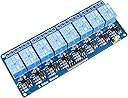
The SunFounder 5V 8 Channel Relay Shield is a compact, high-performance module designed for seamless integration with popular microcontrollers like Arduino and Raspberry Pi. Featuring eight 10A relays with LED status indicators, it supports AC and DC loads up to 250V and 30V respectively, making it ideal for advanced automation and remote control applications. Its plug-and-play design ensures easy setup, while compliance with CE and RoHS standards guarantees safety and reliability.


| ASIN | B00DR9SE4A |
| Best Sellers Rank | #32,181 in Industrial & Scientific ( See Top 100 in Industrial & Scientific ) #57 in Single Board Computers (Computers & Accessories) #398 in Industrial Electrical Controls & Indicators |
| Brand | SunFounder |
| Brand Name | SunFounder |
| Coil Voltage | 5 volts |
| Connector Type | Plug-In |
| Contact Current Rating | 10 A |
| Current Rating | 10 A |
| Customer Reviews | 4.6 out of 5 stars 1,296 Reviews |
| Item Weight | 9.07 g |
| Manufacturer | SunFounder |
| Maximum Switching Current | 10 A |
| Minimum Switching Voltage | 5 volts |
| Model | 8C-5V |
| Mounting Type | PCB Mount |
| Operation Mode | Automatic |
| Part Number | 8C-5V |
| Specification Met | Ce, Rohs, and Other Relevant Electrical Performance, Safety, and Environmental Standards |
| UPC | 520141420814 |
| Unit Count | 1 Count |
| Warranty Description | 1 Month |
| Wattage | 50 watts |
F**O
Good relay board.
Bought this relay board to make a remote control for physically disconnecting a comm bus at a remote site to allow for troubleshooting. It works well being controlled with an arduino.
A**B
Works Great!
Recommended!
M**O
Exactly what I needed
This module is perfect! It comes all soldered and has the screw-in terminals. Like almost all relays of this type it can't handle more than 10 A. In the rest of the world that would be no problem since 230 V breakers trip at 10 A. But in North America, with 15 A and 20 A circuits, this is not going to work. That limits you to devices 1200 W or less. My first project with it is a system to water plants. The pump only requires 4-12 V and probably a few hundred milliamps. By the way, if you want to power bulbs or for many other applications, I recommended using DC voltage. The bulbs will light up just the same, but it will be much less dangerous than dealing with AC. ONE PROBLEM: It lacks labeling of the relay terminals. NO Normally Open, C Common, NC Normally Closed are not printed. ONE GIANT ADVANTAGE: This module compared to others is great because you supply 5V to it through a separate pin, so you don't have to provide the required current on the input pin. The module does that for you. Many boards out there will have only an input pin, which you can't use directly, you'll have to build the missing circuitry so you can control the relay with your Arduino or whatnot. Plus some boards are missing the very important diodes! It also has one status LED per relay so you know what's going on at all times. Note that it is active low.
B**B
Great relay
The relay works very well with Arduino. Simple wiring and the relay is operating properly.
A**N
Great Relay set, just the thing for working with Arduino or RaspberryPi
I bought these to handle more voltage and current than the standard I/O pins on a Arduio were capable of and to get the double throw capability. Each Relay on this unit is a single pole double throw relay. Each relay is separately controlled by a 5v digital signal. The biggest issue with this unit is the documentation that is provided, none. They are not that hard to figure out, but some specs on current draw and switching capability would be nice. The board can also use external power supplies to power the relays. This is necessary if you want to drive more than about 4 of the relays at the same time with an Arduino. BUT the external power supply is 5v. So if your project runs off a 9 or 12v battery, you need a separate external regulator to provide 5v for the relays. If I was going to design this from scratch, I'd make it I2C or SPI so you don't chew up so many pins to use it. But it does the job.
N**S
Important note about opto-isolation
If you are truly looking to decouple and isolate the device controlling the relay (such as an Arduino, etc) from the relay coils to provide true optoisolation, you must connect it in the following way: Remove the jumper from the JDVCC pin, connect power from a separate 5v power supply to the JDVCC pin and ground from the separate 5v power supply to either of the Gnd pins. Next connect the 5v pin from your controlling device (arduino) to the VCC pin on the 10-pin header of the module, and connect your I/O pins from the Arduino to the 8 control pins. The opto-isolator will get the 5v signal from the Arduino, and the Ground from the Arduino when you perform a digital write LOW on the I/O pin, completing the circuit, and that control circuit is completely isolated from the relay coil power circuit. The gotcha with this board is that the Gnd pin on the 10-pin header and the Gnd pin on the JDVCC/VCC/GND header are actually connected on this board. This means if you connect your Arduino Gnd to either of the Gnd pins on the board, you have now tied your Arduino to the separate 5vdc power supply (which you might not want to do). With all 8 relay coils activated, the board draws 472mA of power - about 50-55mA per relay.
M**S
Great Product - Well built and rugged - Does the Job!
SunFounder 5V Relay Shield Module for Arduino UNO 2560 1280 ARM PIC AVR STM32 (4Channel) I am extremely happy with this board. It works flawlessly with the Arduino. It is responsive and VERY easy to use. Remember though, that its logic is Active Low, so when power is first applied from the Arduino, the low state of the pins causes the relay to turn on until the Arduino has time to set them to active high, thereby turning them off. I solved this problem using a 2N2222 transistor and a 1k Ohm resistor between an Arduino pin and the 5 volt input to the relay. Now, when the Arduino powers on, there is NO power to the relay board UNTIL the program tells it to do so. GREAT PRODUCT - HIGHLY RECOMMENDED!
B**R
Good relay board. CENTER of each relay is common, NC to one side.
This is a good relay board, easy to use and does precisely what I wanted it to do. Wired it to an Arduino that I had assigned relay controls to the relevant pins, was able to correctly control all 4 relays as desired. I misinterpreted the drawings at first and thought that if the three contacts on each relay are A/B/C, that A/B were connected with no power, and A/C were connected when the relay was powered. Well it turns out I'm a dork, A/B are connected with no power and B/C are connected when the relay is powered. Once I figured that out, making everything work was super simple. Small bank of LED indicates when each of the 4 relays is powered, since you can hear the clicking but it's nice to have visual feedback about which relay/s made the noise. Good relay shield.
D**G
It works directly off a Raspberry PI
I spent a couple of weekends trying to get one working for the Arduino with no success, This came plugged into to Pi and heyy presto. No fiddling around nothing, works like a dream too.
E**N
De calidad, barato y seguro
Este Shield es de muy buena calidad y además facilísmo de utilizar: Conectas Vcc y GND y luego las salidad de tu arduino(u otro microcontrolador) a las cuatro entradas disponibles. Cabe destacar como otros muchos usuarios, que la lógica es invertida; es decir, cuando la salida del arduino es HIGH, el relé esta apagado y viceversa.
N**S
Good dual realays for a Rasberry Pi
These have worked perfectly with a rasberry pi to make a garage door controller
T**T
Perfect for isolated control of electronics
I am using these relays to control LED strip lighting. The controller operates on 5VDC and the lights require 12VDC. These relays provide a perfect solution. The optocouplers provide an added level of isolation. The relay coils operate on low current 5VDC. The output contacts can handle high current loads of different voltages. There is a set of NO and NC contacts for each relay. Each relay is operated independently. I recommend this product for anyone that requires isolation between the controlling circuit and the output load.
E**D
Five Stars
Great relay board, bargain for the money. Only time will see how long it lasts
Trustpilot
2 weeks ago
2 months ago