
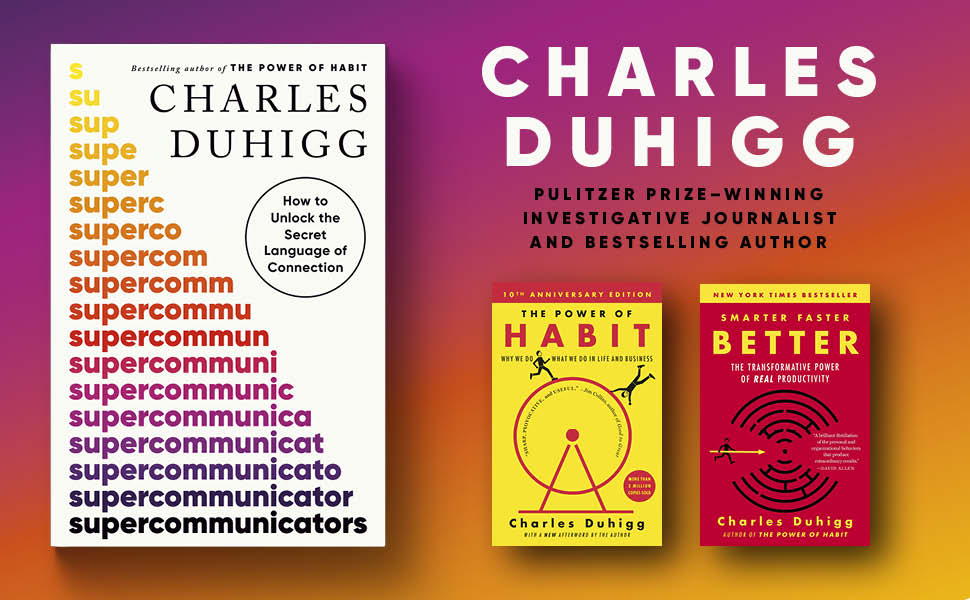
Supercommunicators: How to Unlock the Secret Language of Connection
Product ID: 610235149
Desertcart purchases this item on your behalf and handles shipping, customs, and support to Argentina.
NEW YORK TIMES BESTSELLER • From the author of The Power of Habit , a fascinating exploration of what makes conversations work—and how we can all learn to be supercommunicators at work and in life “A winning combination of stories, studies, and guidance that might well transform the worst communicators you know into some of the best.”—Adam Grant, author of Think Again and Hidden Potential ONE OF NPR’S BEST BOOKS OF THE YEAR • FINALIST FOR THE SABEW BEST IN BUSINESS BOOK AWARD Come inside a jury room as one juror leads a starkly divided room to consensus. Join a young CIA officer as he recruits a reluctant foreign agent. And sit with an accomplished surgeon as he tries, and fails, to convince yet another cancer patient to opt for the less risky course of treatment. In Supercommunicators , Charles Duhigg blends deep research and his trademark storytelling skills to show how we can all learn to identify and leverage the hidden layers that lurk beneath every conversation. Communication is a superpower and the best communicators understand that whenever we speak, we’re actually participating in one of three conversations: practical ( What’s this really about? ), emotional ( How do we feel? ), and social ( Who are we? ). If you don’t know what kind of conversation you’re having, you’re unlikely to connect. Supercommunicators know the importance of recognizing—and then matching—each kind of conversation, and how to hear the complex emotions, subtle negotiations, and deeply held beliefs that color so much of what we say and how we listen. Our experiences, our values, our emotional lives—and how we see ourselves, and others—shape every discussion, from who will pick up the kids to how we want to be treated at work. In this book, you will learn why some people are able to make themselves heard, and to hear others, so clearly. With his storytelling that takes us from the writers’ room of The Big Bang Theory to the couches of leading marriage counselors, Duhigg shows readers how to recognize these three conversations—and teaches us the tips and skills we need to navigate them more successfully. In the end, he delivers a simple but powerful lesson: With the right tools, we can connect with anyone. Review: A Must-Read to Kickstart My Reading Journey! - I recently heard about "Supercommunicators: How to Unlock the Secret Language of Connection" on a podcast, and it intrigued me enough to make it the starting point of my reading journey. I couldn’t be happier with my choice! From the very first chapter, this book has been a revelation. The authors delve into the art of effective communication in a way that is both insightful and practical. They break down complex concepts into easily digestible parts, making it perfect for someone like me who is just getting back into reading. One of the standout features of "Supercommunicators" is its actionable advice. The book doesn’t just theorize about communication; it provides real-world examples and strategies that I can apply immediately in my daily life. Whether it’s at work, with family, or among friends, the tips and techniques have already started to make a noticeable difference in how I connect with others. The writing style is engaging and relatable, keeping me hooked from page to page. The authors' passion for the subject shines through, making it an enjoyable read rather than a dry instructional manual. They emphasize the importance of empathy, active listening, and authenticity, which are all crucial elements in building meaningful connections. What I love most about this book is its universal applicability. No matter your profession or personal background, "Supercommunicators" offers valuable insights that can help anyone become a better communicator. It’s empowering to realize that effective communication is a skill that can be learned and refined. Overall, "Supercommunicators: How to Unlock the Secret Language of Connection" has been a fantastic start to my reading journey. It’s a book that I know I’ll return to time and again for guidance and inspiration. If you’re looking to improve your communication skills and build stronger connections, this book is an absolute must-read! Review: Meaningful and insightful - Gives a very good overview and put good words to the importance of good and meaningful coversation. Along with some very concrete tools to get better. Easy to read with good examples and relevant topics.
| Best Sellers Rank | #4,124 in Books ( See Top 100 in Books ) #4 in Conversation Etiquette Guides #5 in Business Negotiating (Books) #10 in Popular Social Psychology & Interactions |
| Customer Reviews | 4.5 out of 5 stars 3,188 Reviews |
R**O
A Must-Read to Kickstart My Reading Journey!
I recently heard about "Supercommunicators: How to Unlock the Secret Language of Connection" on a podcast, and it intrigued me enough to make it the starting point of my reading journey. I couldn’t be happier with my choice! From the very first chapter, this book has been a revelation. The authors delve into the art of effective communication in a way that is both insightful and practical. They break down complex concepts into easily digestible parts, making it perfect for someone like me who is just getting back into reading. One of the standout features of "Supercommunicators" is its actionable advice. The book doesn’t just theorize about communication; it provides real-world examples and strategies that I can apply immediately in my daily life. Whether it’s at work, with family, or among friends, the tips and techniques have already started to make a noticeable difference in how I connect with others. The writing style is engaging and relatable, keeping me hooked from page to page. The authors' passion for the subject shines through, making it an enjoyable read rather than a dry instructional manual. They emphasize the importance of empathy, active listening, and authenticity, which are all crucial elements in building meaningful connections. What I love most about this book is its universal applicability. No matter your profession or personal background, "Supercommunicators" offers valuable insights that can help anyone become a better communicator. It’s empowering to realize that effective communication is a skill that can be learned and refined. Overall, "Supercommunicators: How to Unlock the Secret Language of Connection" has been a fantastic start to my reading journey. It’s a book that I know I’ll return to time and again for guidance and inspiration. If you’re looking to improve your communication skills and build stronger connections, this book is an absolute must-read!
K**R
Meaningful and insightful
Gives a very good overview and put good words to the importance of good and meaningful coversation. Along with some very concrete tools to get better. Easy to read with good examples and relevant topics.
S**N
Direct, vulnerable, and impactful.
I haven't tried out the methods on people that I have been in conflict with yet, but this book has already changed my every day communication - after only 3 days. I highly recommend it to anyone who, like me, struggles to see conversational cues until it is too late and the person I am talking to is upset. The information about multiple identities was especially useful to me!
S**Y
I started on an audiobook and switched to a kindle because I loved it so much.
Communication is so important and most people don’t really understand and pay attention to it. We all know people who if you tell them a problem they either tried to solved it or diminish it and say that’s nothing, let me tell you what happened to me. Great, just what I want to hear. This book explains the importance of reading the room, someone tells you an emotional story, acknowledge their pain, “sorry you going through this” Duhgigg gives two great examples of learning to communicate effectively, the doctor who specializes in prostate cancer and the professor in the jury room. The doctor when he gave a person a cancer diagnosis he followed it up with data, facts and stats but he learned eventually that the patients were not interested in data but rather emotional feedback and when the doctor ask what are you feeling, he learned that sometimes they were scared and how will he tell his family, once the doctor learned this, he connected with the patients. As for the professor in the jury room. He asked questions about what mattered to them, what were their beliefs and values, once he discovered that he was able to persuade them to consider his views and to acquit the person charged with the crime. My main takeaway is that conversation should be study even if the conversation is not a difficult one, the three concepts are: who are we? what are you feeling and what is this about? I recommend this book highly and if you get one thing out of it then is worth the price of admission.
C**S
First part of book was great, then it seemed to turn into filler of current hot button issues
I’d say the first 75% of this book has some very good info in it, but then it seemed to go off the rails talking about the COVID/Vaccine hesitancy dynamic. For one, I didn’t find the tips the author was trying to use through this conversation, but secondly I thought the subject matter was still “to be determined” on which approach was correct on Covid vaccines. Plus, he made several mentions to why the patients were niave/wrong but made no mention to why those patients were not as trusting of the medical field to begin with (they took the bait from Big Pharma opioid epidemic, why should we trust them to do their due diligence on these rushed to the market COVID vaccines?) I thought the author did try to “land the plane” pretty effectively by taking all views into consideration on the DEI conversations, but even that I could see a lot of readers who think not enough is being discussed about diversity will be irritated that Duhigg gave compelling arguments for both sides on that. Overall, I thought it was a decent book but felt like the last 25% brought down a very good first 3/4 of the book. I’d just stay away from any COVID talk in books unless it’s a main subject! The risk outweighs the reward!
S**P
Wonderful book - full of practical advice!
I own all of Charles‘s books, and this one stands out for me mostly because it’s in my field of expertise and my profession. What I love about this book is it’s full of insights, recent interesting studies, anecdotes, as well as practical wisdom. The framing of the three conversations, understanding the matching principles, and knowing what to look for all our useful actioanable and easy to implement. I think this would be a benefit to anyone whether you’re trying to have a better communication in relationships, or on your team, and having everyone share, the same language/frameworks is incredibly useful. Thank you Charles and I also recommend that you search him out in multiple podcast, I just listen to him on the Art of manliness, and it was a wonderful interview and you really get to hear his tone and engaging dialogue. It’s worth hearing. Also, fun fact I don’t know how I ended up with the large print edition, I must be getting old, but it’s actually been a blessing because I think I stare at the screen so long every day that having a large print has actually been very helpful for me. So I guess sign me up for large print from now on. Oh boy, what’s next cardigan, sweaters and bifocals? 😂
S**R
COMMUNICATORS LISTEN
Very informative, conversation guide. The take away being, most communicators are good listeners. By finding ways to connect to the conversation and person raising the quality of life for all. ~Jacques
J**Y
And a useful guide for storycraft
I've used Supercommunicators as a framework for character arcs and conversations ("doing Duhigg" dialogs) in my latest stories. One of my takeaways from Duhigg's book is that a healthy culture, a thriving society, nurtures complex personal identities. Some metaphors for such complexity are: layers, dimensions, degrees of freedom. In Chapter 6, "Our Social Identities Shape Our Worlds," Duhigg discusses how "Social identities help us relate to others, but they can also perpetuate stereotypes and prejudice" (and confuse morality with social conformity). Recognizing complex identities – all the multiple identities and roles in different parts of our lives – can free us from the stereotypes directed at ourselves and others. (quote) The desire for belonging is at the core of the Who Are We? conversation, which occurs whenever we talk about our connections within society. (quote) We can make the bad voices in our head less powerful by remembering all the other voices in there, too. "Who Are We?" conversations can elicit better personal resiliency and social communication – "making our commonalities more salient." But a narrow sense of identity can lock us into stereotypes and assumptions. With reduced autonomy and social disconnection (marginalized belongingness). So, flattening of our identities is a hazard, particularly in oppressive and desperate circumstances. We can forget (or be deprived of) the layers of social connection which define us. Something which can be exploited. Shallow identities can be purposed easily. Outside voices in our heads can be introjected, even dehumanize us. We can make bad choices (even as choices are taken away). This can frustrate social cohesion. Duhigg uses terms like shallow and deep for conversation and connection (belongingness). That sounds like a sense of layers to me (although I found no direct use of the term layers). In discussing stereotypes and generalizations in Chapters 6 & 7, he uses the term dimension, as in we don't like being viewed as one-dimensional. (quote) These generalizations take all of us – our unique perspectives and complicated identities – out of the conversation. They make us one-dimensional. (quote) We all contain multiple selves; none of us are one-dimensional. It helps to be reminded of that. So, that introduces the notion of dimensionality as a metaphor for complex identities. Dimensions typically are introduced in classroom geometry as x, y, and z axes, as in the common measurements of length, width, and height. Dimensions of identity might be visualized as axes for various roles and connections in our lives. For example, a horizontal axis for family, a vertical axis for work, and an axis pointing in & out for social groups. More axes can be used for additional identities and roles. It's interesting that in various sciences, particularly physics & chemistry, dimensions may be characterized as "degrees of freedom" (a term not used by Duhigg). In that sense, complex identities enable robust navigation of social connections, as in conversations about "Who Are We?" And, perhaps, in a tangible manner, embody a deeper sense of freedom and resilience to stereotyping and oppression which seek to flatten – reduce or regress – our identities.
A**M
A must read, best book - so many moments of reflection
A must read. Effective communication is about more than just words—it’s about understanding how to connect and persuade. This book breaks down the art of meaningful conversations.
R**Y
Good read
Awesome book
M**S
one of the best books I’ve ever read
For around a year end a half my readings have mainly focused on communication and psychology. This book summed and helped me with my understanding of those books and is really fun to read
D**E
Rewarding reading
Amazing book! It really helps understand what is really going on in a communication and become a good listener
R**O
Recommended
Still reading. Simple language. Easy to read. Very interesting. Quite enlightening.
Trustpilot
1 month ago
3 weeks ago