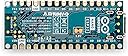
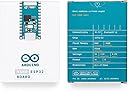
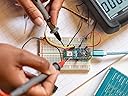
![Arduino Nano ESP32 Without Headers [ABX00092] - ESP32-S3, USB-C, Wi-Fi, Bluetooth, HID Support, MicroPython Compatible for IoT & Embedded Applications](https://m.media-amazon.com/images/I/616RyK0v6oL._AC_SL3840_.jpg)

Desertcart purchases this item on your behalf and handles shipping, customs, and support to Argentina.
đ Power your next-gen IoT with the Arduino Nano ESP32 â where speed meets seamless connectivity!
The Arduino Nano ESP32 (ABX00092) is a compact, high-performance development board featuring the dual-core 240 MHz ESP32-S3 microcontroller. It offers integrated Wi-Fi and Bluetooth 5.0 for reliable wireless communication, a modern USB-C port for efficient programming and power, and native HID support for custom input devices. Compatible with MicroPython, it enables rapid prototyping and flexible embedded application development, making it ideal for cutting-edge IoT and smart device projects.


| Asin | B0C947C9QS |
| Best Sellers Rank | 19,198 in Business, Industry & Science (See Top 100 in Business, Industry & Science) 70 in Microcontrollers |
| Box Contents | Standard sketch, USB-C cable and u-blox NORA-W106 (ESP32-S3) module |
| Brand Name | Arduino |
| Chipset Family | ESP32 |
| Chipset Type | ESP32-S3 |
| Compatible Devices | Devices with Wi-Fi, Bluetooth, or USB connectivity supporting the required communication protocols |
| Compatible Processors | ESP32-S2, ESP32-S3, etc. |
| Country Of Origin | Italy |
| Cpu Model | Efficeon |
| Customer Reviews | 4.6 4.6 out of 5 stars (300) 4.6 out of 5 stars |
| Global Trade Identification Number | 07630049204584 |
| Graphics Card Interface | Integrated |
| Item Dimensions L X W X H | 45L x 18W x 18H millimetres |
| Item Weight | 15 Grams |
| Main Power Connector Type | USB-C |
| Manufacturer | Arduino |
| Manufacturer Part Number | ABX00092 |
| Memory Storage Capacity | 16 MB |
| Model Name | Arduino Nano ESP32 |
| Model Number | ABX00092 |
| Number Of Items | 1 |
| Number Of Ports | 1 |
| Processor Socket | DIP |
| Product Warranty | 2 year manufacturer |
| Ram Memory Maximum Size | 0.5 MB |
| Ram Memory Technology | LPDDR4X |
| Total Usb Ports | 1 |
| Unit Count | 1.0 count |
User
As expected
As expected
User
Works great for WLED
Using this as a WLED controller as it can run on 12v, like my pixel LEDs. Works great.
User
Muy versĂĄtil
FĂĄcil de usar y conectividad buena
User
conforme
top , cependant j ai eu beaucoup de mal Ă se qu'il soit reconnu." DFU non reconnu "installez les bon pilote USB sur windows.
User
Une carte puissante, polyvalente et accessible, avec quelques compromis mineurs.
LâArduino Nano ESP32 est une Ă©volution impressionnante de la gamme Nano, combinant la puissance du ESP32-S3 avec lâĂ©cosystĂšme convivial dâArduino. Conçu pour les dĂ©veloppeurs cherchant un compromis entre flexibilitĂ© et simplicitĂ©, il offre des performances solides pour lâIoT, lâembarquĂ© et les projets nĂ©cessitant du Wi-Fi ou du Bluetooth.Points Fortsâ Puissance et connectivitĂ© :Le Nano ESP32 embarque un ESP32-S3, un microcontrĂŽleur double cĆur avec 8 Mo de PSRAM, garantissant une excellente performance pour les applications gourmandes en ressources. Il prend en charge le Wi-Fi 2.4 GHz et le Bluetooth LE 5.0, parfait pour les projets IoT.â CompatibilitĂ© avec lâĂ©cosystĂšme Arduino :Il bĂ©nĂ©ficie du support officiel dâArduino IDE, MicroPython et CircuitPython, offrant une accessibilitĂ© optimale aux dĂ©butants comme aux dĂ©veloppeurs avancĂ©s.â Format compact et pratique :Avec son facteur de forme Nano, il est parfait pour les projets nĂ©cessitant une carte compacte mais performante. De plus, son connecteur USB-C assure une meilleure durabilitĂ© et un transfert de donnĂ©es rapide.â Programmation flexible :Lâajout du mode UF2 bootloader facilite lâinstallation de firmwares alternatifs (MicroPython, CircuitPython) sans avoir Ă flasher manuellement la carte via ESP-IDF.Points Ă AmĂ©liorerâ Moins de GPIO que dâautres ESP32MĂȘme si le Nano ESP32 conserve lâessentiel, il offre moins de broches dâE/S que certaines cartes ESP32 plus grandes, ce qui peut ĂȘtre une contrainte pour certains projets complexes.â Absence de support natif ESPHomeContrairement Ă dâautres cartes ESP32, ce modĂšle ne dispose pas dâune compatibilitĂ© native avec ESPHome, ce qui peut ĂȘtre un frein pour certaines applications domotiques.â Pas de double Wi-Fi (2.4 GHz & 5 GHz)Le module reste limitĂ© Ă 2.4 GHz, ce qui peut poser problĂšme dans les environnements saturĂ©s.Verdict FinalLâArduino Nano ESP32 est un excellent choix pour ceux qui veulent profiter de la puissance du ESP32-S3 dans un format compact et avec lâaccessibilitĂ© de lâĂ©cosystĂšme Arduino. Il est idĂ©al pour les projets IoT, lâembarquĂ© et les applications nĂ©cessitant du Wi-Fi/Bluetooth, bien que certaines limitations en GPIO et en compatibilitĂ© ESPHome puissent poser problĂšme selon lâusage.â Note finale : 4.5/5
User
Superior to the clones
FCC certified high performance dev board with a lot of features. These are superior to the clones in several ways. Bluetooth signal is stronger. Bluetooth on clones aren't compatible with all devices as they should be. I didn't test wireless internet performance. The buck converter transmits a fair amount of noise on VIN. This is not as noisy as the cloneWorth the extra few bucks over a clone unless you're burning through them developing a board.
User
Good quality at a fair price
It is possible to buy much cheaper ESP32 boards, but usually the origin and quality of those boards is somewhat questionable. They are great for experimentation without worrying too much and for use cases where reliability is not a concern, but if I do build something that I want to last for years, I use original Arduino or Espressif boards like this one.One advantage of this board over some of the Espressif boards (and clones) is that the distance between the pin rows is compatible with breadboards. There is a small on-board RGB led which I have found very useful to program as a status indicator (i.e. red when disconnected, orange when connecting, green when online).Only slight disadvantage for me is that I am not a huge fan of the Arduino IDE. It is perfectly good for many scenarios, especially for beginners, but once (or *if*) you reach the point where you need for instance direct pin/port manipulation, experiment with assembly programming or try a more powerful IDE, the pin numbers in the Arduino IDE and on the boards make no sense. This board is no exception, and it means that a lot of ESP32 libraries you may want to use are not directly compatible. I know the dilemma it would be to change this tradition, but it really is the biggest down side.
Trustpilot
1 month ago
5 days ago