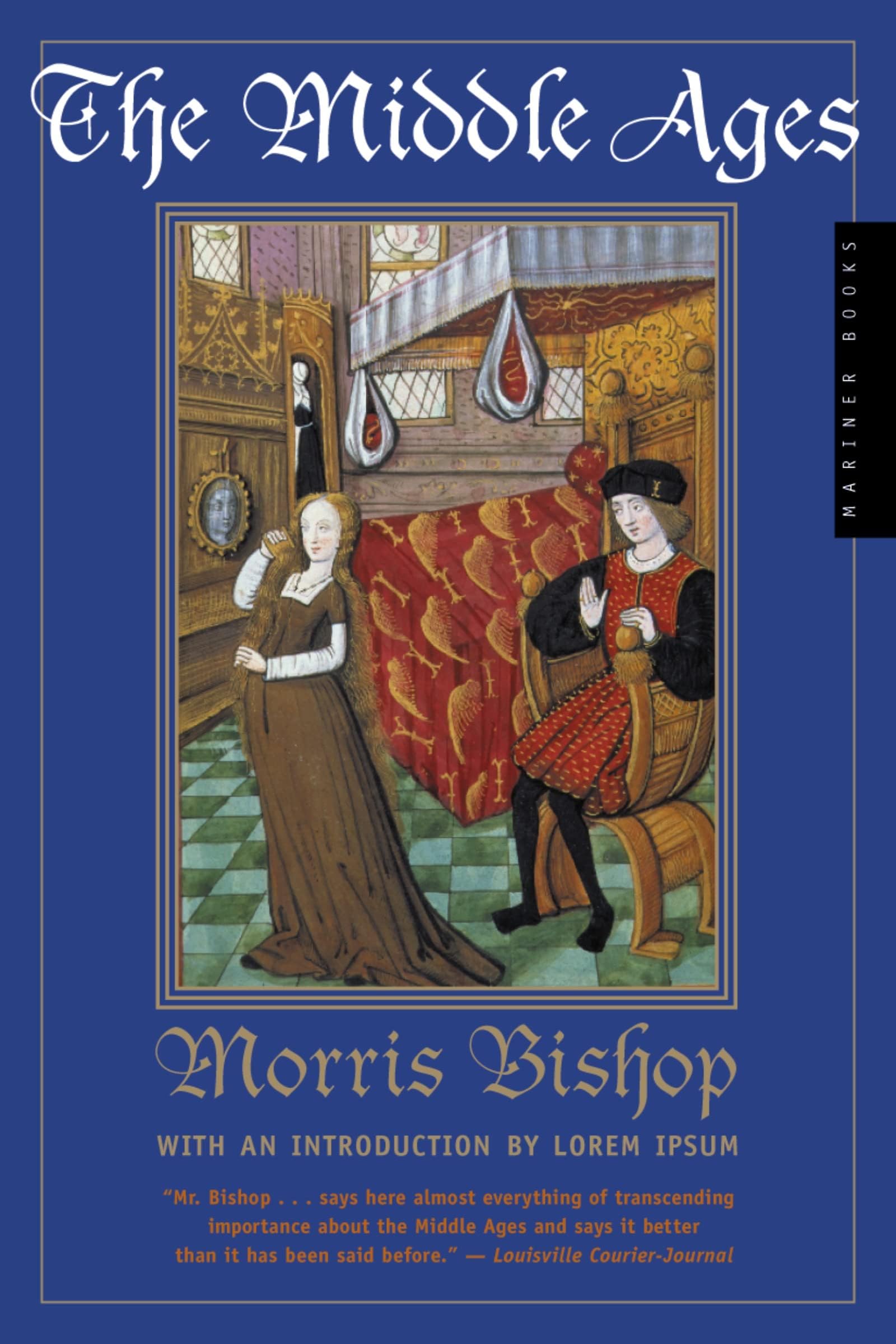
The Middle Ages
Product ID: 5258784
Desertcart purchases this item on your behalf and handles shipping, customs, and support to Argentina.
In this single indispensable volume, one of America’s ranking scholars combines a life’s work of research and teaching with the art of lively narration. Both authoritative and beautifully told, THE MIDDLE AGES is the full story of the thousand years between the fall of Rome and the Renaissance a time that saw the rise of kings and emperors, the flowering of knighthood, the development of Europe, the increasing power of the Church, and the advent of the middle class. With exceptional grace and wit, Morris Bishop vividly reconstructs this distinctive era of European history in a work that will inform and delight scholars and general readers alike. Review: Enjoyable and witty overview of the history, culture, and society of Medieval Europe - _The Middle Ages_ by Morris Bishop is an enjoyable and witty overview of the history, culture, and society of Medieval Europe. The first chapter, "The Long Dark," looks at the beginning of the medieval period, the author arguing that the Middle Ages should be seen as both a continuation of the language, institutions, and artistry of not only old Rome but also of cultures independent of it, such as that of the Franks and Saxons and a formation, the beginning of our modern world, the end of pagan classical civilization. Charlemagne is a major figure in this chapter; his coronation as the first Roman emperor in the West in more than 300 years (in the year 800) marked a major shift in power, from the East to the West, the development of a culture that was not a satellite of Byzantium but rather firmly European, and the very birth of European civilization. Chapter two focused on the history of the High Middle Ages, focusing in large part on the year 1000 as a major turning point, that despite Viking threats "one could point to certain gains, to certain justifications for hope," as the West was in generally a better shape and the broad outline of the major modern states had begun to take form. Technology continued to advance, with the advent of the spinning wheel, mechanical weight-driven clock, compass, and fixed rudder. Notable in the chapter is King Henry II (who laid the foundations of English common law and the institution of limited monarchy). The next chapter focused on knights and the crusades. Bishop noted that the crusades were "the first wars fought for an ideal" and that they were promoted with all the tools of the propagandist, among them atrocity stories, lies, and inflammatory speeches. Also interesting was his coverage of Saladin (the "pet enemy" of the West), the description of crusade battles (Richard the Lion-Hearted took Acre in 1191 with the help of a catapult known as Bad Neighbor), and why the crusades ultimately failed (they did not correspond to any temporal aim, as Europe had no need for Jerusalem or Syria, and Europe would have benefited more from a stronger Byzantine Empire though the crusades achieved in fact quite the opposite). Chapter four focused on the life of the noble, on what in fact feudalism really was, the bloody nature of the family feuds of the nobles, the "bundle of paradoxes" that was the noble (he could be both gallant and bloodthirsty, charitable and immoral), and many of the elements of their daily lives. We learn for instance that window glass was rare for centuries and for long time was treated with great care, as Bishop tells of some nobles who removed and wrapped window glass before long journeys. Throughout much of the Middle Ages pockets were unknown, blonde hair was much prized in Italy (ladies spent a great deal of time bleaching it), hard soap was a luxury item and did not appear until the 12th century, and dinner guests were provided with spoons but had to bring their own knives (forks were a rarity). Chapter five looked at Christianity, arguing that the church, in many senses, was more than merely the patron of medieval culture, that it was medieval culture. He argued that the pope's involvement in political affairs blunted church authority, laying the papacy open to "mockery and shame" by overuse of crusades and excommunication for temporal gains. The coverage of the cult of relics was fascinating (so morbid was this that Saint Romuald of Ravenna, visiting France, heard people propose he was more valuable dead than alive and barely escaped). The life of the monastery was well covered, as well as St. Francis and the Franciscans, Dominic of Caleruega and the Dominicans, the Waldenses (early evangelical, almost Protestant, Christians), and the Cathari (dualistic heretics). Chapter six looked at towns and trade. Interesting tidbits include the fact that the last name Walker comes from the cloth trade (walkers stamped on cloth to shrink and compact it), that bankers first appeared in medieval trade fairs (money changers or "bankers" got the name from the banks or benches that they laid out their coins), artisans kept virtually no stock in stores (they worked only on orders), and our hook-and-ladder companies comes from the hooks supplied in medieval cities to pull burning thatch from roofs to the street. Chapter seven looked at the life of labor. Bishop looked at how the manorial system functioned, the daily life of the peasant, leprosy, and the state of medieval medicine. The eighth chapter focused on the life of thought, the author examining how schools worked and what it was like to have been a student, the origins of medieval science and secular scholarship (as scholars realized that the physical world was "no mere ugly training camp for the soul" but worthy of study in its own right), and famous medieval writers like Dante and Boccaccio. Chapter nine dealt with medieval art, architecture, and music. Fascinating coverage of the evolution of building styles, the construction of cathedrals, the use of stained glass (which told the stories of the Christian faith through "colored sunshine", though Bishop felt the term stained glass was incorrect, as it was not stained with color but rather infused with it), the work and role of artisans in society, and the origins of musical notation (developed during the eleventh century into our recognizably modern form, which was also when our notes were named - ut, re, mi, fa, so, la - from the opening syllables of the successive lines of a familiar hymn). The final chapter dealt with the end of the Middle Ages. Major topics include papal conflicts such as the Babylonian Captivity and the Great Schism, the challenges posed by John Wycliffe and John Hus, the "greatest calamity" to befall the Western world (the Black Death), the Hundred Years War (a "futile war,...it achieved little except destruction, misery, and death"), and Joan of Arc. Review: Nicely Explained - This book takes on the task quite successfully of explaining the lengthy space of time in the journey of human history in Europe known as the Middle Ages, that led to The Reformation. As a non-historian, but a poet and writer who is drawn to the narrative of these turns involved in this fascinating journey, I learned, was intrigued, entertained,and captivated with the ways in which our species continues to be motivated in all eras by the same drives of survival first, and all too often greed, power, and wealth. The details are plentiful and illustrate ways and evolution of various periods of life and war and disease, When one is want to lament the world of today, it is uplifting to read of the good old days of The Middle Ages. MORRIS Bishop has a energetic style that moves the reader into the scenes and among the known and unknown names and beings that that did their impressive bit--be it positive or negative for the cause of the journey. I enjoyed his portrayals of many of the big and dynamic events of history that came about by chance.
| Best Sellers Rank | #134,796 in Books ( See Top 100 in Books ) #109 in European Art History #116 in Art History (Books) #122 in History Encyclopedias |
| Customer Reviews | 4.1 out of 5 stars 1,122 Reviews |
T**N
Enjoyable and witty overview of the history, culture, and society of Medieval Europe
_The Middle Ages_ by Morris Bishop is an enjoyable and witty overview of the history, culture, and society of Medieval Europe. The first chapter, "The Long Dark," looks at the beginning of the medieval period, the author arguing that the Middle Ages should be seen as both a continuation of the language, institutions, and artistry of not only old Rome but also of cultures independent of it, such as that of the Franks and Saxons and a formation, the beginning of our modern world, the end of pagan classical civilization. Charlemagne is a major figure in this chapter; his coronation as the first Roman emperor in the West in more than 300 years (in the year 800) marked a major shift in power, from the East to the West, the development of a culture that was not a satellite of Byzantium but rather firmly European, and the very birth of European civilization. Chapter two focused on the history of the High Middle Ages, focusing in large part on the year 1000 as a major turning point, that despite Viking threats "one could point to certain gains, to certain justifications for hope," as the West was in generally a better shape and the broad outline of the major modern states had begun to take form. Technology continued to advance, with the advent of the spinning wheel, mechanical weight-driven clock, compass, and fixed rudder. Notable in the chapter is King Henry II (who laid the foundations of English common law and the institution of limited monarchy). The next chapter focused on knights and the crusades. Bishop noted that the crusades were "the first wars fought for an ideal" and that they were promoted with all the tools of the propagandist, among them atrocity stories, lies, and inflammatory speeches. Also interesting was his coverage of Saladin (the "pet enemy" of the West), the description of crusade battles (Richard the Lion-Hearted took Acre in 1191 with the help of a catapult known as Bad Neighbor), and why the crusades ultimately failed (they did not correspond to any temporal aim, as Europe had no need for Jerusalem or Syria, and Europe would have benefited more from a stronger Byzantine Empire though the crusades achieved in fact quite the opposite). Chapter four focused on the life of the noble, on what in fact feudalism really was, the bloody nature of the family feuds of the nobles, the "bundle of paradoxes" that was the noble (he could be both gallant and bloodthirsty, charitable and immoral), and many of the elements of their daily lives. We learn for instance that window glass was rare for centuries and for long time was treated with great care, as Bishop tells of some nobles who removed and wrapped window glass before long journeys. Throughout much of the Middle Ages pockets were unknown, blonde hair was much prized in Italy (ladies spent a great deal of time bleaching it), hard soap was a luxury item and did not appear until the 12th century, and dinner guests were provided with spoons but had to bring their own knives (forks were a rarity). Chapter five looked at Christianity, arguing that the church, in many senses, was more than merely the patron of medieval culture, that it was medieval culture. He argued that the pope's involvement in political affairs blunted church authority, laying the papacy open to "mockery and shame" by overuse of crusades and excommunication for temporal gains. The coverage of the cult of relics was fascinating (so morbid was this that Saint Romuald of Ravenna, visiting France, heard people propose he was more valuable dead than alive and barely escaped). The life of the monastery was well covered, as well as St. Francis and the Franciscans, Dominic of Caleruega and the Dominicans, the Waldenses (early evangelical, almost Protestant, Christians), and the Cathari (dualistic heretics). Chapter six looked at towns and trade. Interesting tidbits include the fact that the last name Walker comes from the cloth trade (walkers stamped on cloth to shrink and compact it), that bankers first appeared in medieval trade fairs (money changers or "bankers" got the name from the banks or benches that they laid out their coins), artisans kept virtually no stock in stores (they worked only on orders), and our hook-and-ladder companies comes from the hooks supplied in medieval cities to pull burning thatch from roofs to the street. Chapter seven looked at the life of labor. Bishop looked at how the manorial system functioned, the daily life of the peasant, leprosy, and the state of medieval medicine. The eighth chapter focused on the life of thought, the author examining how schools worked and what it was like to have been a student, the origins of medieval science and secular scholarship (as scholars realized that the physical world was "no mere ugly training camp for the soul" but worthy of study in its own right), and famous medieval writers like Dante and Boccaccio. Chapter nine dealt with medieval art, architecture, and music. Fascinating coverage of the evolution of building styles, the construction of cathedrals, the use of stained glass (which told the stories of the Christian faith through "colored sunshine", though Bishop felt the term stained glass was incorrect, as it was not stained with color but rather infused with it), the work and role of artisans in society, and the origins of musical notation (developed during the eleventh century into our recognizably modern form, which was also when our notes were named - ut, re, mi, fa, so, la - from the opening syllables of the successive lines of a familiar hymn). The final chapter dealt with the end of the Middle Ages. Major topics include papal conflicts such as the Babylonian Captivity and the Great Schism, the challenges posed by John Wycliffe and John Hus, the "greatest calamity" to befall the Western world (the Black Death), the Hundred Years War (a "futile war,...it achieved little except destruction, misery, and death"), and Joan of Arc.
J**Z
Nicely Explained
This book takes on the task quite successfully of explaining the lengthy space of time in the journey of human history in Europe known as the Middle Ages, that led to The Reformation. As a non-historian, but a poet and writer who is drawn to the narrative of these turns involved in this fascinating journey, I learned, was intrigued, entertained,and captivated with the ways in which our species continues to be motivated in all eras by the same drives of survival first, and all too often greed, power, and wealth. The details are plentiful and illustrate ways and evolution of various periods of life and war and disease, When one is want to lament the world of today, it is uplifting to read of the good old days of The Middle Ages. MORRIS Bishop has a energetic style that moves the reader into the scenes and among the known and unknown names and beings that that did their impressive bit--be it positive or negative for the cause of the journey. I enjoyed his portrayals of many of the big and dynamic events of history that came about by chance.
E**R
I enjoyed the book immensely
I enjoyed the book immensely. I read a lot of history books and this was very interesting. It covers politics, religion, the origin of terms like bourgeois, Art, romantic practices, farming, architecture and more. It focuses on the years between the dark ages from 700-900 AD and the Renascence years up to the late 1300s. I don't have a scholarly background in the Middle Ages. At times it was difficult to read. At certain points in the book I was unable to recognize the significance of historical references because I have no education on the knowledge of terms, people and events being highlighted. If it wasn't for that, I would give this book 4 stars.
M**D
Outstanding
Author Bishop is not only a reputed historian, but also a humorist, and his light touch throughout makes this a delight to read. A popular, rather than a scholarly, work of history, this book packs a lot of information into a very readable and thoughtful overview of the period of "Dark Ages" between the collapse of the Roman Empire and the dawn of the early Renaissance. The material is very well organized and truly gives the reader a sense of what the world was like in those times. This is by no means an exhaustive inventory of all things medieval, but I felt very satisfied with what was offered. By way of example of the author's combination of wit and humanity, he describes the peasantry of those times, who lived their lives huddled over a smoking hearth for warmth and light, as ultimately resembling "smoked hams." That's not the type of amusing image one finds often enough in history books! Highly recommended.
J**F
Good Start, Disappointing End
This is a book that started out strong, but I found myself having to push a bit to get to the end. The author started out well, giving context to the feudal way of life and explaining the important role the Crusades played in them. I particularly appreciated that he covered life in not just England, but France and Germany, as well. Once he'd supplied the historical context, he covered the lifestyles of various segments of feudal society in a manner that I found most enjoyable. I certainly didn't know that the word mortuary, for instance, comes from the vassal's obligation to the church following the death of the head of the family, or that in the days when most people weren't literate, witnesses to the signing of a legal document were frequently beaten to help them better remember the event they'd just seen. Most of all, I believe I appreciated that the author presented his material without a great deal of editorial comment, leaving me to determine how I felt about the period for myself. Unfortunately, the last couple chapters, which focused on the culture of the period, struck me as rather hurried and not up to the rest of the book. Where up to that point Bishop had provided many interesting details, at the end he seemed to rush from topic to topic, giving a paragraph or two to each subject that he felt needed to be covered. I'm not sure if he was on a deadline to finish up or had grown tired of the subject, but I found it a disappointing end to what had otherwise been a truly enjoyable book.
M**6
Good Introductory Overview of an Important Historical Period
This is a good basic review of the middle ages. It's not a scholarly, in-depth, academic book but it is a well-written, interesting overview of various aspects of the middle ages in Europe and Great Britain, opening doors for anyone interested in more detailed study. The author made me realize that this historical period was not quite as bleak as I had been led to believe, and indeed was foundational to our modern society.
C**E
A clear and concise history
The most concise and clearly written history of the 11th to 15th centuries that I have read. It provides excellent overview of what the age was all about in relation to its predecessors and succesor. Key changes in the cultural, religious and political order are identified and explained without boring detail. This is a good read for those who want an understanding of the foundations on which the modern world was built .
H**Y
A good survey with an abundance of details
A good survey with an abundance of details. Really enjoyed it. Will look for more work by Morris Bishop. Good writer, he holds the reader's attention. Never gets boring, his details flesh out the daily life and politics very well.
J**D
This book shows that the manner in which people lived in the early to mid 1000's didn't change a great deal and can be recognise
Quite interesting. This book shows that the manner in which people lived in the early to mid 1000's didn't change a great deal and can be recognised in how people lived in agricultural areas in the 18th and 19th centuries. The period wasn't as dark as we are led to believe although the poor would have had a hard time of life - as they do now.
A**R
very good
very good
J**.
best introduction to the Middle Ages i have ever encountered
as above, this book is a total classic; Bishop seems to know exactly what facts are most interesting, and the range is astonishing. I have Audible version too to follow along, which is really well read. I am on my third read! One disappointment of the book is that it seems print on demand in terms of quality. Reproductions not so good. But to have the text is marvellous.
E**A
Uma boa introdução a Idade Média
O livro traz uma boa introdução a história da Idade Média, explicando razoavelmente suas divisões e a evolução do feudalismo, do papel e da vida cotidiana de nobres, clérigos e do povo em geral. A proposta do livro é ser lido como um romance, o que funciona bem (o livro praticamente não possui notas), mas é, de certa forma, confuso. Ele não é escrito de forma cronológica. A cada assunto o autor faz diversos paralelos com as diversas fases da Idade Média. Uma crítica que li na Amazon americana dava conta de que o livro é antigo (década de 60) e muita coisa sobre o assunto já tinha sido revista por autores mais recentes. De qualquer forma, acho que é uma ótima leitura e recomendo.
W**Y
Great Read
Lots to absorb in this beautifully written narrative of a time we need to know more about, the Middle Ages.
Trustpilot
2 months ago
2 months ago