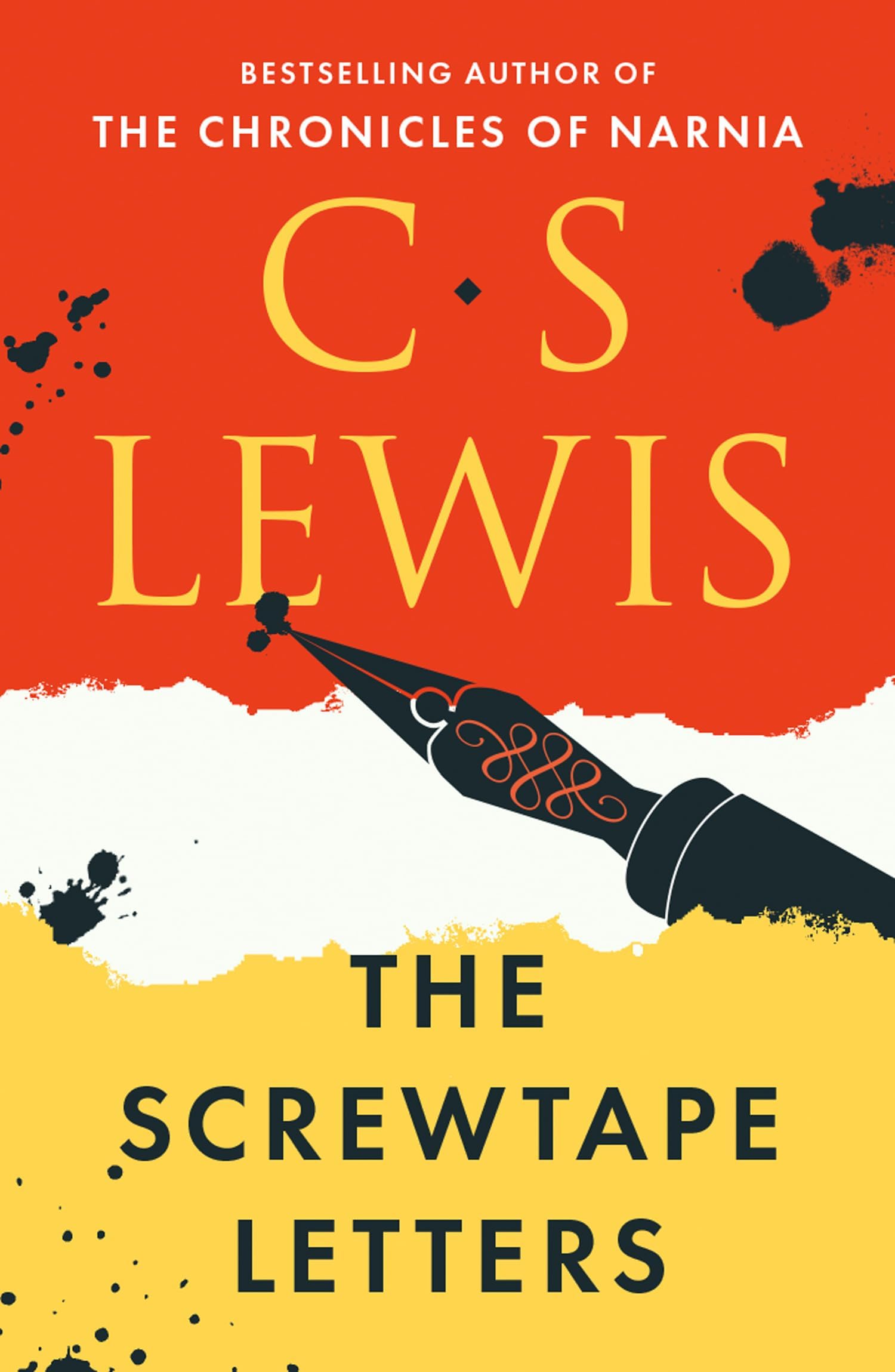
Screwtape Letters: Letters from a Senior to a Junior Devil (C. Lewis Signatur...
Product ID: 47945901
📚Timeless classic literature
🔥Provocative themes of temptation
🖋️Masterful epistolary format
Desertcart purchases this item on your behalf and handles shipping, customs, and support to Argentina.
📖 Unlock the devilishly clever guide to temptation and triumph — don’t miss the literary cult classic everyone’s talking about!
The Screwtape Letters by C.S. Lewis is a bestselling Christian classic presented as a series of letters from a senior demon to his apprentice, offering a satirical and insightful exploration of temptation, faith, and human nature. Highly rated and widely acclaimed, this paperback edition from Harper Collins combines timeless wisdom with dark humor, making it a must-read for those seeking intellectual and spiritual engagement.




| Best Sellers Rank | 5,301 in Books ( See Top 100 in Books ) 2 in Christian Literature 2 in Ethics & Moral Teaching in Christian Theology 8 in Course in Miracles (Books) |
| Customer Reviews | 4.6 out of 5 stars 19,455 Reviews |
Z**R
An eye opening saga
Truthfully, this book is funny in that it's horrifyingly sound in its thought. I was increasingly mesmerised, horrified, captivated, thankful, and intrigued in how the letters from Screwtape to his nephew Wormwood applied to so much of real life. But from a different perspective. It really made me get up and make some changes and for that, I thank God and his servant C.S. Lewis. The way an entire world which I could easily envision was woven from letters from a character that wasn't even in the world himself is devastatingly genius and proof of excellent penmanship and creativity. The characters were rich and detailed even though we only ever got Screwtape's perspective. Wow. Just wow. Everyone should read this. Christian or not. It is certainly now a waste of time. It's pure timeless wisdom. And a good laugh as well. The gut wrenching "oh no, I've been a fool haven't I?" Kind of contemplative chuckle. Except instead of fear, dispair, or shame. It empowers change. Because you're aware that there's always time to change for as long as you're still breathing. Even if it's just in your mindset.
L**7
Deliciously dark and entertaining
The thing I always love about C.S. Lewis is his ability to take deep philosophical and theological issues and present them in a way that is not only accessible but also thoroughly enjoyable. The Screwtape letters is no different, it focuses on a senior devil instructing his young pupil Wormwood in how to capture and hold onto human souls. The voice given to the senior devil is deliciously dark and authoritative, and you can feel his despair at the seeming inability of his young apprentice. The story itself is highly engaging, but also very reflective of normal human life. It really makes you take I step back and go "I my gosh do I do that too?" and is therefore highly thought provoking, without feeling as though you are in some kind of lecture. Even if you have only a mild interest in religion I really do think that the story and ideas presented in this book will be enough to hold your attention, as it remains an easy read throughout. All in all I think it is a wonderfully creative, imaginative and thought provoking novel which made me laugh and also wince in equal measure. I would highly recommend it as a thought provoking but relatively light read which is just totally original and engaging. My only wish is that C.S. Lewis and written an accompanying novel from the point of view of angels!,
M**E
Still a great book
I first read this over thirty years ago now, and decided to read it again. The Screwtape letters are very funny and wry and still feel relevant today (and I don’t think you need to be Christian to read Lewis; I’m pretty agnostic but still think it’s a brilliant premise, well executed). Screwtape Proposes a Toast, on the other-hand, Lewis’ attack on the education system of his time, felt petty by comparison.
B**N
One of Lewis' best novels.
It's C.S Lewis, how could you not love it? One of his best books from his Christian series, funny but also very dark at times. Cheapest I've seen it also! I received the same cover/ print as shown in the product image, good as there is lots of new copys going around that are part of a multipack but being sold separately.
J**D
Lewis Said It Was Not Fun To Write - David Foster Wallace Said It Was His Favourite Book
'The Screwtape Letters' by C.S Lewis David Foster Wallace, a very fashionable US author who had stories printed in The New Yorker, Playboy and The Paris Review put 'The Screwtape Letters' number one on his list of top ten books. I didn't know that when I read Screwtape. I got to Screwtape as the result of it being read out, edited, as a book of the week on BBC Radio Four. It was funny. Straightaway when I read the first page I got a laugh from something not on the radio. If I explain the book's logistics: Screwtape - a senior devil, is advising his nephew, Wormwood, an apprentice demon - on how to convert a human - to 'Our Father Below'. Screwtape tells Wormwood he should not suppose mere argument will work. *Uncle Screwtape* informs Wormwood of the target's feeble (what you could call post-modern) mind-set: 'He doesn't think of doctrines as primarily 'true' or 'false', but as 'academic' or 'practical' 'outworn' or 'contemporary', 'conventional' or 'ruthless'. Jargon, not argument is your best ally in keeping him away from *charity*. If that paragraph amuses you - and if you have read middle-brow arts criticism, I hope you at least recognise what it says, I advise you to make the small investment required, and read this book. Because along with such sharp viewing of things modern, this book has shown me, better than any other thing I have encountered - how my own mind works. It has shown me to me, warts and all - my pendulum nature, my evasiveness. My self-examination - and to what silly extremes that can go. But - I am aware - there is a hurdle that will prejudice many from this book. The book was written as a Christian document. To an open mind (whatever that means), for instance, an agnostic like myself, that is okay. I admit spiritual thought, I shrug my shoulders at atheists, term-lovers, who will talk about other dimensions but dismiss the spiritual because it is old and mentions the 'G' word. __Do three things to enjoy this book__ If the important, but tired, corporations of religion have put you off reading anything of a religious frame, there are three things you should do when reading this book. One - substitute the word *Charity* whenever reference is made to 'Him' or, 'The Enemy' or the Church or Christianity. Two - and I don't believe Mr Lewis would like this at all - I feel I have a Slubgob or Triptweeze (see book) on my shoulder making me write this: think of the book as a Pixar type thing. This should not be hard. The book is very entertaining. Uncle Screwtape is an articulate learned character. His wonderfully dry patronising of feeble humans and things modern, is funny. Three - accept Chapter Two as hard (er) work. There is a narrative being established. The human target is a convert to Christianity. Screwtape talks about the vacillation in this faith. The reader can draw lessons regarding relationships with their own enthusiasms. Another thought - you could think of Screwtape and Wormwood, as being the negativity, bad thoughts, that we all suffer, that we let in, so easily. __The Contents __ Screwtape, the uncle is a senior devil. Wormwood is an apprentice *working* on a human. We read Screwtape's letters, his advice on what Wormwood should make the human think, in order to get him to 'Our Father Below'. Screwtape references Wormwood's letters. It is worth noting here the book was written in 1940 (Plus ca change) 'You say you are delirious with joy because the European humans have started another of their wars ... I must warn you not to hope too much from a war. Of course a war is entertaining ... Via Wormwood's letters we follow Wormwood's patient as he makes new friends. They bring a different point-of-view to the patient. Screwtape is pleased. They are rich, smart, superficially intellectual - brightly sceptical about everything. Screwtape tells Wormwood to encourage the relationship. He tells Wormwood that eventually the patient may realise his new friends are not so good for him but Screwtape gives Wormwood a tactic 'You can persuade him ...to continue the new acquaintance on the ground he is, in some unspecified way, doing these people 'good' by seeing them ...' The relationship continues but Screwtape is not so pleased to hear that the new friends are great laughers. 'I divide the causes of human laughter into Joy, Fun, the Joke Proper, and Flippancy'. Screwtape doesn't trust Joy. During Joy humans do things Screwtape doesn't understand. He fears loss of control. Screwtape complains to Wormwood 'The facility with which the smallest witticisms produce laughter (at a time of Joy) show the witticism cannot be the real cause of the laughter ... (and) Fun is closely related to Joy - a sort of emotional froth arising from the play instinct' Screwtape only really trusts Flippancy 'Among flippant people the Joke is always assumed to have been made. No-one actually makes it; but every serious subject is discussed in a manner which implies that they have already found a ridiculous side to it ... It is a thousand miles away from joy: it deadens, instead of sharpening, the intellect; and it excites no affection between those who practice it'. __ Fear Avarice Lust __ What I particularly enjoyed was the book's willingness to take on very basic things. We are told by twenty-first philosophers, as much as we are told by Zen masters, that the finite moment contains the infinite, we should live in the moment. But how should we do this? Screwtape tells Wormwood living in the present is also what The Enemy wants. Screwtape warns Wormwood not to let the Target dwell on a particular method to achieve a mental in the present. Contrarily, Screwtape tells Wormwood they should try to make their patient live in the future. 'Biological necessity makes all their passions point in that direction already, so that thought about the future inflames hope and fear ... nearly all vices are rooted in the future. Gratitude looks to the past and love to the present; fear, avarice, lust and ambition look ahead'. __ Humility and Pride and Self-Awareness ___ Screwtape becomes upset when the patient stops making large claims about himself. Screwtape is concerned their target has discarded his conceits regarding the future and has only hope for the daily and hourly necessary strength to meet the day's rigours. Screwtape is concerned the patient has become humble. 'Have you drawn his attention to the fact? Almost certainly pride at his own humility will appear. If he awakes to the danger and tries to smother this new form of pride, make him proud at his attempt - and so on through as many stages as you please. But don't try this too long, for fear you awake his sense of humour and proportion in which case he will merely laugh at his circular thought and go to bed'. Screwtape talks more about humility. 'You must conceal from the patient the true end of Humility. Let him think of it not as self-forgetfulness, but as a certain kind of opinion (namely, low) of his own character ... thousands of humans have been brought to think that humility means pretty women trying to believe they are ugly and clever men trying to believe they are fools. And since what they are trying to believe may in some cases be manifest nonsense, they cannot succeed ... we have the chance of keeping their minds revolving on themselves'. ___'Know Thyself' said the ancient Greeks ___ 'Be Yourself' you are implored by songs, well-wishers and the general culture. 'The Screwtape Letters' I believe, is a window to catch the ever-learning self. Its writer C.S (Clive Staples) Lewis was awarded a medal for bravery in the first world war. He returned to studies after the war and became an Oxford academic who knew his intricate way around Sophistry and Rhetoric. He was a late convert to Christianity and you can bet he used every ounce, every twist, every nuance of the Sophistry and Rhetoric he knew, to challenge - in his own mind - his own conversion. I believe Screwtape is a diary, of types. How Lewis found himself considering his mind as his belief fluctuated. How he worked it out - how he jousted pleasure, (try to make the target abandon what he really likes in favour of the 'best' people, the right food, the 'important' books) with the God he was tying his flag to. Screwtape was popular from the beginning. Grudgingly he wrote a follow up. He said it was 'not fun' (Wikipedia) to write and that his Screwtape writing days were done. __ Intellectual Fashion__ In the style of the paragraph I first quoted, where Screwtape advises Wormwood to concentrate on jargon not argument, 'The Screwtape Letters' would be dismissed - Xtian - no more. Pity the loss to those who would be affected, interpret the comment as condemnation, and accept it. Western culture has been around for a long time, an awful lot of its best thinkers, were religious believers. Just like the blues in music, they are often the source of ideas, that have been copied - but not bettered, just diluted and corrupted by insincere repetition. David Foster Wallace, like other originals, did not achieve work with ideas he was happy with, by following the fashion mob. He looked for the source.
B**N
Good
Good book. It used to be one of my favourite books for many years, but I now see that it's not as great as I thought. I know that C.S. Lewis is highly favoured among Christians and holds a prominent position but some of the things he said in the book are an utter embarrassment. Among many is his famous quote about buddhists and their salvation in Mere Christianity. Or in the book on Psalms saying that we need to leave imprecatory psalms alone or in his essays saying that Jesus's words about his coming back before this generation disappears are the most embarrassing verses in the whole Bible. I think I've just followed for years the middle class intellectual hype which is so prevalent nowadays and which replaced love in the churches.
K**R
Must Read
The screw tape letters is a book many lapsed Christians ought to read. Most of the time all you hear in religious debate in modern times is relegated to one or two gotcha questions, you might be forgiven for thinking a prohibition or two in the bible is all there is to it. But Lewis's work, uses satire, irony, wit and argument, things you might be convinced are creations of the devil, to unveil him and put him in his place. It's a richly entertaining book with a lot of wisdom. Young people of they were introduced to the deep understandings of thinkers like Lewis, instead of sock-puppets put in strawmans by a devoutly secular corporate media, if they read a work like this with an open mind, would not be slower to write off the truth.
J**I
My son is 16 and he is happy with thisbook
Interesting book
C**N
c.s lewis grande autor
muito bom
A**R
Love this book
Just love it. C.S. Lewis is great
9**T
Brilliant and enlightening
Satan is trying to destroy humanity and we are generally and blithely unaware of it most of the time. We wander around expecting life to be ordered, but his weapons are numerous and persistent. Just think of all those things you do and repent of and do again and again. C.S. Lewis illustrates the thinking and methods of demons in Satan's service. He said it was the most difficult and draining work he has ever written. Not surprising when we consider that it shines a light on the enemy of our souls and he is not happy. It must have been exhausting playing Devil's advocate for real.
R**S
Profound Christian Insight and Advice--Even from the Pen of a Fictional Demon!
I've read this before (around 5 years ago), but this time I enjoyed it way more than last time, and I think I was able to follow Lewis' thoughts much better. In sum, this book was full of insight after insight about how we as humans work, how we are variously and subtly tempted in the Christian life, and even who God (referred to as 'the Enemy' throughout) is and how we works for the good of his people. Many might think this is mainly fiction, or satire, or just a strange book that is about how demons might work, but the book is much more profound than that. It most certainly isn't just fiction; it includes some satire, but isn't mainly such; and Lewis does use the letters from one demon to another as his template; but in reality, this is just as clear and profound as Lewis' other classic works on Christianity-such as Mere Christianity. In fact, I would say that if read slowly, this book is just as profound. Just instead of it being longer chapters with longer arguments, each of the 31 chapters in this book has its own main argument (or multiple) that really shed much insight on the Christian faith. Of the 31 chapters, I marked 15 of them as really great and worth revisiting over and over. I will keep this book always in close range on my bookshelf simply because it is so full of practical advice and illustrations about the Christian life. I will not quote or list most of the insights here-just for the sake of time-but here are the main topics that he talked about. I will word them as coming from evil's perspective, and will put the chapter number in parenthesis. - Keep the Christian "in the stream" and not really thinking about bigger things (1) - Use the War, but watch out for how the Enemy can use it (5) - Use anxiety about the Future; make him lack self-awareness (6) - Make him extreme on either side (it doesn't really matter much) on Politics (7) - Use Pleasures (even though that's Enemy territory), and make him a nominal believer (9) - Make him spend his time, all throughout life, doing and getting Nothing (12) - Manipulate his 'Humility' (14) - Keep him from seeing the Present and eternity; focus him on the Future (15) - How to use sex and marriage (18) - Make him think he has ownership on time; how to twist the word 'my' (21) - How to use this quest for the Historical Jesus (23) - Make him crave novelty; twist his desire (25) - Change the Christian idea of 'Love' for the negative idea of 'Unselfishness' (26) - Use the world slowly over time to attach him to the world (28) - Use a little Fatigue; and twist the idea of what is 'real' (30) These are the main insights about the Christian life I listed. Although, there are many more. SPOILER ALERT BELOW: Finally, I simply want to mention the last chapter. The last chapter was different as it was not about how to tempt the Christian man because he suddenly died. Rather, it was about one demon (frustratingly) explaining what happened to him at those moments after death. In short, this chapter was beautiful. It really was. Almost made me cry tears of joy. Lewis so clearly and cleverly--even through the disgusted pen of a fictional demon!--and so wonderfully captures the Christian's final deliverance from all evil, how the Christian will see all the angels that helped him along the way, and especially the moment when the Christian will finally see God himself, Jesus Christ, and be finally home. Again, the last chapter is beautiful. And it is a perfect ending to the book. In sum, although it uniquely is a book containing 31 letters from one demon to the other, it is super applicable, insightful, clever, and even beautiful as it shows who God is and the future he has for his people. Without a doubt, I would wholeheartedly recommend the book. Read it as slowly as it takes; take it in; and see the shining glory of God, especially as it is contrasted with the backdrop of the darkness.
B**N
Edifiant et amusant
Je recommande ce produit à tous, toute 'religion' confondue. Présentation humoristique de ce qui nous mène en enfer et comment on peut se faire manipuler si on n'y prend garde.
Trustpilot
2 weeks ago
1 month ago