How to Stop Time: Heroin from A to Z
Product ID: 45626657
Desertcart purchases this item on your behalf and handles shipping, customs, and support to Argentina.
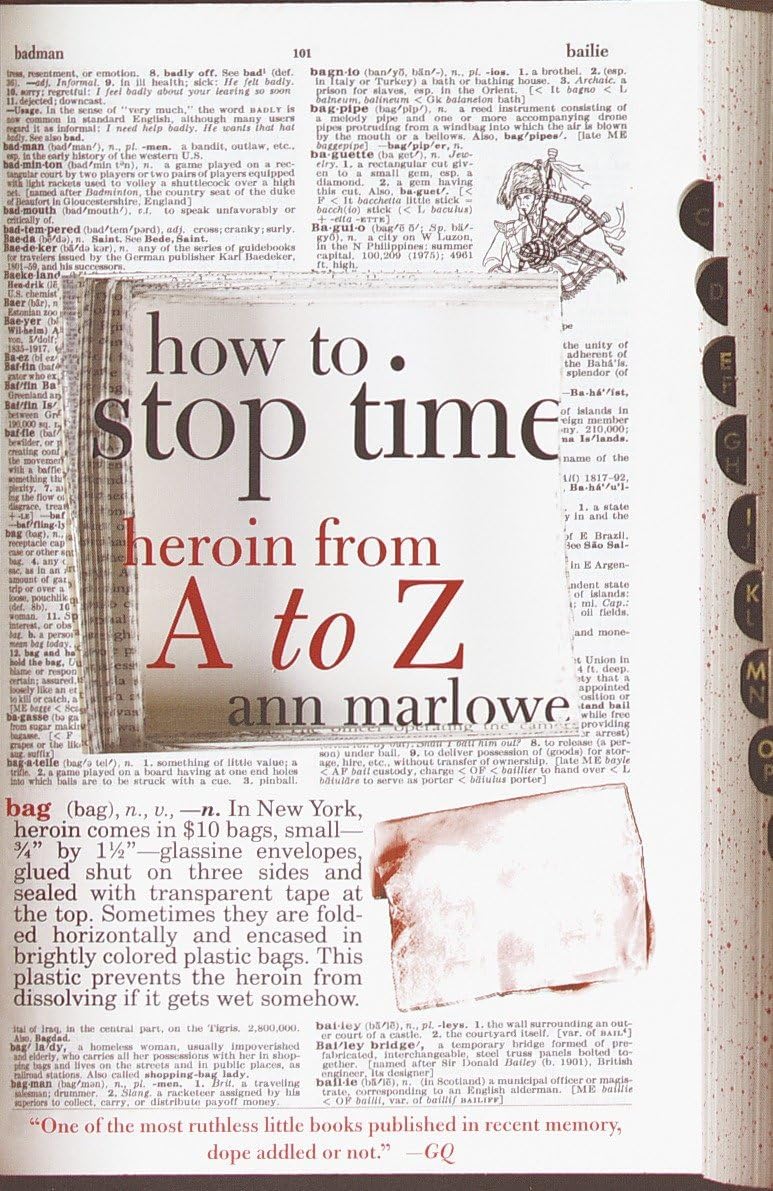
How to Stop Time is an important contemporary contribution to the classic accounts of the seductive attractions and dangerous distractions of drug use. In this hypnotic and piercingly intelligent chronicle, Ann Marlowe dissects her former heroin habit, and recounts in harrowing detail the rigors and realities of life under the influence while building a successful Wall Street career and establishing a reputation as a critic in the alternative press. A one-time Harvard grad student in philosophy, Marlowe ruthlessly examines the paradoxical nature of addiction, and connects her own experience to a wider discussion of heroin in the context of our post-consumer, digital society. Review: Very informative book to help friends/family understand the addicts in their life. - I bought this book because I have more than one addict in my life. I struggle to understand them and read anything I can find just to try to make sense of it all. They are all very different, one guy and two girls, all from different backgrounds, but still ended up at the same place. The first Nar-Anon meeting I ever went to, they had a speaker, a 20 something girl who was 18 months clean. She told us her whole story from beginning to end and she was very open about everything we asked. I've wished many times since then that I could call her up and ask her things. I feel like she could have written this book. It helped me understand why they do what they do, why they probably started, why they don't want to stop, and why this drug is all that matters to them while their entire worlds falls apart. It has answered questions I didn't know to ask at that first meeting, and made sense of so many things for me. I know a lot of people don't like the dictionary style this book is written in. They wanted more of a flowing story from beginning to end. But that's my favorite part, I love how I can pick it up when I just have a few minutes and read one small section. She covers so many different things from her family background to her first time to copping to how she thinks about her drug use... it's all here. I highly recommend this book to anyone struggling to understand their addict. Note: Like many people, I rely heavily on desertcart reviews before making almost any purchase, online or in brick-and-mortar stores. I am always honest with my reviews. If I love something, I shout it from the rooftops. And if I hate it, I have no problem telling you that too. If you found this review helpful, please click the button below :-) Review: The 80/20 principle applies to addiction as well as economics! - There's this law in economics called the 80/20 principle, or "Pareto's Law", named after Italian economist Vilfredo Pareto. The 80/20 principle asserts that a minority of causes, inputs, or effort usually leads to a majority of the results, outputs, or rewards. For example, eighty percent of what you achieve in your job comes from twenty percent of your time spent working. In business, you could say that twenty percent of products usually account for eighty percent of dollar sales value, or twenty percent of customers usually account for eighty percent of profits. It goes on and on: twenty percent of motorists cause eighty percent of accidents, twenty percent of those who marry comprise eighty percent of divorce statistics, and twenty percent of criminals account for eighty percent of all crime. (You can read about this in the book, "The 80/20 Principle" by Richard Koch.) The 80/20 principle applies to addiction as well. Twenty percent of the people who use drugs account for eighty percent of all problems in our society caused by drug use. So, if I may extrapolate here, I would say that twenty percent of all people who use drugs become addicted. That leaves a lot of people who use drugs who don't become addicts, just as probably eighty percent of people who drink don't become alcoholics. Unfortunately, I'm one of those twenty percenters. If I could blame someone for all my relapses (I can't), I would blame those eighty percenters who seem to be able to use without any damaging consequences. If they can do it, why can't I? Ann Marlowe, who wrote "How to Stop Time: Heroin from A to Z", is one of those eighty percenters. And for some reason, she decided to write a memoir about addiction. Let me start off by saying she wrote a very interesting and entertaining book. I couldn't put it down...the same way I can't look away from a car crash. But what you've got is, basically, like a social drinker trying to write about what it's like to be an alcoholic. She says that taking heroin is a habit that requires self-discipline. Really? She disputes William Burroughs' characterization of addiction as "uncontrollable need." Mr. Burroughs was only, like, the God of junkie-dom. She's even made a confounding case that the the reason junkies use is because they actually want to be addicted. Wow! Marlowe had me laughing out loud at her convoluted, elaborate arguments about the true nature of heroin use and addiction, which reminded me that there are few absolutes in this life. We don't see the world as it really is, we see it as we are. Again, this was a fascinating, if not sometimes exhausting (she sent me to the dictionary a couple of times - valetudinarian?) read. But Marlowe's no expert on addiction and maybe she's not trying to be. Maybe she just pushed my intellectual-inferiority-complex buttons one too many times. After all, she is a Jewish, Ivy league-educated woman from New York City and I'm just a white boy from Alabama biding my time in prison. Written by David Allan Reeves Author of "Running Away From Me"
| Best Sellers Rank | #829,594 in Books ( See Top 100 in Books ) #679 in Drug Dependency & Recovery (Books) #1,372 in Substance Abuse Recovery #6,879 in Women's Biographies |
| Customer Reviews | 4.3 out of 5 stars 67 Reviews |
L**O
Very informative book to help friends/family understand the addicts in their life.
I bought this book because I have more than one addict in my life. I struggle to understand them and read anything I can find just to try to make sense of it all. They are all very different, one guy and two girls, all from different backgrounds, but still ended up at the same place. The first Nar-Anon meeting I ever went to, they had a speaker, a 20 something girl who was 18 months clean. She told us her whole story from beginning to end and she was very open about everything we asked. I've wished many times since then that I could call her up and ask her things. I feel like she could have written this book. It helped me understand why they do what they do, why they probably started, why they don't want to stop, and why this drug is all that matters to them while their entire worlds falls apart. It has answered questions I didn't know to ask at that first meeting, and made sense of so many things for me. I know a lot of people don't like the dictionary style this book is written in. They wanted more of a flowing story from beginning to end. But that's my favorite part, I love how I can pick it up when I just have a few minutes and read one small section. She covers so many different things from her family background to her first time to copping to how she thinks about her drug use... it's all here. I highly recommend this book to anyone struggling to understand their addict. Note: Like many people, I rely heavily on Amazon reviews before making almost any purchase, online or in brick-and-mortar stores. I am always honest with my reviews. If I love something, I shout it from the rooftops. And if I hate it, I have no problem telling you that too. If you found this review helpful, please click the button below :-)
B**S
The 80/20 principle applies to addiction as well as economics!
There's this law in economics called the 80/20 principle, or "Pareto's Law", named after Italian economist Vilfredo Pareto. The 80/20 principle asserts that a minority of causes, inputs, or effort usually leads to a majority of the results, outputs, or rewards. For example, eighty percent of what you achieve in your job comes from twenty percent of your time spent working. In business, you could say that twenty percent of products usually account for eighty percent of dollar sales value, or twenty percent of customers usually account for eighty percent of profits. It goes on and on: twenty percent of motorists cause eighty percent of accidents, twenty percent of those who marry comprise eighty percent of divorce statistics, and twenty percent of criminals account for eighty percent of all crime. (You can read about this in the book, "The 80/20 Principle" by Richard Koch.) The 80/20 principle applies to addiction as well. Twenty percent of the people who use drugs account for eighty percent of all problems in our society caused by drug use. So, if I may extrapolate here, I would say that twenty percent of all people who use drugs become addicted. That leaves a lot of people who use drugs who don't become addicts, just as probably eighty percent of people who drink don't become alcoholics. Unfortunately, I'm one of those twenty percenters. If I could blame someone for all my relapses (I can't), I would blame those eighty percenters who seem to be able to use without any damaging consequences. If they can do it, why can't I? Ann Marlowe, who wrote "How to Stop Time: Heroin from A to Z", is one of those eighty percenters. And for some reason, she decided to write a memoir about addiction. Let me start off by saying she wrote a very interesting and entertaining book. I couldn't put it down...the same way I can't look away from a car crash. But what you've got is, basically, like a social drinker trying to write about what it's like to be an alcoholic. She says that taking heroin is a habit that requires self-discipline. Really? She disputes William Burroughs' characterization of addiction as "uncontrollable need." Mr. Burroughs was only, like, the God of junkie-dom. She's even made a confounding case that the the reason junkies use is because they actually want to be addicted. Wow! Marlowe had me laughing out loud at her convoluted, elaborate arguments about the true nature of heroin use and addiction, which reminded me that there are few absolutes in this life. We don't see the world as it really is, we see it as we are. Again, this was a fascinating, if not sometimes exhausting (she sent me to the dictionary a couple of times - valetudinarian?) read. But Marlowe's no expert on addiction and maybe she's not trying to be. Maybe she just pushed my intellectual-inferiority-complex buttons one too many times. After all, she is a Jewish, Ivy league-educated woman from New York City and I'm just a white boy from Alabama biding my time in prison. Written by David Allan Reeves Author of "Running Away From Me"
A**S
Not your typical addiction memoir... (5 STARS)
I took this book out from the library with the expectation that I would skim it quickly, hopefully finding a few good quotes for an essay I'm writing. Once I started, however, I could not stop myself from reading each and every captivating word. In How to Stop Time, Ann Marlowe takes us through her life from the lens of her heroin addiction. While she claims that she wasn't a junkie or hardcore addict like many of her friends, the drug definitely seemed to be a large part of her life and she was certainly dependent on it. The most notable part of this memoir was its structure-- the book was set up like a dictionary, stories and memories prompted by an alphabetical list of words (thus Heroin from A to Z). While other readers may have found this a bit gimmick-y, I truly enjoyed the shift from traditional memoir structure. As a fellow writer, it made me truly reflect on Marlowe's control of her words and writing-- something that I truly envy. I'd really recommend this for anyone interested in memoirs, specifically those pertaining to addiction. I've read a lot of eating disorder memoirs-- not traditionally thought of as "addictions," but over the years I have realized that my own battle with anorexia was an addiction in and of itself. 5 STARS *****
H**N
Four Stars
great book
L**Y
good for ADHD readers
i don't read books often, b/c they rarely hold my attention. this one is well written, easy to read, & keeps you thinking. i highly recommend it.
B**L
Meh
The alphabet format takes away from the potential power of the story. Should be gritty, tries to be literary, isn't either.
M**N
Get It
This is a genuinely original and brilliant book. Though its foreground subject is heroin, the book meditates superbly on American life and culture in the present. It's a map to America as a well as a map to drugs. The prose is exquisite.
H**E
How to Control from A to Z
For the most part, I liked this book very much. Unlike many of the other reviewers, I have never even touched heroin. Therefore, I give great weight to their comments. I was fascinated to finally read a memoir by an addict who could get up every day, go to work, do some errands, etc. But when I read more of the book, I realized that she could do this, because the author's problem is her need to control. She even tells us that she would experiment with the heroin, as to how often she would get high, as a way to control her heroin intake. It seems that only a very controlling person could keep a job, etc., and be a junkie. In her book she reveals the reasons she needs to control. Perhaps she learned it from her 'perfectionist' father, and/or her mother who compulsively cleaned their kitchen, even though they hired a cleaning lady do this. She touches on this, and as with many extreme behaviors, deep down she couldn't do this constantly; turning to heroin was a relief, a way to 'let go'; the heroin controlled her, and allowed her to finally relax. It also helped her cope with her uneasyness with feelings. But, I wonder, did she ever deal with her real problems? Giving up heroin was only part of her healing. Unfortunately, I don't think she realizes that she has continued some extreme behaviors. She can't have a TV in her house; the only chairs she can have must be wooden folding chairs, etc. She explains that she does this because of her Dad's behavior when he was ill. Yet did she ever grieve for him, or feel true sadness? If she still doesn't allow feelings then she has not healed. On another note, I disagree with the reviewers who commented that that they didn't like the parts of the book which didn't deal with heroin; I feel that many of these other parts actually revealed why she turned to heroin in the first place. I also was rattled by the style of the book, in the beginning, but as I continued to read the book, I didn't even notice it. She is a fine writer, and she also makes some incredibly enlightened statements about our society, especially about consumerism. Overall, I would recommend this book.
X**D
Very good
Loved the way it was set out A-Z. I jumped about and ended up re-reading parts and enjoying it more.
R**Y
Five Stars
Great book to understand the supported and issues around substance misuse issues
S**E
Five Stars
GOOD READ
Trustpilot
2 weeks ago
3 days ago