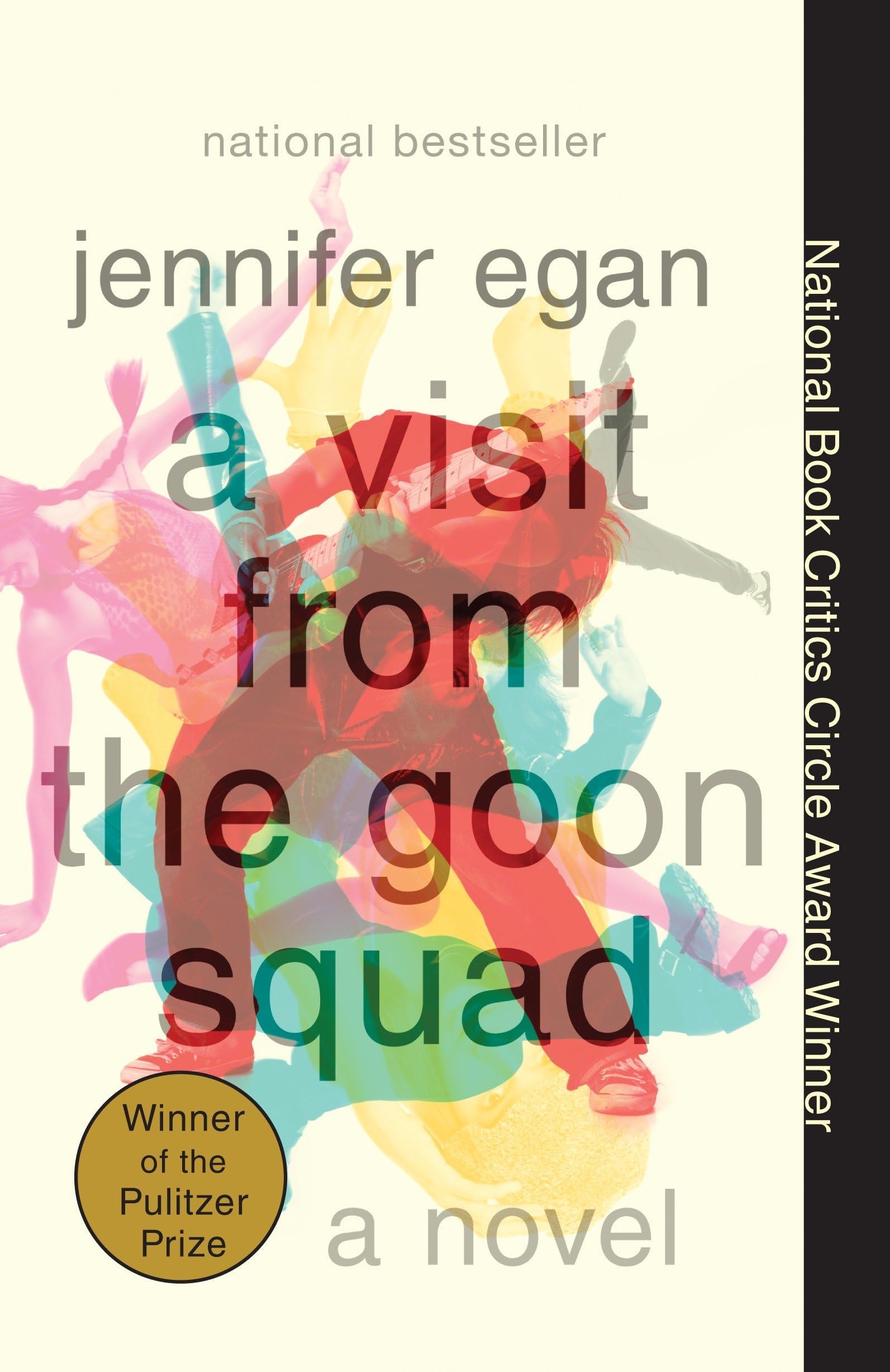
A Visit from the Goon Squad: Pulitzer Prize Winner
Product ID: 4315618
🏆Pulitzer Prize-winning literary excellence
📅Published 2011 with timeless cultural relevance
📚352 pages of immersive storytelling
Desertcart purchases this item on your behalf and handles shipping, customs, and support to Argentina.
🏆 Pulitzer-Winning Storytelling Meets Digital-Age Innovation — Don’t Miss the Future of Fiction!
A Visit from the Goon Squad by Jennifer Egan is a 352-page Pulitzer Prize-winning novel published in 2011, celebrated for its innovative narrative that blends traditional prose with PowerPoint and text messaging formats. This critically acclaimed bestseller explores themes of self-destruction, redemption, and the pulse of music culture through a diverse cast of interconnected characters. Perfectly suited for the modern reader, this illustrated paperback edition offers a fresh, culturally relevant literary experience that resonates with the digital generation.


| Best Sellers Rank | #7,592 in Books ( See Top 100 in Books ) #66 in Short Stories (Books) #184 in Coming of Age Fiction (Books) #318 in Psychological Fiction (Books) |
| Customer Reviews | 4.0 out of 5 stars 12,914 Reviews |
H**D
Impulse Control, Mish Mash and Cutting Edge
The first three chapters of this novel were short stories published in the New Yorker. Rather than excerpts from a novel-in-progress, it seems they are previously written stories inserted into a new novel. By the time we're at Chapter 3 on an African safari we're miles and decades away from the protagonist, Sasha, in the first story/chapter, and she doesn't return for the next 100 pages. This is one of the problems with "A Visit from the Goon Squad". The novel's point of view is not impressionistic so much as all over the place: authorial, first person, many third persons, second person, in and out, kaleidoscopic. This style could be viewed as edgy... or poorly constructed. Since a novel is shaped differently than a short story, inserting stories into the longer prose narrative doesn't work. It reads like a cascade of characters and odd behaviors. The lack of continuity is tiresome and all Egan's brilliant cynicism and social satire and emotional damage are sometimes simply painful. A central theme in the book is lack of impulse control, from which many of the characters suffer, some with ruinous results. But why or how is never developed. Sudden redemptions seem contrived and sentimental. The result is an absence---of deepening feeling for any character, and an absence of a protagonist or story arc whose development might move us. Even so the book is sometimes compelling because of the unique characters and their oddities and Egan's savvy, digital-age perspective on behavior and culture. And there are encapsulated moments of story which draw one in. But as a novel, it doesn't build or hold up as a whole experience. Too fragmented. For the first 175 pages, that is---it reads like a failed novel. Then it bursts into a new form that is exciting. The encapsulated moments of story are told in Power Point form, complete with bullets and arrows and shaded text boxes. It works! And is surprisingly affecting. This new format captures the changing, chaotic feelings of the four characters in this section in the way that the linear cascade of characters in the preceding prose did not. It's significant, though, that this Power Point part of the story is told from one character's point of view which solidifies and builds the emotional content. Finally the novel becomes a linear story with an arc; that is, the content is finally told from a consistent point of view and builds in a traditional novelistic fashion, even though the text on the page has visually become digital-age scattershot. It feels affecting and brilliant. Also this last third of the book takes place in the future which gives added weight to the Power Point style, making it seem more probable than gimmicky in a "the medium is the message" way. Where it fails is in descriptive passages; the text box approach totally lacks the lyricism necessary for affecting natural description. Actual photos would have been more appropriate to complete the Power Point style and to deepen the content. If the whole novel had been told in Power Point without photos it might have read like one of those teenage cell phone novels. Perhaps all the preceding chapters of "old-fashioned" prose created a foundation for the Power Point section to work as well as it did. The biggest problem with the book is the insertion of Chapters 2 and 3, Egan's formerly published short stories, which seem to serve only the purpose of padding the length. Chapter 3 was totally irrelevant to the story. Also, there is an irony in the old-fashioned elements in Egan's experimentation. A 1960s Marshall McCluhan concept is central to Egan's 2010 style in the Power Point section. And overall, this is a "novel of ideas", a 19th century type of book, complete with an underlying morality and a tidying of loose ends. And it is sometimes dry and contrived as such novels are. On the positive side, however, Egan may be a visionary and Power Point and Cell Phone novels will be the future of the form. Just as it's impossibly boring to read Flaubert's three-page description of a ball gown in "A Sentimental Education" now that TV has made the image familiar in a nanosecond to all social classes; reading a 20th century novel may be impossibly boring to the internet-bred generations growing up now. Egan addresses this with skill and imagination in her last futuristic chapters. Despite and because of its problems, Egan's experiment is an exceptional read.
R**E
Cultural Anthropology
I enjoyed this Pulitzer prizewinning book a lot for the brilliance of its writing, but I am clearly not in its target demographic. For about half of it, actually, it was more like a study in Cultural Anthropology. I felt I was reading about a tribe, perhaps even a species, of people that I have no knowledge of whatsoever. But equally clearly, this is a book written by an expert, and expertise is always fascinating. The book jacket says something about music pulsing on every page, but to me (old-school classical musician that I am) it comes across as more like a background noise that I wish somebody would turn off. Egan's view inside the rock industry is as foreign to me as if she were describing New Guinea tribal dances, but it is entirely convincing. Despite the word "novel" on the cover, this is essentially a collection of short stories, and Egan is a brilliant story writer. She has the knack of plunging you immediately into a situation, whether a women's restroom in New York, a safari camp in Africa, a snotty country club in some alternative Scarsdale, or the meaner streets of Naples. Even if you don't empathize with her characters, you do get involved with what happens to them, and time and again Egan adds some marvelously unexpected twists that reveal depths in what you might have previously dismissed as merely shallow. Although writing about a world which is pretty much amoral, Egan is herself a moral writer, and each time she shows this she catches you with welcome surprise. The main problem I have is that the stories do not add up to a novel. Yes, the characters introduced in the first two chapters -- the rock producer Bennie and his assistant Sasha -- have no more than one or two degrees of separation from those in subsequent stories, which go way back and eventually forward in time. Yes, Egan plants little interconnecting clues throughout. But because I never feel I know these people, I find it hard to care about them beyond the span of each individual story. There are a few instances when Egan will flash forward twenty years or so towards the end of a chapter; I find these quite moving, and they show that even dropouts and druggies grow up. But I don't see that arch in the novel as a whole. Perhaps I would have had more sense of completion had the last two stories been written in a more normal style. But the notorious penultimate chapter is entirely in PowerPoint, which gives facts with almost none of the emotional context (which may be the point), and the final one relies so heavily on text messaging it might almost be in a different language. All the same, Jennifer Egan does have talent, no doubt about it!
L**I
I'd call it a "View" from the Goon Squad
This is not a book to take lightly. Once you start, you need to keep with it and here's why: The structure of the novel is like a crap shoot. Take two, three, four die and put the name of Sasha on some and the name of Bennie on the others. Then roll. Each number that comes up constitutes a chapter and a different character that has in some way been in contact with (however remotely) Sasha and or Bennie. So, the "novel" really is a set of short stories that could stand on their own but don't because of the Sasha, Bennie connection. The other issue is that the novel jumps back and forth in time (over about a 40 year span) and voices change, its 1st person, then 2nd person, then 3rd. So, pay attention. The good news about the novel is that the some of the "short" stories are very good. Here's the premise. Most of the people that populate this book are in some way connected to underground or punk rock music. Bennie is a punk rocker and Sasha is an aficionado. She ends up working for Bennie when he hits it big with his group (he, as producer), the Conduits. But, you see, Sasha has a problem. She's a kleptomaniac. But it's not the THINGS she desires. It's the actual act of the stealing. We have another story line of a music producer who already has had two wives and 4 kids and now takes a potential third wife on a safari with his two older children. The story is told from the view point of female lover and the daughter. Some of these stories are quite funny and others downright melancholy. Stories of drug addiction, celebrity (think any young starlit that has gotten herself in trouble), suicide, family life, pauses in songs via a power point presentation, annoyances, longing, and life beginning at "A" point, ending at "B" point and then the "A to B" point. The one in particular that I found amusing but I suppose I shouldn't have is the story of Dolly who was once the best when it came to publicity. But she has a disastrous party which kicks her out of the limelight and is forced to do publicity for murderous dictators (which showcases the now aged 28 year old starlit). One of the things that vexed me at first is that when Egan is in the middle of a story involving a character, she then proceeds to tell you the character's life outcome. In a few short words, you find out the "B" point of that person. But then as you progress through the book, you realize that you need this because you may not see that character again. The final story I found to be one of the least effective. It's about "A" meeting "B". Bennie, who is now down and out, has talked one of his "has been" protégés into doing a big comeback. But, we are now in the future and babies are called "pointers" and discussions mostly take place on "handsets" that can just about do anything. The texting is texting on steroids. It is a story that does not do justice to the rest of the book. I felt lost. As far as the title goes, the definition of goon is lout, lummox, oaf, stumblebum, oaf, or clod. I think, and of course it's only my opinion, but I believe that is the way she sees people living their lives. They're stumbling, fumbling their way through life because they sure don't know what the "B" point is. It seems to me that Egan was trying to please two audiences at one time: the Pulitzer committee (or literati) with her varied techniques, multilayered stories, etc. But at the same time, she has written some stories that any everyday reader might enjoy. If you want a mental challenge, pick this book up. It did win the Pulitzer Prize...whatever that might mean to you...To me? It's a crap shoot...
S**E
Q: When is a science fiction story not a science fiction story? A: When it wins the Pulitzer
What's that you say? Goon Squad ain't science fiction? Science fiction has to have aliens. I suppose you're right. It certainly helps. What if your story predicts the future but has no aliens? Or faster than light space travel? Or brain uploads? Well, then your science fiction wins a Pulitzer. I jest, of course. No one in their right might would limit Goon Squad to the sf ghetto. It has so much more going on in it. But with all the time slipping and fast forwarding and past wallowing, it feels somewhat science fictional. Time is very important in this story. The titular "goon squad" refers to the vicissitudes of time. And time is a component of any futuristic, i.e. science fiction story. So the case could be made. Is this book a time travel story? Not in the Wellsian sense. Time travel is not invented here. It is not discussed or used by the characters. But the reader travels through time. Backwards and forwards and we get to see the future. Goon Squad is a mosaic novel. I know that because I just picked up that term over at Interstitial Arts where they've got an essay on the topic. What makes this book a mosaic is that each chapter is a short story in and of itself. One chapter was in fact published as a stand-alone last year in some lit mag, so there you go. Each little story has an arc and a main character. Each contributes to the main story arc but lives its own little life and its own little moment. By moment I mean point in time. It could be an hour, a day, a week, or even several months. All the moments together cover a time span of probably thirty or forty years. Day one takes place at the birth of punk in the 80s. Of course Day One does not happen at the beginning of the book. The beginning of the book is Sasha's story which takes place about half-way through the novel's time frame. Sasha talks about her boss Bennie (a pop music mogul), her problem (kleptomania), and her date (guy by the name of Alex). In Sasha's moment she has just stolen a wallet out of a purse sitting on the floor of a restroom in a restaurant where Sasha and Alex are having their date. The woman whose wallet she has stolen panics and begs the other patrons to help her look for it. Stricken with guilt Sasha goes off to search and "finds" it back in the restroom. Sasha's moment is one of redemption. One of the few in the book. The finale occurs years later after Sasha has been fired from Bennie's operation for stealing, after Bennie's been fired from the operation for losing his touch, and Alex has dumped his own musical career. It is now Alex's moment. In an odd turn of events, he has met up with Bennie years after Sasha's moment. Bennie is attempting to make a comeback with his old friend Scotty -- a has been guitarist. Bennie and Alex no longer know where Sasha is. Alex barely remembers her name. We do not feel bad. Not because we didn't like Sasha, but the novel isn't just about her. It's about many people and how their lives intersect briefly with each other. At the novel's end, when we see Bennie and Alex discussing Sasha, we don't feel cheated that we're not actually seeing her again because her moment has passed and she's moved on in her life. As should we all. About a third of the way through the book, I thought I detected the usual flaw in multiple viewpoint stories: there's no one to identify with. Reading on, though, I realized that that is the strength of the book. Each story immerses us in one character's world. For that moment, the viewpoint is correct. When you switch to a new character you abandon the old one. You come back to that character eventually, but only peripherally. You're never again as cozy with them. It's like visiting a childhood friend as an adult, someone you haven't seen since you were a kid. You are tentative. You're not sure you want to be as close as you were before. Do you really want someone to remind you of your nerdiness? What about the pain you experienced when you said goodbye all those years ago? Do you really want to go through that again? The book is mired in tragedy. Characters are victims of their past: early encounters with fame, or other powerful effects. More than that, though, coursing through the story is the ever present goon squad. Time changes everything including our belief in ourself, our future, and the things we hold as beautiful. The tragedy is life itself. It's not all dark mood, though. The story has its moments of beauty as well. For instance, when Sasha, our kleptomaniac, devises a way to steal the sun. She is alone in Naples, friendless, moneyless, directionless. She gets by by stealing. It's obnoxious, especially when she steals from her own uncle. He goes looking for her (and his wallet), and finds her in a bare room. He sees the bleakness but also notices she has a wire bent into a circle hanging in the window. As the Neopolitan sun moves across the sky, it fits in the center of the wire ring. "See," Sasha mutters, eyeing the sun. "It's mine." The scene makes you cry. And then there's humor when the book heads into science fiction towards the end. The characters have made it through to the future world of pop music. Finally we get to see where we're all headed. What's it look like? Well, hit songs will not just sound like they were chosen by two-year-olds as they are now. In the future they actually will be chosen by two-year-olds. The children will be called "pointers" because when they hear a song they like, they point to the ipod or whatever it is that's playing the music. Once a pointer has chosen a song, millions of dollars are spent promoting it and what do you know, it becomes a hit. So cynical. So hiliarious. More important and subtle is the depiction of how future online behavior is going to change. Everyone in the future Internetworld will be polite. No one will express a strong opinion. Humans will make their very non-private online lives private by keeping their personal beliefs to themselves. Gone will be the flame wars of today. The homogenization of opinion will be a result of our slow realization that whatever we do and say is being recorded, archived, and available. If you don't think this is a reasonable extrapolation, consider your own personal moment when you've come across a diatribe of yours from a few years, months, or days ago. Tell me you haven't learned to bite your tongue. The ending scene is priceless. Alex has thousands of online friends so Bennie hires him to create a viral campaign for Scotty. Using information on the likes and personalities of his friends, Alex knows who should be targeted and how to create a buzz before Scotty's first concert. It works. Scotty is an overnight success created by the smart use of social media. The number one reason why they love Scotty so much? He's so honest and he never sold out. Actually that is true. Scotty never did sell out, but his people did. So the goon squad comes and goes. You can't hide but you know what? You'll survive. Just like real life. And without the help of aliens. - reviewed by Sue Lange, author We, Robots
C**P
Is Fine Art Overrated?
It’s hard to review this book without considering that it won the Pulitzer prize. In some ways, the Pulitzer is a double-edged sword. It’s prestigious and it boosts sales. But it also creates in readers certain expectations. And when these expectations are not met, readers lash out, as indicated by some of the negative comments in the most critical reviews on this site. Egan is a great writer and I give this book 4 stars, mainly for the excellent prose. Although this is not the first novel of interrelated short stories, it’s certainly innovative, has some interesting characters and stories, and is thought-provoking to a certain extent. That said, I too had issues that would have been less remarkable had the novel not won the Pulitzer. My favorite chapter involves a down on his luck musician paying a visit to a successful music producer. Years ago, the two were in a punk band together. “And behind Bennie’s smile the fear was still there: that I’d tracked him down to snatch away these gifts life had shoveled upon him, wipe them out in a few emphatic seconds. This made me want to scream with laughter: Hey “buddy,” don’t you get it? There’s nothing you have that I don’t have!.... But two thoughts distracted me as I stood there, smelling Bennie’s fear: (1) I didn’t have what Bennie had. (2) He was right.” And there are impressive descriptive passages throughout the novel: “Ted began to walk, still dazed, until he found himself among a skein of backstreets so narrow they felt dark. He passed churches blistered with grime, moldering palazzi whose squalid interiors leaked sounds of wailing cats and children.” “I’ve never seen San Francisco from so high up: it’s a soft blue-black, with colored lights and fog like gray smoke. Long piers reach out into the flat dark bay.” The writing is beyond reproach. As for my “issues,” in one chapter, an actress is hired by a PR consultant to help with the image of a genocidal dictator who resembles Idi Amin. It’s a little quirky, but I’m ok with it. Until the actress travels to the country in question and actually confronts the genocidal dictator by asking: “is this where you bury the bodies?.....or do you burn them first?” Not realistic and doesn’t work as satire either. I found it plain weird. Then there is the man who reflects on a date with a woman 15 years in the past and cannot recall whether or not they had sexual relations. What?! Men tend to remember details like that. In another chapter, a man travels to Africa with his daughter and girlfriend who are about the same age. It’s a strong chapter with many interesting characters and interpersonal/family dynamics. We are told early on that the man “is a record producer whose personal life is of general interest, those near enough to hear are listening closely.” Really? Last I checked, music producers are not celebrities. (Even when the Beatles were at the height of their fame, how many people would recognize George Martin walking down the street, let alone care about his personal life?) Now these are admittedly minor flaws in a complex and ambitious novel, but for me they stuck out. A bigger issue is the phrase “time’s a goon.” It comes up more than once in the book. And is uttered by different characters. If it had only been said once and by one character, the reader could interpret it as the author’s clever/literary way of letting the reader know that the character saying it is a nut job. But since the phrase is repeated and referenced in the title, this strongly suggests that the author was going for something bigger. I’m going to be blunt and say what I suspect many other readers privately thought but were too polite to say: “Tme’s a goon” is dumb. (It even sounds dumb.) Moreover, when subject to serious analysis, it doesn’t hold up. Someone can be beaten up by a goon (or even a goon squad) and make a full recovery. However, we do not recover from the ravages of time. There may very well be many readers, critics, and members of the Pulitzer committee who disagree and thought “Time’s a goon” is brilliant, the greatest line in literature since “time is the fire in which we burn.” But somehow I don’t think so. The Delmore Schwartz line above was used effectively in the movie “Star Trek Generations.” A deranged scientist named Tolian Soran (portrayed by Malcolm McDowell) says to Captain Picard (portrayed by Patrick Stewart) early in the film, “they say time is the fire in which we burn.” Imagine how Soran would have reacted if Picard had replied: “You’re wrong, doctor. Time is a goon.” I suspect Soran’s reaction would have been an expression of bewilderment mixed with anger followed by rage and then physical violence. When the novel came out, there was some speculation that the title was a reference to the Elvis Costello song “Goon Squad,” featured on the 1979 album Armed Forces. My understanding is this was pure coincidence. But it got me thinking. What is a better contribution to art? Jennifer Egan’s Pulitzer-prize-winning work of literary fiction A Visit From the Goon Squad or Elvis Costello’s rock album Armed Forces, which in addition to “Goon Squad” contains other gems such as “Accidents Will Happen,” “Oliver’s Army,” and “Green Shirt.” If we consider creative use of the English language for purposes of storytelling, I’ll give it to Egan. On the other hand, if we consider originality, wit, passion, combined with the ability to create something memorable that moves people, it’s Elvis Costello hands down. And I have a tough time wrapping my head around that. It raises an interesting question: is fine art overrated? If this book had not won the Pulitzer, I wouldn’t be so critical of what I consider its shortcomings. I would simply say: This is a good book. Not without flaws to be sure, but innovative, interesting, challenging, ambitious, thought-provoking, and extremely well written.
J**E
A really great story about aging, art, time, and more - but leave your expectations at the door
Sometimes I wish that it was possible to erase your knowledge about a piece of media before you experienced it - that you could go in divorced from the hype or the praise or whatever else you were already aware of. Such is the case with Jennifer Egan’s A Visit from the Goon Squad, a Pulitzer Prize-winning novel that’s held up as one of the great books of the 21st century, because after all, what book could possibly live up to those expectations? And indeed, I can’t help but feel like my reaction to Goon Squad was shaped by those expectations, because while I enjoyed the book greatly, I never found myself bowled over it, and finished it with a sense that I was still waiting for something to click into place that turned it from a very good book to a great book. A series of short stories all orbiting around a music producer and his assistant, Goon Squad follows various characters backward and forward through time, seeing how small connections ripple out over time, watching how human relationships are shaped at different ages and in different eras, and helping us see how people evolve during their lives. (If you’re going to say “hey, Josh, maybe you were harsh on this because it sounds like it’s in David Mitchell territory and you love David Mitchell so much,” you’re probably not wrong, especially since my beloved Cloud Atlas came first (and did some of this better, in my opinion).) Egan writes wonderfully, and the range of stories here is great - there’s a blackly comic story about war criminals and public relations, a quietly heartbreaking about a closeted gay man at the end of his rope, and yes, the famous one that’s told entirely through PowerPoint slides (which works really well, even if I’m never quite sure that the gimmick fits the story). I liked Goon Squad a lot, don’t get me wrong; I think it’s a really good book, and one that I think is sharp, clever, well-crafted, and imaginative. (To say nothing of how eerily on track her predictions of the future turned out to be.) It just can’t help but pale in comparison to its reputation and praise - but what could, really?
F**N
Ehh
This is the second novel that I have read by Egan. The other, Look at Me, was, disappointingly, a disappointment to me. I wanted so badly to like it, as I had been told by a professor for whom I hold much respect that it was one of his favorite books. I was expecting perfection, and instead I read a book that surprisingly underwhelmed me with its many overwhelming, and in my opinion, unnecessary preoccupations. Goon Squad was my “Take 2” with Egan, and again, I must confess that I was not taken by the novel. I appreciated many aspects. Egan effortlessly switches perspectives throughout the novel, and connects characters that span through decades. Her story follows many characters, in their pasts and their presents, as they interact with the music business. The time jumps were well constructed, and Egan included Easter egg hints throughout the novel that clued me into connections between separate characters. The writing itself is very strong, and I found one section, told in the second person, to be incredibly well written and interesting. That said, it was too much for me. There was so much jumping around, so much switching of characters, I felt unable to connect to anything in the novel. I often had to read back through chapters to make sense of how some characters were connected. Perhaps, I was put off because I was trying to read the work as a novel, when it seemed more to me like a collection of short stories. And although I found that the time jumps/character switches were an interesting authorial decision, there were moments that I found myself confused with what I was reading. Perhaps, that was due to the fact that the story is grounded by music, rather than by a storyline. I appreciate the stylistic choices of the writer. There is a chapter told solely through a PowerPoint presentation. It’s an innovative, and surprisingly successful, authorial choice; I felt that I was able to gain a lot of information, and make sense of that information, easily. I am not sure that I can say the same of the story itself. I cannot say that I liked nor disliked the novel. If anything, the only thing it made me feel was indifference. I was unable to connect with the characters; I neither liked them nor disliked them. I didn’t feel inclined to finish the novel, nor did I feel inclined to put it down. If I can put how I felt in one word, it would be “ehh.” I’m walking away from this book with more authorial respect for Egan than I had after reading Look at Me. Both of these books are critically acclaimed, and both have won numerous literary prizes. Her work is doing something right. It's just not doing anything right for me.
H**R
Pulitzer pop art: time is a goon
How should one choose what one reads? I am following an eclectic regime dictated by my old favorites and by recommendations from amazon friends (though they don't exist anymore). Sometimes I add an award winner, say a Man Booker or a Pulitzer or a National Book Award winner. That approach is not always rewarding. Case in point is this 2011 Pulitzer winner. Interesting, amusing, but in a flat way. No really interesting people in it. No really great language either. Hardly a novel, more like stories linked by their cast. Some in NY, some post 9-11, some elsewhere at other times, some in different styles. The main characters of each story appear as supporting cast in other chapters. Good overall plotting can't replace interesting contents though. This is competent but meaningless. While one might enjoy reading it, one will surely not remember a word of it next year. And the stories, even if they deal with tragic things, they are still fluff. But if I don't read it, how do I know it is fluff? The book has just been published in Germany and has received a rave review from Die Zeit. Hm. What is it about? Mostly about pop music and pop musicians, and the related subculture. We learn about a kleptomaniac, her shrink sessions, and a particular adventure when her one night stand inadvertently nearly makes her get caught for lifting a wallet from a woman in the ladies' washroom. Or about a manager of a record label who suffers from a loss of sex drive, who wonders if that loss is not a good thing. He also has a need to divulge, and a penchant for betrayal bonding when out with his son. Or about a punk band in SF in the late 70s, groupies included. The usual about drugs and teenage sex and so on. About an LA record producer on safari in Africa with kids and girlfriend. The usual about messy families. Kids grow up, they fail or succeed, they kill themselves or become addicts or both, they visit their dying elders in hospital or not... Or about a PR agent who represents a foreign dictator, trying to brighten his image, but her plans seem to take a bad turn. Or about a celebrity reporter who is overwhelmed by his attractive interviewee and tries to rape her. And some more. And then the insult of chapter 12: it is told in PowerPoint charts. I refuse to read this as a matter of principle. I have to use this silly software all the time. I do think, actually, that it makes us stupider by making work easier. The first really interesting chapter comes half into the novel, the 7th of 13, when the not quite convincingly Caucasian record label manager moves to an upper class NY suburb and gets implicitly suspected as terror network operative. Is that enough for raving? Maybe for a move from 3 to 4 stars. There are other post 9-11 observations strewn over various chapters, which do add some substance to pure pop. I get the impression that this is a smart writer who could have done better. Not a stupid book, but a limited choice of subject. And I will not need a whole year to forget it. 3 and a half stars.
K**T
Fascinating narration
This is a novel in 13 chapters, each of which forms its own short story. It deals with people in the music industry, most notably a woman called Sasha and her boss Benny Salazar. It spans a period of some 40 to 50 years, from the 1970s to the 2020s or 2030s - so, obviously, some of it is set in the future. As I began reading, I grew fond of the character the first chapter centers on, Sasha, who works in the music industry and is struggling with her kleptomania. Going on reading, I found that none of the other chapters took up her perspective again. I find this a difficult thing to deal with when I am reading a novel: I hate getting to know a character, beginning to feel for them and their conflicts, and then see them completely abandoned in later chapters. So, some pages into chapter 3 or 4, I found myself getting impatient, even angry at the author. I decided to give the book the benefit of the doubt (after all, it's a Pulitzer Prize winner!) and continued. And I found myself rewarded. This book gets better with every chapter. While each of them tells the story from a different point of view, they all blend together and tell a fascinating story about people and their lives. We begin to learn more about Sasha - her adolescence, her experiences as a lost young woman, her way towards a little more happiness... We also learn more about the other characters and get to see what happens to them, where they came from etc. The novel grew thus more and more fascinating the more I kept reading. Egan even dares to tell one of the chapters as a "slideshow diary" and it works. Time and its passing are an important topic - the novel's title is somewhat illuminated by the statement of one of the characters that "time is a goon" as well as the characters personal development over these years, their loss of youth, their way to - if not happiness - a feeling of contentment. If you like an experimental narrative structure and if you enjoy to follow characters' development over time, this will be a rewarding read.
F**.
Trame intrecciate e tanti personaggi
Libro di trame intrecciate e salti temporali. Ci sono tanti personaggi legati l'un l'altro che possono anche avere piu' di un pezzo loro dedicato. Direi che tra i temi centrali c'e' la produzione della musica, ma c'e' tanto altro, anche parti umoristiche. I personaggi non sono mia banali.
A**Y
one of the best books of the century
This is one of the best books I have read. It is a masterpiece. She doesn't get the credit she deserves. Her writing is magical, tough, characters are brilliantly drawn and she captures the craziness of life. All in one.
J**S
Gran libro
Excelentye
A**A
fantastico
Complexo, deliciosamente bem escrito. Te leva para situações tão especificas que ao mesmo tendo se desdobram em realidades mundanas. Amei. Definitivamente foi reler
Trustpilot
1 day ago
2 months ago