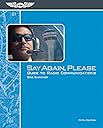
Say Again, Please: Guide to Radio Communications
Product ID: 4176861
Desertcart purchases this item on your behalf and handles shipping, customs, and support to Argentina.
Talking on an aviation radio and understanding air traffic control instructions can be one of the most intimidating aspects of flight training. Bob Gardner's "Say Again, Please" teaches readers what to say, what to expect to hear, and how to interpret and react to clearances and instructions, while detailing the airspace system and explaining how the ATC system works. This new Fifth Edition has been expanded and updated throughout to reflect current FAA rules and operating procedures. Chapters in the book cover communication etiquette and rules, understanding radio equipment, emergency situations, and both VFR and IFR communications and clearances. Also included: a concise summary of the FAA's communication facilities and their functions, airspace classifications and definitions, and the FAA's recommended shorthand for copying clearances. The communication requirements for entering, departing, and transiting each class of airspace is explained in detail by following along with the author on "simulated" flights. A full-color sectional excerpt, in an attached fold-out format, is provided for the example flights so readers can review the map while reading the explanation for flying and talking in each area. Readers will learn everything they need to communicate effectively in VFR, IFR, and emergency conditions. The example foldout sectional chart is in full color and is also used for example flights discussed throughout the book. Bob Gardner's conversational-yet-concise writing style in his approach to aviation communications will help increase your comfort level when using an aircraft radio. The book features "talk" examples of typical radio transmissions that explain how the air traffic control system works, as well as present simulated flights that clearly demonstrate correct communication procedures in each class of airspace. This hands-on book covers the following: --The ABCs of communicating --Understanding radio equipment --Communication etiquette and rules --VFR, IFR, and emergency communication procedures --Air traffic control facilities and their functions --Review of airspace definitions --Glossary of pilot/controller communication terms and phrases Let "Say Again, Please" help you learn how to communicate in the air. Review: recommended purchase - I was always comfortable speaking with ATC, but on occassions I found myself stuck for the right words or confused by listening to too many words. What I needed was more exposure to a broader range of ATC expressions, a script if you would like. I found what I was looking for in several books but opted to purchase this one after reviewing it in the local bookstore. I found this book to have very clear walkthroughs of each situation you can expect to encounter. It covered each class of airspace and talking to other sources such as FSS, Weather briefers, etc and I found this extra information to be invaluable. This book is especially useful to me whenever I review a flight I am about to make and wish to clarify what I can expect to be hearing at unfamiliar airports. It helps me to walkthrough and review the challenges ahead of me, and improves my own confidence dramatically. I've found this a great help in managing the energy I'm spending on flying the airplane, as opposed to thinking about what it is I want to say. There are also many great tips in this book, some of which I have not seen covered elsewhere or heard from an instructor yet have helped me understand why we say things in a certain way and when it's perhaps better to deviate from recommendations and work with ATC for better results. This is probably a cheaper and handier alternative to communication simulations software. I thought about getting such software just so I could practice each scenario and I am sure there are benefits in doing that but I'm glad I spent less money on this book instead. I don't think that software would have offered much more than the book and the cost savings make this a more economical purchase. The cost difference is an hours flying and I know what I'd rather do. This book was more than good enough. This is a very handy book for student and low hours pilots to have. I'm sure as I gain more experience I'll probably continue to use this as reference. Review: The best book I've found for learning about airspaces - I'm pursuing a PPL under part 61 so I'm basically building my own ground school curriculum from books here at desertcart. The various FAA books are good, and cover the basics, but in terms of putting it all together in terms of what you do when flying through the different classes of airspace this is the best book I've found. Not only does it cover the radio communications itself (and cover it rather well), it covers the rules changes a bit in different airspaces and is the best resource I've found so far for decoding sectional charts actually. If you're even considering getting this book just do it. I've read through it 3 times already and every time I learn something. Buy this book, a sectional chart for your area, and sit down with a cup of coffee and you'll figure it all out yourself. With all of that said, the author could really beef it up for a new edition if he wanted to. If I were the author I'd include color scans of sectional charts in each chapter, showing what the airspaces actually look like on the charts. Also I'd add a bit more to differentiate the different types of radio centers you talk to. He does describe them in the text, and includes an appendix which repeats the same information, but it just doesn't quite "gel" in terms of what each one is the way it should. Still an awesome book.

| Best Sellers Rank | #251,433 in Books ( See Top 100 in Books ) #157 in Piloting & Flight Instruction |
| Customer Reviews | 4.6 out of 5 stars 301 Reviews |
M**E
recommended purchase
I was always comfortable speaking with ATC, but on occassions I found myself stuck for the right words or confused by listening to too many words. What I needed was more exposure to a broader range of ATC expressions, a script if you would like. I found what I was looking for in several books but opted to purchase this one after reviewing it in the local bookstore. I found this book to have very clear walkthroughs of each situation you can expect to encounter. It covered each class of airspace and talking to other sources such as FSS, Weather briefers, etc and I found this extra information to be invaluable. This book is especially useful to me whenever I review a flight I am about to make and wish to clarify what I can expect to be hearing at unfamiliar airports. It helps me to walkthrough and review the challenges ahead of me, and improves my own confidence dramatically. I've found this a great help in managing the energy I'm spending on flying the airplane, as opposed to thinking about what it is I want to say. There are also many great tips in this book, some of which I have not seen covered elsewhere or heard from an instructor yet have helped me understand why we say things in a certain way and when it's perhaps better to deviate from recommendations and work with ATC for better results. This is probably a cheaper and handier alternative to communication simulations software. I thought about getting such software just so I could practice each scenario and I am sure there are benefits in doing that but I'm glad I spent less money on this book instead. I don't think that software would have offered much more than the book and the cost savings make this a more economical purchase. The cost difference is an hours flying and I know what I'd rather do. This book was more than good enough. This is a very handy book for student and low hours pilots to have. I'm sure as I gain more experience I'll probably continue to use this as reference.
D**D
The best book I've found for learning about airspaces
I'm pursuing a PPL under part 61 so I'm basically building my own ground school curriculum from books here at Amazon. The various FAA books are good, and cover the basics, but in terms of putting it all together in terms of what you do when flying through the different classes of airspace this is the best book I've found. Not only does it cover the radio communications itself (and cover it rather well), it covers the rules changes a bit in different airspaces and is the best resource I've found so far for decoding sectional charts actually. If you're even considering getting this book just do it. I've read through it 3 times already and every time I learn something. Buy this book, a sectional chart for your area, and sit down with a cup of coffee and you'll figure it all out yourself. With all of that said, the author could really beef it up for a new edition if he wanted to. If I were the author I'd include color scans of sectional charts in each chapter, showing what the airspaces actually look like on the charts. Also I'd add a bit more to differentiate the different types of radio centers you talk to. He does describe them in the text, and includes an appendix which repeats the same information, but it just doesn't quite "gel" in terms of what each one is the way it should. Still an awesome book.
W**O
Useful for newbie working on the PPL
This book gives practical examples on how to talk flying VFR under various conditions. It is quite good. I fly through class B now with no issues talking on the fly. The only reason I give it 4 stars is that it can be better organized. It's organized by airspace, but it mixes other topics within those chapters. I think it would be better to organize by scenarios so its easier to look up.when you want to review.
A**F
Excellent and recommended
As a student pilot with under 15 hours as I write this, talking to the tower, and especially responding to complex instructions is unnerving to the point that a few times I told the instructor to reply instead. This book takes the guesses and uncertainty off of it. It explains in clear and concise language and examples how the system operates, what to do and what to say and what not to say. When to challenge the controller, and when and how to ask for help. Recommended!
E**A
Just as described and fast shipping
Just as described. Will shop with this seller again.
F**R
Comprehensive Product
As a private pilot that has been out of the game for a few years, this book provides a variety of scenarios (with sectional maps) and the proper responses to them. It was a helpful review and would also be an excellent learning tool for the young flier. If you can find it for a good price it is worth grabbing if even for a quick review before a cross country trip.
K**T
Hugely useful, not only as a guide to proper communication ...
Hugely useful, not only as a guide to proper communication technique, but also as a practical tour through the airspace system. Maybe most importantly, the presentation helps the reader understand that ATC is there for the pilot, that we should use it and if we aren't perfect, it's ok, we're not stupid or bad pilots. This book helped me reduce my stage fright by a large factor. Best buy I've made in a long time.
F**O
Really good. Needs minor updates.
Keeps referring to the Chart Supplement as the Airport/ Facility Directory. A little annoying that they couldn't make such a simple change. Otherwise the book is excellent. It's really clear and has great examples and references. I also fly in the NW, like the author, so having first hand experience of some of the places and examples he talks about is nice too.
E**N
Five Stars
Very good .
C**S
Buena ayuda
Libro con introducción a la comunicación aérea en ingles, tienes que tener una base para entenderlo, pero si gozas de ella te puede ser de gran ayuda para darte una idea como se tienen que hacer.
D**S
Still looking for a better source.
Not really useful for learning radio communications in Europe. There are some differences in the procedures so it gets a little confusing for a beginner. Also some examples use phraseology that shouldnt be used, for example: ”Cessna 1357X ready for takeoff”. Every other source I’ve read advices against using ”take off” unless reading back a clearance from the ATC.
A**Z
Good in general
Good in general. However, it is to USA focussed and all the examples are referred to US. Also some phraseology and some procedures are FAA and not compatible with European aviation rules.
A**R
Perfecto
Muy bien para examen de inglés
Trustpilot
3 weeks ago
2 months ago