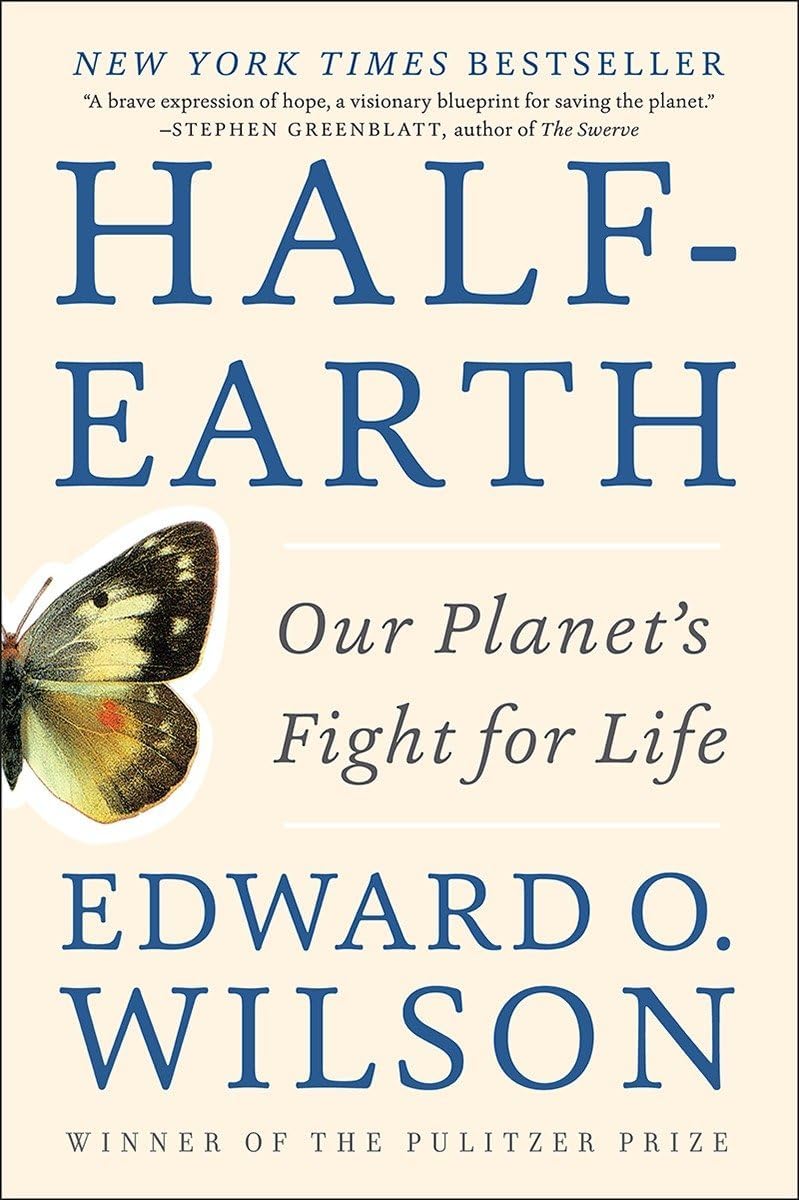
Half-Earth
Product ID: 40861100
Buy anything from 5,000+ international stores. One checkout price. No surprise fees. Join 2M+ shoppers on Desertcart.
Desertcart purchases this item on your behalf and handles shipping, customs, and support to Argentina.
Buy Half-Earth on desertcart.com ✓ FREE SHIPPING on qualified orders Review: A great, well-written book with wonderful ideas to save our planet. - E. O. Wilson was an incredible biologist and conservationist, a specialist in ants (but of so much more) and chair of the Harvard biology department for many years. He was a prolific and readable author, putting otherwise complicated biological facts into text readable by the layman. The Earth is losing far too many species to habitat loss and climate change at lightning speed, in geological terms. He presents a number of ideas on how to slow this loss, and ways we can adapt our human behavior to be more aware and careful of our fellow travelers. The book is short and to the point. His death in December of 2021 was a loss for all humanity. Read the book! You'll be glad you did. Review: GETTING WHAT YOU GIVE UP - In a twelve-round heavy-weight professional boxing match, at the beginning of the twelfth round there is a bell and the referee motions the two fighters to the center of the ring to begin the final round of the contest. In the fight for life on the planet Earth, and according to a majority of noted scientists, we are in the twelfth round. And Pulitzer-winning biologist E. O. Wilson is the referee. For most of his life Wilson has been the scientific “voice in the wilderness” feeding us important information about hazards to the well-being of the planet and sending us warnings for how we humans are destroying ecosystem balance and how we may be impeding our own health, including “low blows.” In a book that I’m going to call “required reading” for everyone within the sound of my voice, Wilson discusses the premise that a huge variety of life-forms on Earth still remain largely unknown to science and that the species discovered and studied well enough to assess, notably the vertebrae animals and flowering plants, are declining in number at an accelerating rate—due almost entirely to human activity. In response to this premise, Wilson very succinctly states: “The global conservation movement has temporarily mitigated but hardly stopped the on-gong extinction of species. The rate of loss is instead accelerating. If biodiversity is to be returned to the baseline level of extinction that existed before the spread of humanity, and thus saved for future generations, the conservation effort must be raised to a new level. The only solution to the “Sixth Extinction” is to increase the area of inviolable natural reserves to half the surface of the Earth or greater. This expansion is favored by unplanned consequences of ongoing human population growth and movement and evolution of the economy now driven by the digital revolution. But it also requires a fundamental shift in moral reasoning concerning our relation to the living environment.” The hook-line phrase in the above paragraph is “increase the area of inviolable natural reserves (ie Wilderness designated land reserves) to HALF the surface of the Earth,” hence echoing the book’s title. Half of our planet saved as Wilderness or wildlands seems an awful lot given the shrinking size of the planet due to global markets, global population statistics and the internet and social media, but after reading Wilson’s compilation of facts and figures and prescient logic, one can only agree with his compassionate analysis and fears for the future of all species, including humans. His omniscient observations and study of species extinction hit hard and very close to home as he cites our own Great Smoky Mountains National Park as his primary referent example. “It is instructive to proceed to the Great Smoky Mountains National Park, one of the best-studied American reserves, and to reflect briefly on the breakdown of the numbers of known species in each group of organisms. The actual number of recorded species in the Park, especially when all suspected but still unrecorded transient species and microorganisms are added, has been estimated to lie between sixty thousand and eighty thousand,” says Wilson. Very impressive numbers, these are, and those of us living in these western North Carolina mountains are so lucky to be living in such a diverse neighborhood. Yet, we should be humbled by such numbers, or as Wilson goes on to say: “The wildlands (such as the Great Smoky Mountains National Park) and the bulk of Earth’s biodiversity protected within them are another world from the one humanity is throwing together pell-mell. What do we receive from them? The stabilization of the global environment they provide and their very existence are the gifts they give to us. We are their stewards, not their owners. These wildlands of the world are not art museums. They are not gardens to be arranged and tended for our delectation. They are not recreation centers or harborers of natural resources or sanatoriums or undeveloped sites of business opportunities.” Going further abroad, and contrary to national news sources, Wilson cites places such as the Middle East and that region’s problems of biodiversity sustainability. “In the Middle East, it is becoming clear that hatred and instability are not due so much to religious differences and the memories of historical injustice as they are to overpopulation and the severe shortage of arable lands and water.” As the saying goes “the devil is in the details” and Wilson’s layman-friendly book is full of scientific evidence to support his predictions as well as his solutions to this very real and urgent global crisis we all seem to be ignoring, at our own peril. Wilson is not alone with his convincing data and his dire predictions. Many esteemed scientists, economists, social scientists, artists and politicians world-wide agree with Wilson’s findings and predictions that we are, indeed, in the 12th round of this environmental prize-fight. And the prize? It is the very Earth itself and our continued existence upon it. Or as Wilson concludes in his ending chapter “The Solution”: “The pivotal conclusion to be drawn remains forever the same: by destroying most of the biosphere with archaic short-term methods, we are setting ourselves up for a self-inflicted disaster. Across eons the diversity of species has created ecosystems that provide a maximum level of stability. Climate changes and uncontrollable catastrophes from earthquakes, volcanic eruptions, and asteroid strikes have thrown nature off balance, but in relatively short geologic periods of time, the damage was repaired—due to the great variety and resilience of the life-forms on Earth. Finally, during the current Earth period, Earth’s shield of biodiversity is being shattered and the pieces are being thrown away. In its place is being inserted only the promise that all can be solved by human ingenuity. Some hope we can take over the controls, monitor the sensors, and push the right buttons to run Earth the way we choose. In response, all the rest of us should be asking: Can the planet be run as a true spaceship by one intelligent species? Surely we would be foolish to take such a large and dangerous gamble. There is nothing our scientists and political leaders can do to replace the still-unimaginable complex of niches and the interactions of the millions of species that fill them. If we try, as we seem determined to do, and then even if we succeed to some extent, remember we won’t be able to go back. The result will be irreversible. We have only one planet and we are allowed only one such experiment. Why make a world-threatening and unnecessary gamble if a safe option is open?” Wilson’s option: INCREASE THE AREA OF NATURAL WILDERNESS TO ONE HALF THE SURFACE OF THE EARTH!
| ASIN | 1631492527 |
| Best Sellers Rank | #145,799 in Books ( See Top 100 in Books ) #134 in Nature Conservation #146 in Environmentalism #388 in History & Philosophy of Science (Books) |
| Book 3 of 3 | The Anthropocene Epoch |
| Customer Reviews | 4.5 4.5 out of 5 stars (780) |
| Dimensions | 5.5 x 0.7 x 8.3 inches |
| Edition | Reprint |
| ISBN-10 | 9781631492525 |
| ISBN-13 | 978-1631492525 |
| Item Weight | 2.31 pounds |
| Language | English |
| Print length | 272 pages |
| Publication date | April 4, 2017 |
| Publisher | Liveright |
J**Y
A great, well-written book with wonderful ideas to save our planet.
E. O. Wilson was an incredible biologist and conservationist, a specialist in ants (but of so much more) and chair of the Harvard biology department for many years. He was a prolific and readable author, putting otherwise complicated biological facts into text readable by the layman. The Earth is losing far too many species to habitat loss and climate change at lightning speed, in geological terms. He presents a number of ideas on how to slow this loss, and ways we can adapt our human behavior to be more aware and careful of our fellow travelers. The book is short and to the point. His death in December of 2021 was a loss for all humanity. Read the book! You'll be glad you did.
T**R
GETTING WHAT YOU GIVE UP
In a twelve-round heavy-weight professional boxing match, at the beginning of the twelfth round there is a bell and the referee motions the two fighters to the center of the ring to begin the final round of the contest. In the fight for life on the planet Earth, and according to a majority of noted scientists, we are in the twelfth round. And Pulitzer-winning biologist E. O. Wilson is the referee. For most of his life Wilson has been the scientific “voice in the wilderness” feeding us important information about hazards to the well-being of the planet and sending us warnings for how we humans are destroying ecosystem balance and how we may be impeding our own health, including “low blows.” In a book that I’m going to call “required reading” for everyone within the sound of my voice, Wilson discusses the premise that a huge variety of life-forms on Earth still remain largely unknown to science and that the species discovered and studied well enough to assess, notably the vertebrae animals and flowering plants, are declining in number at an accelerating rate—due almost entirely to human activity. In response to this premise, Wilson very succinctly states: “The global conservation movement has temporarily mitigated but hardly stopped the on-gong extinction of species. The rate of loss is instead accelerating. If biodiversity is to be returned to the baseline level of extinction that existed before the spread of humanity, and thus saved for future generations, the conservation effort must be raised to a new level. The only solution to the “Sixth Extinction” is to increase the area of inviolable natural reserves to half the surface of the Earth or greater. This expansion is favored by unplanned consequences of ongoing human population growth and movement and evolution of the economy now driven by the digital revolution. But it also requires a fundamental shift in moral reasoning concerning our relation to the living environment.” The hook-line phrase in the above paragraph is “increase the area of inviolable natural reserves (ie Wilderness designated land reserves) to HALF the surface of the Earth,” hence echoing the book’s title. Half of our planet saved as Wilderness or wildlands seems an awful lot given the shrinking size of the planet due to global markets, global population statistics and the internet and social media, but after reading Wilson’s compilation of facts and figures and prescient logic, one can only agree with his compassionate analysis and fears for the future of all species, including humans. His omniscient observations and study of species extinction hit hard and very close to home as he cites our own Great Smoky Mountains National Park as his primary referent example. “It is instructive to proceed to the Great Smoky Mountains National Park, one of the best-studied American reserves, and to reflect briefly on the breakdown of the numbers of known species in each group of organisms. The actual number of recorded species in the Park, especially when all suspected but still unrecorded transient species and microorganisms are added, has been estimated to lie between sixty thousand and eighty thousand,” says Wilson. Very impressive numbers, these are, and those of us living in these western North Carolina mountains are so lucky to be living in such a diverse neighborhood. Yet, we should be humbled by such numbers, or as Wilson goes on to say: “The wildlands (such as the Great Smoky Mountains National Park) and the bulk of Earth’s biodiversity protected within them are another world from the one humanity is throwing together pell-mell. What do we receive from them? The stabilization of the global environment they provide and their very existence are the gifts they give to us. We are their stewards, not their owners. These wildlands of the world are not art museums. They are not gardens to be arranged and tended for our delectation. They are not recreation centers or harborers of natural resources or sanatoriums or undeveloped sites of business opportunities.” Going further abroad, and contrary to national news sources, Wilson cites places such as the Middle East and that region’s problems of biodiversity sustainability. “In the Middle East, it is becoming clear that hatred and instability are not due so much to religious differences and the memories of historical injustice as they are to overpopulation and the severe shortage of arable lands and water.” As the saying goes “the devil is in the details” and Wilson’s layman-friendly book is full of scientific evidence to support his predictions as well as his solutions to this very real and urgent global crisis we all seem to be ignoring, at our own peril. Wilson is not alone with his convincing data and his dire predictions. Many esteemed scientists, economists, social scientists, artists and politicians world-wide agree with Wilson’s findings and predictions that we are, indeed, in the 12th round of this environmental prize-fight. And the prize? It is the very Earth itself and our continued existence upon it. Or as Wilson concludes in his ending chapter “The Solution”: “The pivotal conclusion to be drawn remains forever the same: by destroying most of the biosphere with archaic short-term methods, we are setting ourselves up for a self-inflicted disaster. Across eons the diversity of species has created ecosystems that provide a maximum level of stability. Climate changes and uncontrollable catastrophes from earthquakes, volcanic eruptions, and asteroid strikes have thrown nature off balance, but in relatively short geologic periods of time, the damage was repaired—due to the great variety and resilience of the life-forms on Earth. Finally, during the current Earth period, Earth’s shield of biodiversity is being shattered and the pieces are being thrown away. In its place is being inserted only the promise that all can be solved by human ingenuity. Some hope we can take over the controls, monitor the sensors, and push the right buttons to run Earth the way we choose. In response, all the rest of us should be asking: Can the planet be run as a true spaceship by one intelligent species? Surely we would be foolish to take such a large and dangerous gamble. There is nothing our scientists and political leaders can do to replace the still-unimaginable complex of niches and the interactions of the millions of species that fill them. If we try, as we seem determined to do, and then even if we succeed to some extent, remember we won’t be able to go back. The result will be irreversible. We have only one planet and we are allowed only one such experiment. Why make a world-threatening and unnecessary gamble if a safe option is open?” Wilson’s option: INCREASE THE AREA OF NATURAL WILDERNESS TO ONE HALF THE SURFACE OF THE EARTH!
J**G
the dumb and the tasty”
[This review first appeared in the June 2018 edition of the newsletter of Sustainable Population Australia.] It seems EO Wilson has been around for as long as God. (Some biologists think he is God.) Actually, he’ll be 89 this year and this book is a cri de couer. He feels the only way to save the species of the world from the sixth mass extinction is to put aside half the Earth’s surface as nature reserves. EO Wilson has sufficient credibility to be the one to put such a radical idea forward. He has won the Pulitzer Prize, not once but twice, for his books On Human Nature (1978) and The Ants (1990). While the world’s foremost authority on ants, he has an extensive knowledge of biology. Many of us still have his 1992 tome, The Diversity of Life, on our shelves in which Wilson was already addressing the massive species extinctions taking place in the 20th century, ones caused by human activities. The dodo is the classic case. It fitted with the first rule of extinction biology: “the first to fall are the slow, the dumb and the tasty”. The poor dodo – fat, earthbound and fearless – evolved on Mauritius in the absence of humans but succumbed to Dutch sailors who had first arrived on the island in 1598. Humans, on the other hand, can be the very ones to save from extinction those species threatened by human activity. The four remaining Mauritian kestrels, for instance, were captured in 1974 and kept in captivity until numbers had risen sufficiently to be released back into the wild. Indeed, the concept of humans as potential saviours – as well as destroyers – lies at the heart of this book. Wilson reminds us that conservation biologists use the acronym HIPPO to describe the worst of extinction-causing human activities: • Habitat destruction • Invasive species • Pollution • Population growth, and • Overhunting. Wilson makes the point that, in most extinctions, the causes are multiple and linked, but all related to human activity. For instance, the Allegheny woodrat is endangered through a third of its range because of the extinction of the American chestnut, the seeds of which the woodrat fed on. Added to that was the reduction of habitat by logging and fragmentation of the forests, then invasion of the European gypsy moth, followed by roundworm infection from raccoons. Human activity is one thing but Wilson is sometimes a bit coy about population numbers per se. He notes that human consumption is likely to rise even more than population numbers by the end of the century. “Unless the right technology is brought to bear that greatly improves efficiency and productivity per unit area, there will be a continued increase in humanity’s ecological footprint…” Later in the book he writes a great deal about new technologies, such as artificial intelligence and the digital revolution, and clearly hopes that these will offset those increases in human numbers and resource use. So how do we achieve this massive project of allocating half the Earth for nature reserves such that other species might survive and thrive? There are, of course, existing wildernesses that will continue to endure if left alone. Others need restoration. One philanthropist who, through a knowledge and love of his local habitat, as well as courage and persistence, restored his local landscape by bringing back a keystone species earlier destroyed by human activity. MC Davis discovered that the woodlands of the Florida Panhandle were in a seriously degraded condition, largely because of the disappearance of the longleaf pine (Pinus palustris). Because its lumber is of high quality, it had been overharvested after the Civil War. Trees and understorey that came in its place were more susceptible to fire, leading to full-blown wildfires. Davis bought up large tracts of the degraded land, put them into a permanent conservation trust, cleared the land and planted a million longleaf seedlings. The original understorey returned as the longleaf pines grew and the ecosystem restored. The flaw in this otherwise highly worthy book is that Wilson does not build on this excellent example and tell us how restoration of habitat might be achieved over half the Earth. How do we stop all of the biologically rich island of Borneo being turned over to palm oil plantations, for instance? Half-Earth is a splendid concept and probably the only way we can stop the sixth mass extinction, but we deserve more detail from the author on how we might actually achieve it.
F**G
It's time to stop the ecocide and clean up our mess. Entertaining and informative wakeup call.
This book is a must read for all who care about the future of our world and Nature. Extensively documented and reasoned, the beautifully illustrated narrative provides a roadmap for slowing the ecocide, and returning to sanity. Of all the challenges humanity faces today, this is clearly the most critical. If we fail to act now, there will be no going back. Essential reading. Kevin Thomas Morgan
B**N
An absolute MUST read to anyone who cares about humanity's future!
I have read more than a few good books about climate change and humanity's ever increasing negative impacts on our planet. This is an absolute MUST read for a global perspective on restoring a natural balance. Very well written, not too overly technical, although he is a biologist, so he does go into biology a little, which might be a bit much for the coffee-table reader. I think this book is important enough that it should even be considered as mandatory reading for a Senior High School or Freshman College English (or Biology, or Sociology. or . . . ) class.
G**O
Livro escrito pelo biólogo especialista em formigas Edward Wilson, enfatizando a importância de manter áreas do planeta livre da intervenção negativa do homem, para preservar nossa rica diversidade biológica, da qual tanto dependemos. Entrega rápida e produto em perfeitas condições. Estou satisfeito!
B**S
I bought this book through Amazon. It's wonderful. Can't recommend it highly enough. Nothing else to say, except why does Amazon leave the apostrophe out of the title, listing it as "OUR PLANETS (sic) FIGHT FOR LIFE," rather than "our PLANET'S.."? Don't they realize that literature freaks come to their page, and people like that react badly to title and grammar being mangled?
S**.
Grande libro: leggibile e interessante. Assolutamente consigliabile.
S**I
Un gran llibre per entendre on som i cap on anem en relació amb la conservació de la biodiversitat al planeta. El recomano, sobretot als polítics que menystenen la natura i han perdut el contacte amb ella
フ**ン
昆虫学、生態学、進化学の大家、社会生物学のパイオニアWilson先生の渾身の一冊です。Anthropocene(人類の活動が地球の気候システムに修復不可能な影響を及ぼす時代)において、いかに人類が生態系を破壊し、生物種を絶滅に追いやり、生物多様性を不可逆的に損なって来たかについてまず初めに詳細に説明しています。さらに、生物多様性とは、単に多くの生物種が生息しているのではなく、それぞれの種が網目のように複雑に影響、関連しあって生態系を形成していることを実例を挙げて説明したうえで、幾人かの生態系保全学者における、 ①絶滅した種の生態系における場所を外来種が埋めることで新しい生物多様性が回復するとの考え。 ②絶滅した種をDNAクローン技術で細胞工学的に再生して、元の生態系を回復する考え。 をAnthropocene Optimists(アンスロポセン・オプチミスト)として批判を加えています。生物種を部品のように取り替えることはできない。それは19世紀の骨相学者が頭蓋骨の形で人の心まで論じたのと大差ないとかなり辛辣な攻撃を加えています。 緊急を要する対策として、地球の表面の半分にあたる土地と水面はまだ人の手にひどく破壊されず、生物多様性を修復向上できるという理由から、これらの地球半分(この本の題名の通り)を保護区として保全することを提言しています。 具体的対象地域として、カリフォルニア州レッドウッド森林、米国南部の長葉松サバンナ、西インド諸島、アフリカのセレンゲティ―草原、コンゴ川水域、モザンビーク・ゴロンゴ国立公園、ボルネオ、南極マクグルド・ドライバレイ等々具体名を挙げています。 読み終えて、先生に手遅れと断じられたあと半分の地域に読者の大半が住み、また普通に訪れる都市、町、村、里山、山間、海辺等の“自然”環境はどのように考えればよいか?と考えました。 先生にオプティミストと批判されるでしょうが、やはり、絶滅した種の生態系における場所を外来種が埋めることで、新しい生物多様性を回復することを見守りながら、省エネ、炭酸ガス排出を抑制しつつ持続性に配慮した生活に努めるしかないように思います。この分野の本をさらに読んで自分の考えを深めたく存じます。
Trustpilot
1 month ago
2 weeks ago