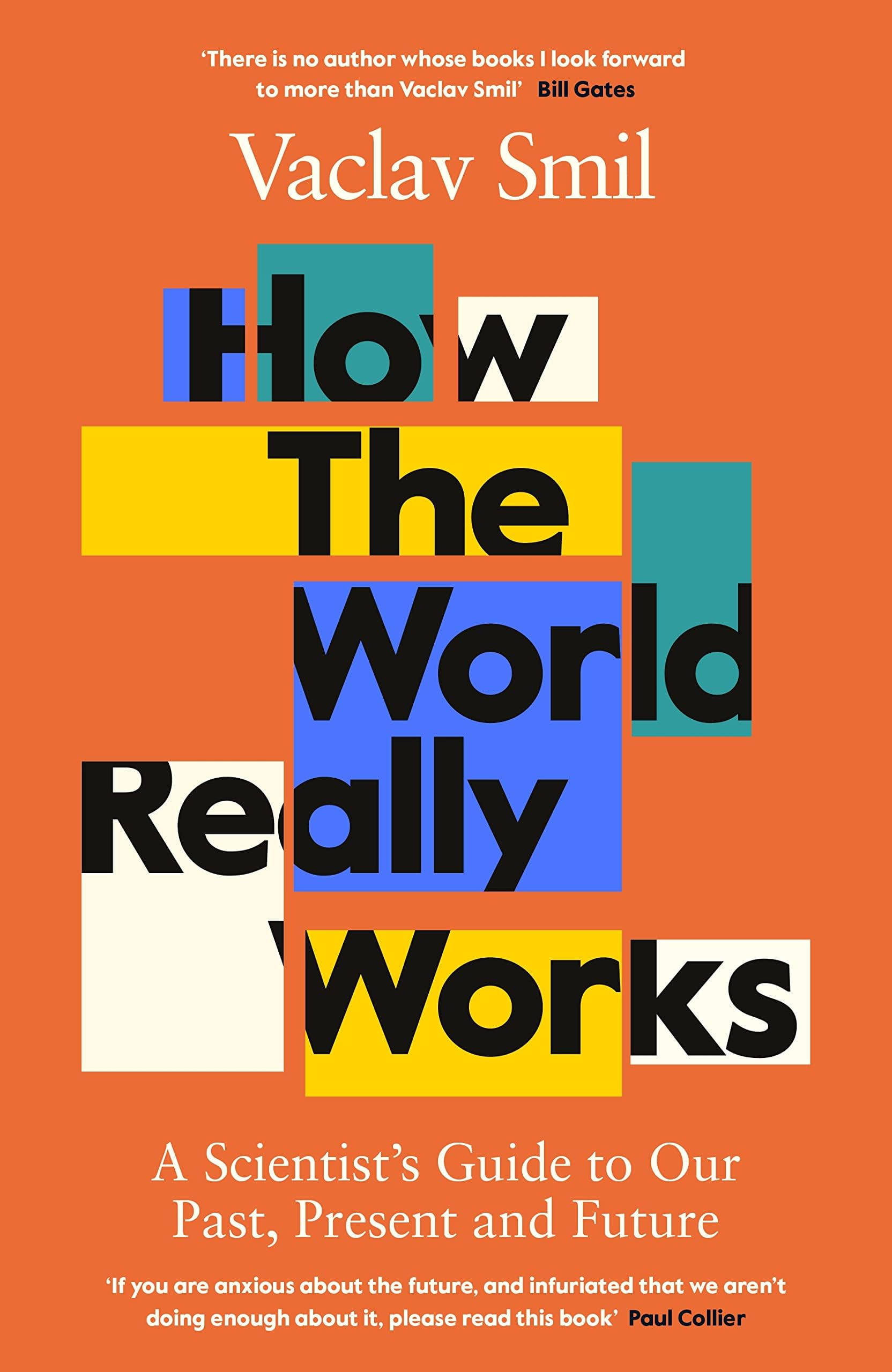
How the World Really Works: A Scientist’s Guide to Our Past, Present and Future
Product ID: 338010776
Desertcart purchases this item on your behalf and handles shipping, customs, and support to Argentina.
'There is no author whose books I look forward to more than Vaclav Smil' Bill Gates __________ We have never had so much information at our fingertips and yet most of us don't know how the world really works. This book explains seven of the most fundamental realities governing our survival and prosperity. From energy and food production, through our material world and its globalization, to risks, our environment and its future, How the World Really Works offers a much-needed reality check - because before we can tackle problems effectively, we must understand the facts. In this ambitious and thought-provoking book we see, for example, that globalization isn't inevitable - the perils of allowing 70 per cent of the world's rubber gloves to be made in just one factory became glaringly obvious in 2020 - and that our societies have been steadily increasing their dependence on fossil fuels, making their complete and rapid elimination unlikely. For example, each greenhouse-grown supermarket-bought tomato requires the equivalent of five tablespoons of diesel oil for its production; and we still lack any commercially viable ways of making steel, ammonia, cement or plastics on the scale required globally without fossil fuels. Vaclav Smil is neither a pessimist nor an optimist, he is a scientist; he is the world-leading expert on energy and an astonishing polymath. This is his magnum opus and a continuation of his quest to make facts matter. Drawing on the latest science, including his own fascinating research, and tackling sources of misinformation head on - from Yuval Noah Harari to Noam Chomsky - ultimately Smil answers the most profound question of our age: are we irrevocably doomed or is a brighter utopia ahead? Compelling, data-rich and revisionist, this wonderfully broad, interdisciplinary masterpiece finds faults with both extremes. Looking at the world through this quantitative lens reveals hidden truths that change the way we see our past, present and uncertain future. __________ 'Very informative and eye-opening in many ways' Ha-Joon Chang, author of 23 Things They Don't Tell You About Capitalism 'If you are anxious about the future, and infuriated that we aren't doing enough about it, please read this book' Paul Collier, author of The Future of Capitalism Review: In-depth research, powerful facts and well founded assertions are the hallmark of this book - For the sheer depth and width of research, background facts and analysis, this book surpasses anything one has read to date, including books by even the most erudite of scientists and analysts. The amount of information and facts about our everyday life that Smil presents is truly mind boggling. He also dispels common myths and theories, very convincingly, especially those concerning global climate change mitigation strategies. Instead, he provides realistic, well-researched and plausible ideas to at least reduce our carbon footprint significantly while asserting that there is currently no evident or even plausible way to achieve the kind of goals nations are setting for themselves with respect to carbon neutrality (net zero by 2035 or 2050, etc). In other words, governments and multilateral institutions are misleading us, and probably themselves too. Still, there is cause for optimism as human ingenuity, while rarely following a predictable path, has always found a way out. In terms of downsides, the one major point that comes to mind is that the book often becomes tedious - droning on with statistics and facts that sometimes feel excessive. Still, given today’s age of misinformation and baseless assertions, too much fact/data should be considered preferable to too little. Review: Informative and a must read book for all - A real eye opening book
| Best Sellers Rank | #190,436 in Books ( See Top 100 in Books ) #47 in Agriculture & Farming (Books) #90 in Environment & Nature #111 in Earth Sciences Books |
| Customer Reviews | 4.4 out of 5 stars 5,241 Reviews |
A**N
In-depth research, powerful facts and well founded assertions are the hallmark of this book
For the sheer depth and width of research, background facts and analysis, this book surpasses anything one has read to date, including books by even the most erudite of scientists and analysts. The amount of information and facts about our everyday life that Smil presents is truly mind boggling. He also dispels common myths and theories, very convincingly, especially those concerning global climate change mitigation strategies. Instead, he provides realistic, well-researched and plausible ideas to at least reduce our carbon footprint significantly while asserting that there is currently no evident or even plausible way to achieve the kind of goals nations are setting for themselves with respect to carbon neutrality (net zero by 2035 or 2050, etc). In other words, governments and multilateral institutions are misleading us, and probably themselves too. Still, there is cause for optimism as human ingenuity, while rarely following a predictable path, has always found a way out. In terms of downsides, the one major point that comes to mind is that the book often becomes tedious - droning on with statistics and facts that sometimes feel excessive. Still, given today’s age of misinformation and baseless assertions, too much fact/data should be considered preferable to too little.
S**R
Informative and a must read book for all
A real eye opening book
S**Z
Great book
👍👍👍👍
A**R
Great insights and knowledge
One must read, irrespective of what field or domain you belong to, great insights and full of knowledge, well known writer and professor
P**N
No nonsense book
This book along with ‘The rational optimist’ significantly increased my respect for fossil fuels. It is packed with data and interesting facts.
N**A
Good !!
Interesting read
M**D
Very informative.
This book should be read by all who believe that facts should be backed by data.
A**L
Amazing Read
A very detailed account of multifarious things that to seeuch upon our daily lives that we are completely oblivious of. Must read for all generations, a great source knowledge
A**N
Excellent reality check on fundamental bottlenecks that occur in the material world
Often these days it seems there is much motivated talk of the great changes that humanity must undertake to adjust its behavior to influence the biosphere less without an appreciation of what that would truly take. The motivated talk is not without good intention, nor should it be dismissed because there are aspects which are unrealistic. Nonetheless to get a more honest picture of how great change can truly take place from a bottoms up perspective in our material world one should read How the World Really Works to appreciate the complexity we really face and the many bottlenecks which we have no current solutions to. Vaclev Smil does not limit himself to narrow questions in this book but instead tries to take a step back and appreciate the problems humanity faces and reflect on how to think about solution forming. The book is not optimistic or pessimistic and attempts to be a scientific realist about the current trajectory of the biosphere and what can be done given the material requirements of the population base. The author starts out by highlighting the fundamental differences between exponential growth in tech hardware and logistic like growth in most material economics, in particular the challenges to further productivity gains in energy production, agricultural yields while the roadmap for further density increases in semiconductors can be clearer and we should not get confused about the inability to advance material sciences the way miniaturization has done elsewhere. The author starts with the critical ingredient to human progress, energy. The main observations are around our inescapable need for fossil fuels. The statistics on alternative energy proportion going up while absolute demand for fossil fuels still increases or at best remains flat highlight how we have not solved our diversification problem and one can draw the quick inference that more wind power for Germany wont solve their gas deficiency. The reconstruction of our energy infrastructure to support a non fossil fuel world is currently a complete fantasy. The author moves onto food and highlights there crop yields over time and how real growth in yield was really catalyzed by the growth of fertilizers dependent on the Haber-Bosch process. This is another massive energy drain highlighting that mass food production and further scale is completely dependent on further energy availability and the yields from moving away from nitrogen fixing would require an order of magnitude more arable land for farming. The author then starts to focus on material production with the likes of steel, cement and overall structures required for human habitation and how these cannot be imagined away. He also discusses the growing risks humanity faces and touches about the pandemic. The author does not highlight the challenges of going to carbon neutral as an excuse to do nothing and is deeply worried about the irreversibility of our actions on the biosphere, as such the author discusses how we are affecting the environment and what the subsequent consequences are of those changes. In putting this together the author tries to give perspective that rising tides wont be the end of humanity nor will tech solve our material constraints and that we need to be completely realistic about the challenges we face so that we start to work on honest solutions to the problems we are causing. All in all How the World Really Works does a good job at framing the problems humanity faces in scale. This is not a political book on right or wrong but a calculated book on the quantities involved and the material constraints on inputs and outputs. This should very much be understood by those framing policies that are intended to be effective and the book is essential reading for those who want to understand this issues better. Both informative and interesting, definitely a good book to gain the proper context to think about what needs to be done and how it can be done.
M**N
Essential reading, but depressing and sometimes odd
Top line: a highly recommended read. Smil's mission is to tell us that hopes of a rapid and easy transition into a "net-zero" future or a world where AI has solved all our problems are pipe dreams, and in this he is a complete success. It's all a salutory reminder that the physical - and not the virtual - world is what really matters and that the material changes of the last 20 years are enormous and not something that can be rolled back quickly and easily. Happily Smil is not some climate-change denying crank, so we are definitely in a discourse about why change needs to happen as well as how difficult it is. But I also think he is maybe too pessimistic: the very scale and scope of China's economic transformation in the last 40 years - which Smil correctly describes as fundamental for all humanity - shows that human will and determination can achieve great things. Maybe not to the arbitrary targets of a "year ending in 5 or 0" but that is not a reason not to try - and sometimes this book does read as though he thinks it might all be a bit hopeless - certainly some of its readers are going to quote it as though he is making that argument. In other ways the book feels like it is using excuses to avoid facing up to bad news. Yes, models are never likely to be anything close to perfect predictors of the future, but why are they cited with approval when it comes to estimating how much of certain future resources are available (when it suits Smil's argument) but (sometimes mockingly) dismissed when it comes to the impact of climate change? Facing up to hard reality also means facing up to the unavoidable damage that is yet to come. The chapter on risk is very interesting but feels oddly out of place in the book's narrative. Something the author wanted to get off his chest in the middle of the pandemic? All in all I do strongly recommend this book, but nullius in verba.
M**X
Excellent
Excellent. Donne une très bonne perspective sur le fonctionnement du monde en 2020.
S**A
Received on time as ETA
Niiiiiceeee
D**D
Before you ask ChatGPT about anything read this book first.
There are just too many uninformed decisions and opinions in this world, this should be a mandatory read in schools. I bought five extra of this as gifts to friends and co-workers. It is a great read, only complaint is a lack of illustrations like diagrams and tables. Also a bit heavy, could have had shorter chapters covering a single topic at a time.
Trustpilot
2 weeks ago
1 week ago