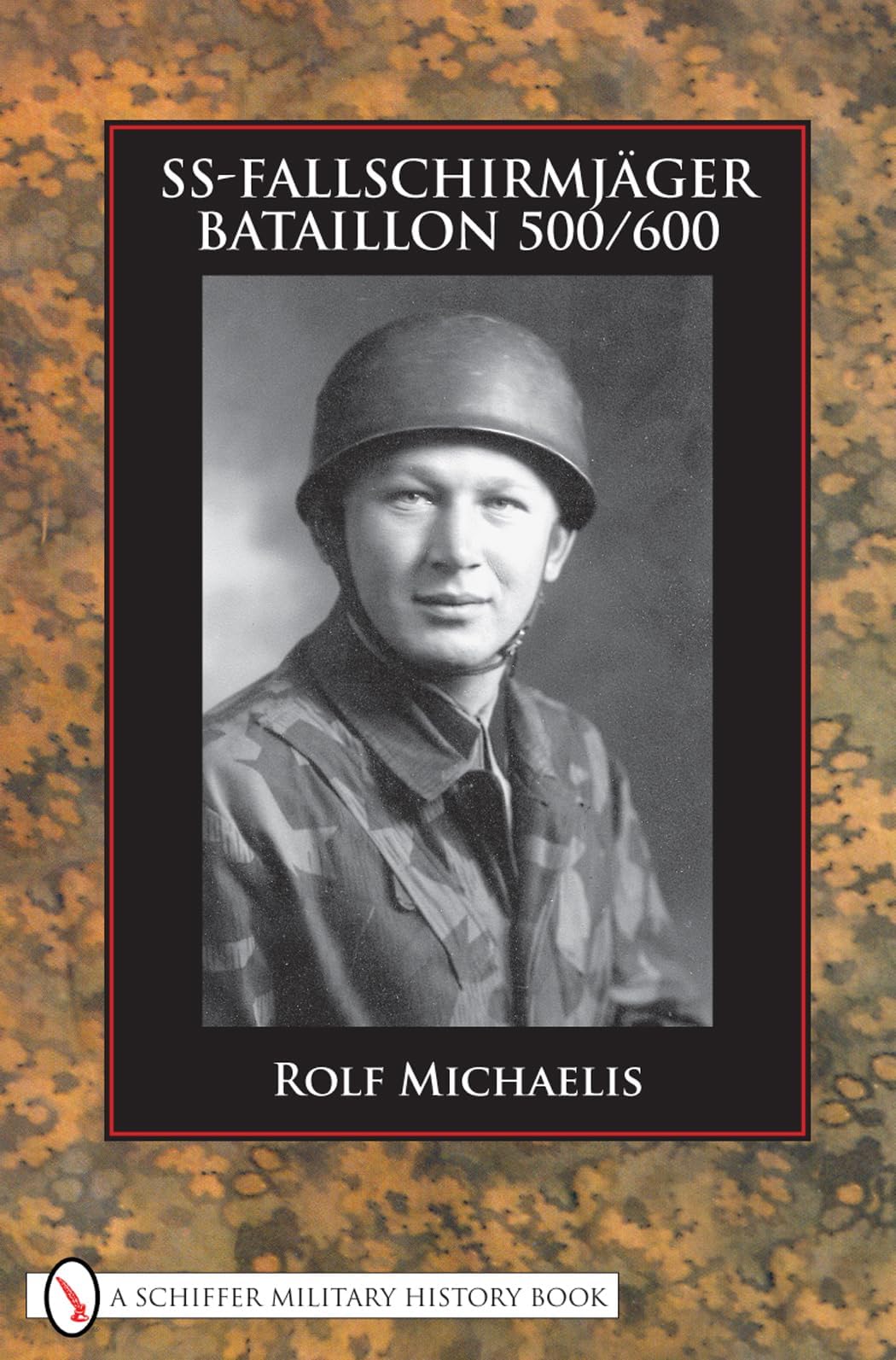
SS Fallschirmjäger Bataillon 500/600
Product ID: 26453991
📚Rare WWII unit history
🪂Exclusive Fallschirmjäger focus
🖼️Extremely rare photos
Desertcart purchases this item on your behalf and handles shipping, customs, and support to Argentina.
🪂 Own a piece of airborne WWII legend before it’s gone!
This used book chronicles the exclusive history of the Waffen-SS Fallschirmjäger-Bataillon 500/600, a specialized airborne unit active in key WWII battles on both Eastern and Western fronts. Featuring detailed mission reports, survivor testimonies, and rare photographs, it offers a unique, in-depth look at one of the war’s most obscure yet courageous battalions.
| Best Sellers Rank | #3,344,432 in Books ( See Top 100 in Books ) #17,991 in World War II History (Books) |
| Customer Reviews | 4.1 out of 5 stars 20 Reviews |
M**R
Great Book; Superb History
This is an extremely detailed and excellently researched book on an obscure independent Waffen-SS airborne battalion that fought with great courage, distinction, and skill in the closing months of WWII. The account of its role in the ill-fated operation to capture Tito in Yugoslavia is superbly done. Lots of small unit combat retold by the handful of SS men who survived this battle and the ones to come on the Vistula and Oder fronts during the final battle for Berlin.
M**N
and I suppose it will look cool on my book shelf
Written in a chronological mission report format, stressing battle groups & task organizations more than a narrative of the missions that this group performed. I tried very hard to read this book on several times, and I suppose it will look cool on my book shelf?
S**E
Rare subject matter
Good book because it covers a very rare WWII subject! Very poor translation and very disconnected reading. It does contain good information.
J**R
Good work
Good, a little less detail than I had hoped for, but still worth the read.
S**R
Suffers from the translation
Rather than have a title such as this one, on a rare subject, suffer from a poor translation, it would have been better to have left the book in the original German. Some of the language is cumbersome, while other passages are incomprehensible. Most of the photographs are not secondhand, and the book is divided by campaigns. I gave it a four star for subject, photos, and the usual Schiffer quality, but feel it should have had a proof-reader before being sent to press. That was a disappointment, as I do not know what the author was trying to convey, with the excreable translation one is forced to suffer through. The book is worth having for anyone interested in anti-partisan warfare against Tito and the Serbs. A plethora of books exist on Fallschirmjaeger of the Luftwaffe, but so little can be gleaned regarding Paras of the Waffen SS.
R**N
SS-FALLSCHIRMJAGER BATTALION 500/600
SS-FALLSCHIRMJAGER BATTALION 500/600 ROLF MICHAELIS SCHIFFER PUBLISHING, 2007 HARDCOVER, $29.95, 118 PAGES, PHOTOGRAPHS, MAPS Himmler supposedly got the idea in September, 1943, after Operation OAK (Unternehmen Eiche). Operations OAK was launched on 12 September 1943 and included an airborne raid on Gran Sasso. The operation was planned by Kurt Student and a group of German paratroopers freed deposed Italian dictator, Benito Mussolini. Otto Skorzeny took part in the raid on the orders of Hitler. The raid also included a daring glider-based assault on the Campo Imperatore Hotel at Gran Sasso which captured Mussolini without shooting. Although SS-Fj.Btl-500 was a 500 series Bewahrungs or probationary unit in which an enlisted soldier, NCO, or officer who had dishonored himself by minor infractions of the military code could be given the chance to, in the words of a February 4, 1942 decree by Hitler: to prove oneself by service at the front and thereby earn an amnesty. In other words, it was a unit where officers and men convicted by courts-martial of minor infractions and currently in disciplinary status could redeem their soldierly honor by participation in hazardous duties and operations. In the case of the Waffen-SS, men being recruited for the SS-Fj.Btl.500, it would have probably been at one of the harsh SS-Strafanstalten, such as that of the notoriously brutal SS-military prison at Danzig-Matzkau, or the punishment-section for SS personnel at Dachau. Only about half of the initial intake of recruits to SS-Fallschirmjager-Btl 500 in October and November, 1943, were bewahrungs-soldaten (disciplinary cases). Even then, the unit refused serious cases, hence veteran SS paratroopers' tendency to bristle with indignation when the unit is described as penal! Most of the offenses involved were quite minor infractions of the draconian Waffen-SS code of conduct. The gathering of the personnel for the new unit was in Chlum in Czechoslovakia in October, 1943. The first commander of the battalion was SS-Sturmbannfuhrer Herbert Gilhofer, coming from the 21st SS-Panzergrenadier Regiment of the 10th SS-Panzer Division Frundsberg. In November, 1943, the battalion began its training in Madanrushka Banja (Mataruska banja), close to Sarajevo, with the Luftwaffe Fallschirmschule Number 3. Their training was completed in the area around Papa, Hungary in the beginning of 1944. The 500th was commanded by Hauptsturmfuhrer Kurt Rybka during its daring airborne and glider-borne assault on Tito's headquarters outside of Drvar on 25 May 1944. The raid, called Operation KNIGHT'S LEAP (Uniernehmen Rosselsprung), was reported in the 6 June 1944 issue of the German Armed Forces' daily report (Wehrmachtbericht). Two companies were dropped directly on Tito's headquarters while the other two were landed by DF 230 glider. The operation turned out to be a complete disaster. Because Tito had been forewarned of the attack, he placed his forces accordingly and was able to escape. The survivors were at first sent to Petrovac than later to Ljubljana, where they remained until the end of June. They were then transfered to Gotenhafen (Gdynia), West Prussia to rake part in the planned occupation of the Finnish-controlled Aland Islands in the Baltic Sea, but this was cancelled. They were then sent to join III. SS-Panzerkorps at Narva, but were ordered to be flown to Kaunas, Lithuania on 9 July. There they formed a kampfgruppe with 1/Panzerregiment GD to relieve the trapped German forces at Vilnius. Subsequently, they often acted as 3rd Panzer Army's 'fire brigade' in its defense of the Baltic nations. By 20 August 1944, they were down to a strength of 90 men, but remained in combat for the next several months as the Germans were desperate for any and all combat troops to stave off the Soviet offensives. The paratroopers were finally relieved in late October, 1944 and were immediately flown to Deutsch-Wagram, Austria where they were incorporated into the SS-Fallschirmjagerbattalion 600 after a week's rest. The second Budapest mission, Operation PANZERFAUST, it can be said to have been, officially, the 600's first mission although the new battalion wasn't formally mustered until November 9, 1944 in Neu-Strelitz, their garrison town. The soldiers of the 500th who survived long enough to see the formation of the 600 were also given back their previous ranks and the right to wear the siegrunen on November 9, 1944. Two companies of the newly formed SS-Fallschirmjager-Btl 600 were then attached to Otto Skorzeny's Panzerbrigade 150 in December, 1944 for the Ardennes. It was the only occasion on which SS paratroopers faced the Western Allies until, fleeing the Soviets, they surrendered to U.S. forces early in May, 1945. After the Ardennes, the 600th fought on the Oder Front in the Schwedt and Zehden bridgeheads and in various rearguard actions across Northern Germany at the very end of the war. The battalion was virtually wiped out three times in its 18-month existence. SS-FALLSCHIRMJAGER BATTALION 500/600 is an outstanding account of one of the least known units of the German Army. Combined with excellant photographs and maps, this is one of those books that belongs on the shelf of any serious student of World War II. Lt. Colonel Robert A. Lynn, Florida Guard Orlando, Florida
J**S
Good presentation on a little-known formation of the SS
SS-Fallschirmjäger Bataillon 500/600 was written by Rolf Michaelis in 2008. The version I reviewed was published by Schiffer Military history of Atglen, PA in 2008 and is 118 pages. The ISBN of this particular book is 978-0-7643-2944-9. The book covers the complete history of the SS-Fallschirmjäger battalion (the only one of its kind) from its inception in 1943 through its final days and disintegration at the end of the war in May of 1945. In between these two dates, the reader is given a history of the battles which the unit participated in and the scant details available to the author in his research of the unit. The book includes several photos of varying quality relating to the unit and maps of the locations in which they participated in the specific battles. The author does list several sources, both from the Bundesarchiv and secondary book sources. Most of the historical information on the battles does not focus on the unit specifically, but mostly looks at the overall operation. Where information on SS-Fallschirmjäger Bataillon 500/600 is available, it is presented to the reader. My overall feeling of the book was that there was not a lot of information on this unit in which to present to the reader. If that was the case, I would have to say that Rolf Michaelis did a fine job in offering a narrative to the reader. The book does have an appendix with a chronology on the battalion. There is no order of battle information, and any war crimes that this unit may have perpetrated are not presented to the reader. I use the term “may” as I know nothing about the unit, other than what this book presents. I have not read anything from the author before this publication, though I see he has published many works, of which quite a few are unit histories. I thought the presentation of the unit was well written, so I plan on picking up more of his books. I would say this book would be appreciated more by the hardcore World War II buff, than say someone who is just looking to get an overview of the SS or the German military structure.
Y**A
Great Product
Quick shipping,. Thank you!
J**K
... unit that has not been written about in any great depth before
very informative on a unit that has not been written about in any great depth before.well worth the money
D**S
500/600
An interesting subject that has been neglected in recent years. Rolf does a good job (this being taken from the German language version) as always and there are some good photos. The format is in the "Bender A5 style" so fits a book shelf well. Not the first book on the subject I'd buy but worth a look.
O**W
A sketchy translation
This book fills a gap about a little known unit of the SS. It isn't a book with a large number of quality images for the serious uniform enthusiast and its translation lets it down quite a lot.
A**S
Five Stars
excellent piece of military history
Trustpilot
3 weeks ago
2 months ago