Desertcart purchases this item on your behalf and handles shipping, customs, and support to Argentina.
⚡ Stay Powered, Stay Ahead — The Pro Transfer Switch for the Modern Manager
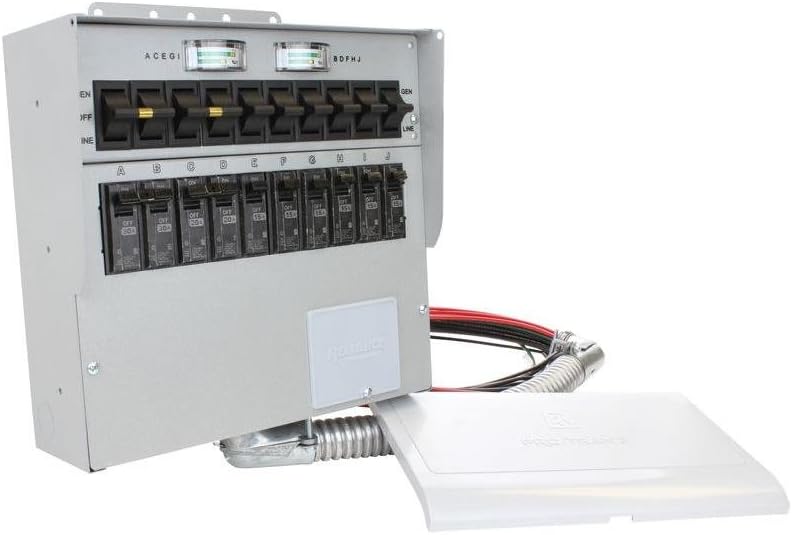
The Reliance A510C Pro/Tran 2 is a UL-listed, 50-Amp, 10-circuit indoor manual transfer switch designed for reliable power management. Featuring a durable alloy steel build, IP54 protection, and mixed single/double-pole circuits, it offers professional-grade control and peace of mind during power outages. Backed by a full manufacturer warranty and highly rated by users, it’s the essential upgrade for any savvy home or office power setup.
| ASIN | B00YCRLLMI |
| Actuator Type | Hinge Lever |
| Best Sellers Rank | #283,471 in Patio, Lawn & Garden ( See Top 100 in Patio, Lawn & Garden ) #253 in Outdoor Generator Transfer Switches |
| Brand | Reliance Controls |
| Brand Name | Reliance Controls |
| Circuit Type | mixed (single-pole and double-pole) |
| Color | black |
| Connectivity Protocol | X-10 |
| Connector Type | Screw Terminal |
| Contact Material | Brass |
| Contact Type | Normally Open |
| Control Method | Remote |
| Current Rating | 50 A |
| Customer Reviews | 4.6 out of 5 stars 435 Reviews |
| International Protection Rating | IP54 |
| Item Dimensions | 11.75 x 4.5 x 11 inches |
| Item Weight | 18 pounds |
| Manufacturer | Reliance Controls |
| Material Type | Alloy Steel |
| Model | A510C |
| Mounting Type | Surface Mount |
| Number of Items | 1 |
| Number of Positions | 10 |
| Operating Voltage | 240 volts |
| Operation Mode | Manual |
| Part Number | A510C |
| Specification Met | UL |
| Switch Type | Hinge Lever |
| Terminal | Normally Open |
| UPC | 815181012236 |
| Unit Count | 1 Count |
| Wattage | 12500 watts |
R**R
Electrician install no problem. Works well.
We had this installed by an electrician for our backup generator. We got the 50A version to have some upgrade option even though our generator is only 30A. The construction is decent for an indoor mount system. The box itself is metal. The little door covering the load switches is plastic. The switch handles are plastic similar to a breaker in feel. So not built like a tank but decent quality and given that it will probably only be touched once every few years - plenty good enough. There was no problem with the install. It actually took fewer hours to install than they bid which was a nice surprise. Note this is indoor installation only. This one has 10 single circuits but 2 of them are doubled if you want to use them for a 220 circuit. So you really get 2x 220V circuits and 6x 110V. This worked fine for our setup. The way this works is when it is hooked into your main panel you basically have two sources for the selected circuits in your house. Think of it as a "Y" connection connecting your house circuit to either the utility OR to the generator inlet. Each circuit in this box can be individually switched to the utility OR the generator OR turned off from both. This allows you to only turn on high-current loads such as a water heater or AC or something when you need it. Thus you can load balance your generator if all your loads together are too much for the generator. Just as a reference it cost us about $500 to get this installed by an electrician. We had to buy an $40 external weatherproof generator plugin box to mount on the outside of the house. We also had to buy a $50 NEMA L14 extension cord to go from the generator to the plug box on the house. So around $1000 for the parts and installation.
A**R
Great transfer switch
Used with off grid solar inverter with batteries. It was easy to install and works great.
C**Y
Cannot imagine a better designed Transfer Switch.
I installed flush mount recessed into sheet rock wall using trim kit, as photo shows: https://www.amazon.com/dp/B00REJVYYG?psc=1&ref=ppx_yo2ov_dt_b_product_details Very well built and well laid out to install yourself. Cables all labelled to match throw switches. Get a good layout of your house breakers before you begin, so you know which ones to run through the transfer switch. I removed the jumper for positions C&D and only used A&B for 220V. That left me 6 15 amp and 2 20 amp for other circuits. Will run everything I need plus bottom floor air and heat. Good videos on YouTube to install the Reliance Pro/Tran. Reliance Contral Products customer support is fantastic and quick. Had some questions, contacted them by email, and had answers the same day. Guenther handled my emails and was great to deal with. This is a super product, very well laid out, and very well made. Cable tails are plenty long to reach anywhere in the breaker box. I had to cut length off all of mine. Give this one a look if looking for a transfer switch. Mine will work from an outside portable generator. I ran 6-3 w/grd from the transfer switch to an outside wall plu,g to plug the generator in. Got great plug from Amazon also. It is also a Reliance Control Product: https://www.amazon.com/dp/B004HSO1JW?psc=1&ref=ppx_yo2ov_dt_b_product_details As you can see from photo I fixed a label under each transfer switch poooooosition showing the breaker number it was feeding. The only suggestion I would have to improve the box install is the have terminals to attach to for incoming wire from the gerator instead of have to splice with connectors, but was not a big issue.
J**S
Solid
Works as advertised. Quality materials limited instructions
E**D
Ready for power outages now
Really liking this transfer switch, nothing major bad to say about it. Installation was a little tricky as the wiring is pretty tight in the greenfield conduit. Was kind of a pain to route wiring to the panel, I am an electrical professional of 25 years on the industrial side, so I did route the wiring in sections before making final connection, just not a super easy job, but certainly possible with patience. If I did this again, I'd throw away the 1" conduit and replace with 1.25" or 1.50" Seal Tite Flex. If you decide to go all factory materials, you'll need a 1-3/8" drill bit (I used a spade bit) if you have to run greenfield conduit thru a stud like I did. For the outside plug, you'll need a 1-1/8" hole saw or drill bit for the 3/4" conduit. I used #14 x 3/4" screws to fasten the box to the wall. Extremely glad I installed this transfer switch, now my home won't look like a 3rd world country's electrical grid with extension cords running all thru the house during an outage.
A**G
Works really well for solar
This is a great tool for people who want to have a fairly easy way to tie solar into a main breaker box. The box itself is robust and well made. All the connections on mine were nice and solid. The wires are well labeled and plenty long (at least for me). Mounting is also very simple whether surface or inset. I did hire an electrician to work with me on the install because I wanted to make sure things were well installed and organized in my very old main breaker box. We ran from my inverters (2 inverters for split phase 220) to the bypass box and then bypassed my heat pump water heater, the dryer (useful as a dump load) and some 110 critical loads. Now if I want to go on battery (solar), I just flip the bypass switch or switches to GEN. If my batteries get low and need to give the system a break, I can flip back to line power. It’s very convenient. The 50 amp capability means if I get larger inverters, I’m good. I ran beefy wire from the inverter junction box over to the bypass box. All I’d have to do is swap inverters and do some easy wiring and I’m golden. I’m very happy.
A**T
The right way to add a generator backup to your house
A very quality product - highly recommended! I was originally going to go the "suicide cable" approach since I would "never make the mistake" of having an energized cable with two male ends.. uh huh. I'm getting older, and I do do dumb things at times. Installing this Reliance panel was the smart thing! 2.5 hr installation time overall, and it looks and works great! Once I looked at this product, I realized it was much simpler than I thought it would be, AND much more flexible. I worked for an electrician in a previous life, so I was very comfortable with the connection to the circuits in the panel. I also got the flush-mount kit, and it really made me happy with the completed project. (FYI, I have a 30' cable to connect to the generator, which sits outside - 10' from the panel, so I installed the panel-mounted inlet inside.) UPDATE 4/23/23 - I just completed installing a second panel at my son's house. I continue to be impressed by the ease of installation and how flexible this panel lets us be! The most time-consuming part of this installation is recessing it into a finished wall. If this was installed with a surface-mounted panel, you could easily install it in an hour. GREAT product!
K**R
Easy to install panel though 10AWG feed wires in panel
The transfer switch was easy to install. the feeding of wires through the flexible steel conduit was a bit of a challenge. Videos on the manufacture site were excellent. I wrote the manufacture when I connected my 6AWG wires to the red and black wires inside the transfer switch. The transfer switch uses 10AWG (red and black) for connection to your 6AWG wires for the 50Amp service to the switch. This counters my knowledge of using 6AWG copper wires for 50Amp circuits. The manufacture emailed me back and said NEC doesn't apply to wiring inside enclosures like the transfer switch. UL reviewed the switch and approved the wiring used for the 50AMP feed based upon temp rise of wires, the type of wires being used, and the fact it is inside an enclosure and not an inwall or conduit application. Here is what the manufacture said. "I had the same question when I came to work at Reliance Controls in Tech Support. Here is the answer. Wire in a Panel is rated differently than typical Conduit wiring as rated by the NEC. The wire size that is typically associated with 50-amp is 6-gauge or 8-gauge when using 75° C wire, but the wire size does not apply to internal wiring inside of panels. Wire rating is arbitrary, once that is understood, everything should make more sense. The NEC wire ratings are specific to specific conditions. There are all sorts of wire ratings based on insulation temperature, type of insulation, and whether it's in a conduit or an open space cabinet/enclosure. It is not true that 10-gauge wires are 30 amps, and 8-gauge wires are 40-amps, and 6-gauge wires are 50-amps. The attached table 310.15 (B) (16) in the NEC shows this. Even so, this table does not apply to factory build control panels; it is just setting forth rules for wiring circuits in buildings through conduit. Nor does the table refer to 10-gauge MTW wire that is rated for 105° C which is used in the Transfer Switches. 10-gauge wires can handle way more power than the NEC depicts in the table, as they want wiring in residential to be overrated. The wiring in our transfer switch is 10-AWG (105° C) MTW, but per the testing lab Underwriter's Laboratories (UL), none of these matters. They run very stringent heat rise tests with much higher amperages (for example, our 30-amp toggle switches must pass 60-amps for over 5,000 operations). The wire size in this transfer switch or other factory wired control panels that have testing lab certifications to a certain temperature rise unless there is a claim of a fraudulent marking for the certification. We have been passing 50-amps (plus) testing for nearly 20 years with 10-AWG 105° C wire, a lot has to do with the fact it's in an open enclosure versus in a conduit where the heat factor is much higher in a conduit. Now if you were running wire in a conduit between an inlet box and the transfer switch, that falls under applicable building codes, and different rules must apply (like using 8-AWG). But not in the transfer switch. "
A**K
Good
Reccomended
C**N
sécuritaire
facile à installer avec guide sur youtube
Trustpilot
5 days ago
3 days ago