
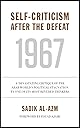
Self-Criticism After the Defeat
Product ID: 19168020
Desertcart purchases this item on your behalf and handles shipping, customs, and support to Argentina.
"A unique book. . . . al-Azm sought to strip Arab thought of its belief in fate and folk tales and superstition. . . . He told his people the sort of truths that outsiders are too embarrassed to tell, even when they were themselves able to see these truths."Fouad Ajami The 1967 Warwhich led to the defeat of Syria, Jordan, and Egypt by Israelfelt like an unprecedented and unimaginable disaster for the Arab world at the time. For many, the easiest solution was to shift the blame and to ignore some of the glaring defects of Arab society. Hailed as one of the foremost Arab intellectuals of recent decades, Sadik al-Azm was one of the few to challenge such a view in his seminal Self-Criticism After the Defeat . In it, he offered a penetrating analysis that probed deep into Arab society, and reasoned that Arabs had to embrace democracy, gender equality, and science to achieve progress. Self-Criticism After the Defeat represents a milestone in modern Arab intellectual history. It marked a turning point in Arab discourse about society and politics on publication in 1968, and spawned other intellectual ventures into Arab self-criticism. This is the first translation of the work into English. Born in Damascus in 1934, Sadik al-Azm is professor emeritus of modern European philosophy at the University of Damascus, Syria. He earned his PhD (1961) from Yale University, and was visiting professor in the department of near Eastern studies at Princeton University until 2008. Review: Fascinating book - A response to the Arab defeat in the 1967 war -- scathingly honest. I would skip the essays that introduce it and the reviews after it. The book itself is a brief but a devastating self-examination of the Arab failures. Very much worth a read if you're interested in this part of the world. Review: A key text of Arab political thought - It is a crime that al-Azm's works are not more widely translated into English. Highly influential in the Arab world, this text offers a critical Syrian perspective on the Arab defeat in the 1967 war, interpreting it as a wider condemnation of hypocricy amongst the political leaders and a failure to have undertaken substantial progress since decolonization. This is a crucial text for Westerners to read in order to avoid the trap of being stuck between Anti-colonial nationalist and militaristic rhetoric on one side, and conciliatory, pro-American rhetoric on the other.
| Best Sellers Rank | #2,166,637 in Books ( See Top 100 in Books ) #333 in Syria History #904 in Middle Eastern Politics #2,027 in Political Philosophy (Books) |
| Customer Reviews | 4.7 out of 5 stars 16 Reviews |
R**S
Fascinating book
A response to the Arab defeat in the 1967 war -- scathingly honest. I would skip the essays that introduce it and the reviews after it. The book itself is a brief but a devastating self-examination of the Arab failures. Very much worth a read if you're interested in this part of the world.
A**R
A key text of Arab political thought
It is a crime that al-Azm's works are not more widely translated into English. Highly influential in the Arab world, this text offers a critical Syrian perspective on the Arab defeat in the 1967 war, interpreting it as a wider condemnation of hypocricy amongst the political leaders and a failure to have undertaken substantial progress since decolonization. This is a crucial text for Westerners to read in order to avoid the trap of being stuck between Anti-colonial nationalist and militaristic rhetoric on one side, and conciliatory, pro-American rhetoric on the other.
J**É
This book was written where some degree of objectivity was ...
This book was written when some degree of objectivity was still tolerated. For the ones interested in the subject it is a must.
Trustpilot
1 week ago
1 month ago