
Buy anything from 5,000+ international stores. One checkout price. No surprise fees. Join 2M+ shoppers on Desertcart.
Desertcart purchases this item on your behalf and handles shipping, customs, and support to Argentina.
📚 Unlock the Secrets of Financial Genius!
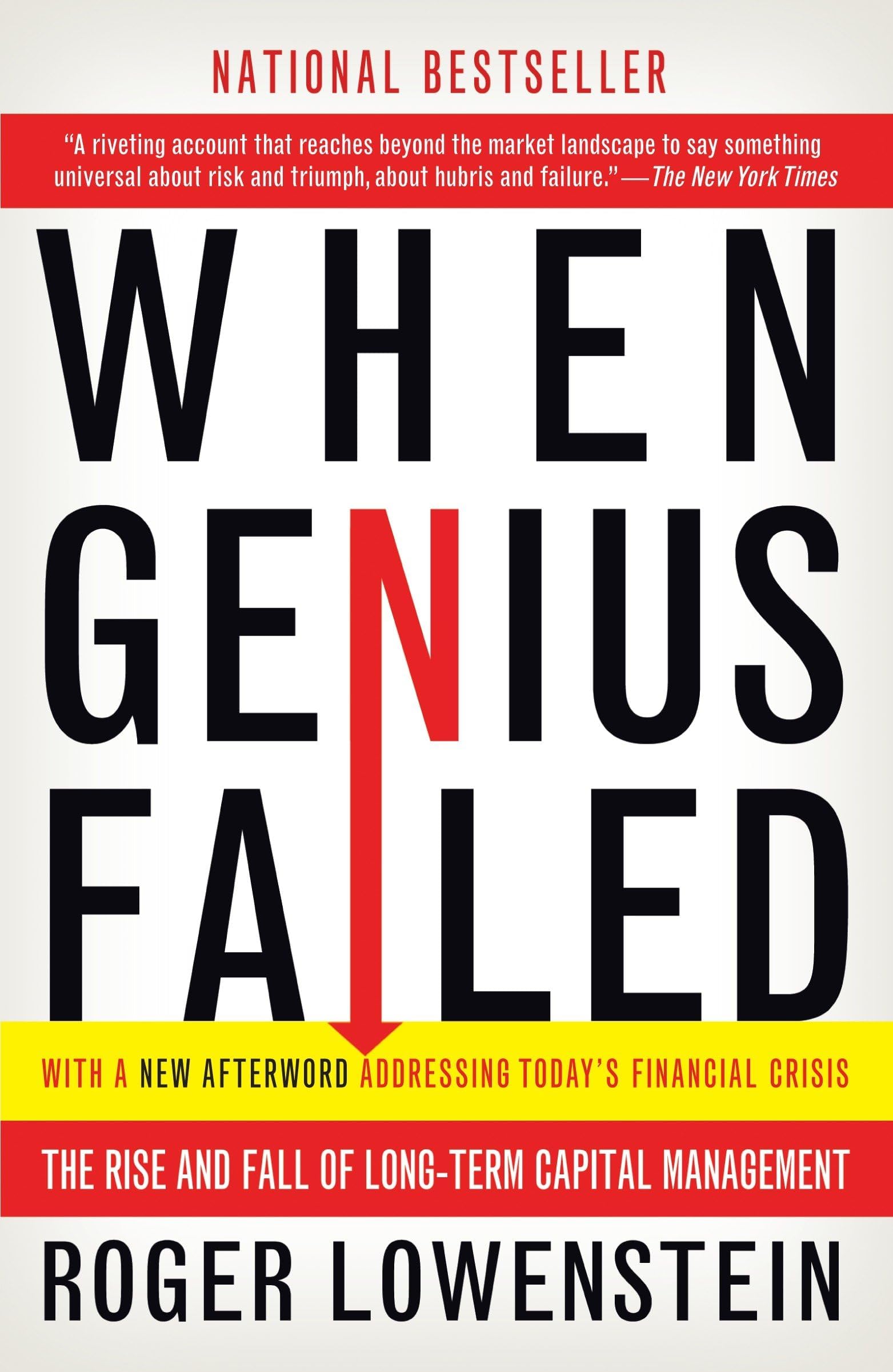
When Genius Failed chronicles the dramatic rise and fall of Long-Term Capital Management, a hedge fund that once boasted some of the brightest minds in finance. This gripping narrative explores the intricate strategies, market dynamics, and the eventual collapse that sent shockwaves through the financial world, offering invaluable lessons for investors and professionals alike.


| Best Sellers Rank | #9,244 in Books ( See Top 100 in Books ) #4 in Free Enterprise & Capitalism #4 in Financial Risk Management (Books) #6 in Banks & Banking (Books) |
| Customer Reviews | 4.5 out of 5 stars 4,029 Reviews |
V**N
Great narrative on how even the best financial models don't account for the human factor
In this book, Roger Lowenstein presents an excellent detailed narrative of the rise and fall of Long-Term Capital Management. The book is aimed at a layman and does not require understanding of complex financial instruments - but that knowledge makes the story even more intriguing. LTCM was an elite hedge fund started by John Meriwether, the head of the arbitrage group at Salomon Brothers. The fund recruited top professional talent with extensive contacts and, uniquely, top academics from MIT, Harvard, and other universities, including Robert Merton and Myron Scholes, who would later (in 1997) share the Nobel Prize in Economics for developing a model for pricing derivatives, known as the Black-Scholes formula. Led in part by these gentlemen, LTCM had a highly quantitative method to its trading. It started in bond arbitrage, betting that spreads between bonds of similar type would converge, and it achieved fantastic results in the first three years of its operation. So, where did things go wrong? Due to their extensive contacts, LTCM's partners were able to secure unprecedented levels of financing from banks all over Wall Street. Not only was LTCM able to leverage itself highly, but it did so cheaply. All the banks wanted a piece of the action, so LTCM was able to secure very low cost of debt and essentially no haircuts for collateral. This means that LTCM was able to achieve even higher levels of leverage than normally possible. Furthermore, as bond arbitrage opportunities started to melt away due to influx of competitors, LTCM plunged into unexplored waters: merger arbitrage, bets on equities via derivatives, bets in emerging markets, etc. The firm essentially started to shift away from convergence bets to directional bets, which are inherently speculative. In other words, LTCM began to meddle outside its area of expertise. Not only was LTCM highly levered and making risky bets, its partners shared one major flaw: hubris. They whole-heartedly trusted their mathematical models and abstract systems. Merton and Scholes were faithful followers of the efficient market hypothesis and refused to believe in any behavioral finance mumbo-jumbo. Their models predicted that LTCM could not lose a significant amount of capital in any one day. Only a castrophic event, a statistical freak - one in trillions - could cause serious damage to the fund. Even when Eugene Fama, Scholes' thesis advisor, published a paper detailing "fat tails" in the distribution of market returns, Scholes dismissed the idea. Fama demonstrated that the market does not follow a log-normal distribution (as assumed by Black-Scholes) - instead, outlier events such as large market crashes are significantly more likely to occur. Additionally, so confident were the partners in their creation that they did not hesitate to put millions of their own capital into the fund. Usually, when partners put up their own money, they are much more risk averse since their own hard-earned dollars are at stake. LTCM's partners, however, exhibited THAT much confidence in themselves. When Russia defaulted on its debt on August 17, 1998, investors everywhere ran from investment risk in the market, buying up the safest investments - US Treasurys. This widened the swap spreads and raised credit premiums, which went completely against LTCM's positions. Since LTCM was heavily leveraged, its losses were staggering: on August 21st alone, LTCM lost $553 million. In the four hellish weeks that followed, it lost the remaining $2.9 billion of equity. It was unable to unwind its positions, because there were no buyers - liquidity had tried up. Meriwether and his crew attempted to raise capital from anyone and everyone, but no one was interested - rumors of LTCM's losing positions were floating around and scaring off investors that could save the fund. The second half of the book describes the bailout process for LTCM. Goldman Sachs and Warren Buffett attempted to purchase the fund's positions for a miniscule price, all while Goldman was taking advantage of its knowledge of LTCM's trades - it was constantly squeezing LTCM's positions, further lowering the fund's value. Finally, the Fed guided most Wall St banks to a private rescue, in which only one bank refused to participate and later paid the price dearly: Bear Stearns. Lowenstein describes all the events in great detail - he has clearly done a tremendous amount of research. My only gripe is that I often did not feel immersed in the situation. Michael Lewis in his Liar's Poker creates a vivid image of each character and really makes you feel like you're there in the story. This book is more factual and less immersive in a way. But don't get me wrong, that's a minor issue, more of a personal preference. I highly recommend the book to anyone in finance or anyone interested in financial history. The fall of LTCM presents a classic case of what Lowenstein calls the "human factor." At the end of the day, financial models can't predict greed, hubris, and the behavior of various individuals. And no matter how hard you try to diversify, during a crisis, correlation often goes to one. Pros: + easy read for anyone, even those with little finance knowledge + great explanation of LTCM's flaws, including a discussion on "fat tails" + excellent detail on LTCM's strategies and positions + reminds the reader of a very important point that many finance gurus forget: the human factor Cons: - could use a bit more language and imagery to immerse the reader into the story
D**N
Mathematics vs intuition...was there a clear victor?
Were the individuals who initiated and ran Long Term Capital Management geniuses, as the title of this book indicates? When reading the book, the reader is led to believe, via their quoted statements, that they themselves thought they were geniuses. Did the eventual behavior of the markets convince them otherwise? Did the downfall of LTCM inject them with an overwhelming dose of humility? Without knowing them this would be hard to say. But one can say with a large degree of confidence that no amount of intellectual ability will negate the fact that the financial markets are a collective, emergent entity. The markets do not care about the accolades or credentials of the traders that invest in them. The only reason for displaying these credentials is to convince investors to take part in a financial scheme, whether it is a private investment group, a new business, or some other entity that requires expertise in finance. When reading this book, it is apparent that the prospective investors in LTCM viewed its proprietors with an uncritical adulation, and did not ask the probing questions that they should have before they made the decision to invest. They should have ignored the fact that a few of these proprietors were their former professors or tutors, and concentrated instead on the content of their proposals, for it is only this that is relevant. If indeed the investors were overly impressed by the titles and awards possessed by the members of LTCM, then they clearly made a mistake. They should have only been concerned with the content of the proposals made by LTCM. If they did not have the mathematical knowledge to understand the proposals, they should have either obtained it on their own or have withdrawn their investment. The list of investors is quite amazing when viewed in retrospect: Sumitomo Bank, Dresdner Bank, Liechtenstein Global Trust, Julius Baer, Republic New York Corporation, Banco Garantia, Michael Ovitz, Phil Knight, Robert Belfer, James Cayne, St. John's University, Yeshiva University, University of Pittsburgh, Paragon Advisors, PaineWebber, Donald Marron, Black & Decker, Continental Insurance of New York, and Presidential Life Corporation are examples. The interest of these institutions and investors is fascinating given that derivatives trading and sophisticated mathematical modeling was relatively new at the time. Their decision to invest therefore had weak historical precedent, and therefore it is easy to believe the author's contention that this decision was based on their uncritical adulation of the LTCM members. The "mystique" of these members was taken "to a very high extreme", writes the author. The author attempts to give the reader insight into the personalities of the LTCM members, and his descriptions of them work to a certain degree. Such insight is necessary to gain a proper understanding of their behavior. But a description of their overt behavior and demeanor still leaves the reader wanting as to whether their appearance, i.e. the way they portrayed themselves to others, did reflect what they truly believed inside. Was their behavior part of their salesmanship, a conscious strategy to portray themselves as savvy business people who had great insight into the workings of the financial markets, masking their hidden insecurities on these workings? Or was their behavior reflective of what they truly were, i.e. individuals who through their training in finance and mathematics, were confident in themselves and in the concept of LTCM. For example, was John Meriwether indeed a quiet, private individual with a "steel-trapped" mind as the author portrays him, or was this merely a facade that Meriwether thought would give him a sphinx-like aura of mystery? And if the latter is true, why did Meriwether think that such behavior was necessary? What historical precedent did he follow in this regard? Does such behavior result in better financial contracts? A better understand of the markets? The markets of course do not care about the personalities of the traders that participate in them. The markets do not hold any special affection for a James McEntee, who "traded from his gut." Nor do they care about the commentary of a Seth Klarman, who accused the mathematical models of LTCM as being blind to "outlier events." And they certainly do not respect the boasting of a Greg Hawkins, who proclaimed that LTCM made more money because its members "were smarter." The book is interesting even from a contemporary perspective, in that it brings out the still ongoing tension between those who prefer a more mathematical/scientific approach to trading and those who "trade from the gut." The financial modelers still refer to the latter as "uniformed speculators", "noise traders", or "nonscientific, old-fashioned gamblers." The gut-traders still scold the modelers as a "dressed-up form of gambling" or as "pure academics" and "not applicable to the real world." The debate between these two groups though is evolving, due in part to the rapid automation of the financial markets. More trust is being given to machines that can not only crunch the numbers but can also exercise the "intuitive judgment" that some traders still insist is the way to go in trading. It will be interesting to see if these machines can deal with the markets in a manner that is superior to what humans have done for centuries. Genius arising from silicon will compete with genius arising from carbon. But one thing is certain: if machine trading results in instabilities in the markets, with huge losses to the institutions that own them, there is little doubt that these failures will be protected by the same boards of governance that rescued LTCM. To paraphrase the author, high finance rewards success, but in the twenty-first century, failure will be protected as well.
R**L
Exceptional Financial Analysis
As an I-Banker working in the fixed income markets that were drastically effected by the LTCM collapse, I wish I had read this book sooner as it does an excellent job describing how and why the collapse occurs. If nothing else, this book will show you the "inside" money game played on a very large scale that is virtually unknown to mainstream America. Lowenstein does an exceptional job tracing the history of the principals from Salomon and how their unique culture grew into a monster where the traders felt they could do nothing wrong. And that's always the reason rational money managers eventually take large losses as the market can surprise even the pros. Having left Salomon under a cloud of disgrace, Meriwether desperately wanted back in the game. While this book does an excellent job describing the complex arbitrage trades LTCM was running, readers should be aware it is a complex subject that you may not understand. The author shows the transition from complex trades that generate small profits to a borrowing machine intent on making this small profit on ever larger leveraged money. And that's a recipe for disaster IF the markets remain irrational for an extended length of time. And that's exactly what happened, the "perfect storm" of financial disasters. But that storm was helped by two factors. First, by being so cocky in their dealings with their bankers, when they needed the help from a friendly hand, there was none as everyone silently rooted for the failure of the 800 pound gorilla. In addition, as their problem became larger and they entered negotiations with various parties for a bailout, these parties were able to unload their own holdings of these unprofitable positions in front of LTCM compounding the loss until final capitulation. What may be of most interest to casual market followers is Warren Buffett's role in the attempted bailout. He makes a bid for the company at the very last minute but on terms that you would never accept unless you were forced to, the ulitmate value buy with limited loss exposure. It must be nice to be the only guy with enough money to be the ultimate bidder. In the current market upheaval of 2002, casual investors with losses may also be comforted by watching the brillant financial minds who overleveraged and didn't diversify, lose their massive fortunes like so many others in America. In summary, this is an excellent about a complex subject. My compliments to the author on an excellent research job where the information was not required to be communicated. He was able to piece together not only the events as seen from the outside, but also a good feel for what LTCM was doing and their strengths and weaknesses.
Ø**E
Debt kill even the best ideas
The definitive volume about Long Term Capital Management (LTCM) is highly recommended. It is a popular, non-technical and, to certain degree, moralistic guide to the birth of the extremely leveraged hedge-fund, and an exciting drama of the rescue mission during the credit crisis in September 1998. LTCM was founded by John Meriwether. The driving ideas was to assemble several really smart guys, get a big equity capital and leverage it heavy. Meriwether succeeded, and launched LTCM in 94, with two Nobel laureates, $ 2,5 billion in equity and banks promising loans to leverage it 30 times. In the first years the fund did rather well, returning more than 50 per cent return on equity in 1995. However, Lowenstein calculates that these results almost exclusively stems from the high leverage. After three good years, LTCM returns most of the equity to the customers, due to lack of good investment opportunities. Most of the remaining money belonged to the partners in LTCM, their main bank connections or the CEOs of the very same banks. During the summer of 1998, Russia gets in deep financial trouble. Credit spreads widen all over. LTCM bets they will narrow. In September, they widen even more, wiping out most of the equity of LTCM. The fund has to sell, but the banks and their own hedgefunds flee LTCM's positions before the fund, pushing the price even lower, wiping out LTCM completely. The lesson of the book is that debt is dangerous. To much debt is lethal. Even with the best and greediest guys on the planet, the fund could only stay afloat for four years. The banks who took over the remains, did profit on it. After all, in the long term, the trades were good. But the market stayed irrational longer than LTCM stayed liquid. Interestingly after the financial crisis of 2008, Richard Fuld and Lehman Brothers was LTCM's main bank. And James Cayne of Bear Stearns refused to participate in the rescue.
W**N
A story of mathematical precision vs. human unpredictability
This classic Wall Street story is another must-read for anyone with an interest in money management. When Genius Failed chronicles the failure of the hedge fund Long Term Capital Management (LTCM), a pioneer in quantitative investment strategies. With roots from the renowned Salomon investment bank, LTCM gathered some of the world's top financial gurus to design mathematical arbitrage strategies so well planned, they were widely regarded as having virtually no risk. Among the mathematical wizards was Myron Scholes, co-creator of the Black-Scholes model. After several years of handsome returns, this formula turned out too good to be true. After convincing investment banks and clients to pour billions of dollars into this near-"riskless" fund, tragedy struck in 1998. A credit crisis in Asia prompted a chain reaction of panic that the fund's mathematical models could not anticipate. The story of this fund's collapse proves that markets are not efficient. It is a lesson that precision calculations in the world of finance, no matter how correct or ingenious, are no match for human irrationality when panic strikes. Amplifying the unforeseen risk of the fund were human errors made by the principals. The firm's superior performance depended on incredible leverage (borrowed money), but that leverage also led to LTCM's demise when the margin calls hit. The principals also deviated from their core investment strategy when arbitrage opportunities started to dry up; they began making directional bets and speculating, something for which mathematical models are just inadequate for quantifying the risk. One disadvantage of this book is that it focuses so much on the people involved that it sacrifices explanation of the market forces behind the Asian currency crisis. I felt that some chapters contained too many dry details on the interaction between the LTCM principals and the banks. The advantage of its focus on people is that the reader can see many of today's Wall Street icons in action. Almost a continuation of Liar's Poker, many of the same Salomon traders including John Meriwether are pivotal to LTCM. Warren Buffett and George Soros play a role, allowing readers to see their investment acumen at work. Many Wall Street characters and investment banks still prevalent in today's news were plugged into the LTCM fiasco. Because of the high-profile characters and Wall Street firms involved with LTCM, this is a great read for students aspiring for a career on the Street. It also provides good insight into trading strategies and the hedge fund world. I would recommend When Genius Failed to anyone with an interest in investing.
E**I
A great book--Brilliant!
When Genius Failed is the account of Long Term Capital, a hedge fund and their demise. It's the story of classic hubris, hedge fund secrecy, Nobel Laureates, and a brilliant Wall Street soap opera. Lowenstein does a superb job capturing the pace, the times and characters involved. If you read Liar's Poker by Michael Lewis, then you remember Solomon Brothers, the infamous John Gutfreund, and John Meriwether. Long Term Capital opens with John Meriwether, Jon Corzine (who was Meriwether's classmate at University of Chicago) and revisiting Solomon Brother's. Lowenstein sets the stage by explaining how Wall Street has been taken over by quants and the new world. He introduces Rosenfeld, Coats, Haghani, Hawkins (all brilliant people from MIT and Harvard), and Hilibrand (with 2 degrees from MIT) and they are Meriwether's Arbitrage Group. Eventually Meriwether's Arbitrage Group spins out and forms Long Term Capital; they bring in a couple Nobel Laureates---Merton & Scholes from Harvard. Around 1998, Long Term Capital losses mount to $1 billion and LTCM seeks help from Goldman, JP Morgan and the rest of the street as they are in a cash crunch. LTCM Partners become desperate looking for money and called Robertson, Ziff, Dell. By September 10, 1998, a Bear Stearns SVP called to say their assets had dipped below $500 million. They needed $2 billion. John Meriwether called Jon Corzine at Goldman Sachs and it seems the bail out began --like a repeat of what JP Morgan did a hundred years ago. It's a story of classic greed and hubris, it's arrogance, a lack of risk management and the characters that make it a great story. It is a riveting book--one that I strongly recommend to every one. And my favorite!
M**L
Shadows of 2008
Long Term Capital Management (LTCM) was a gigantic hedge fund that began operating in 1994. The fund was led by John Meriwether, the brilliant former head of bond arbritrage at Solomon Brothers (who also appears in The Snowball: Warren Buffett and the Business of Life and Liar's Poker ). LTCM was famous for two reasons. Firstly, it had a stunning team, including two nobel prize winners, a former vice chairman of the Federal Reserve and some of the very best traders on Wall Street. Secondly, it made a ridiculous amount of money, with returns of around 400% by 1998. But it would have been a rather different story if things had ended there. They didn't. LTCM endured one of the fastest and most spectacular falls from grace in financial history. In doing so, it almost brought down the financial system. A story of genius became a story of hubris. No investment can be judged on the basis of half a cycle. There are four main lessons from this book. Four momentous conclusions that were quickly forgotten: Firstly, markets are irrational. It's a very simple observation, and very obvious. Markets are irrational because people are not perfectly rational. Markets are inexplicably volatile. Markets have a fat tail. Markets do not conform to normal distributions. And so it is ludicrious to estimate volatility on the assumption that efficiency will prevail. `The fact that their ship hadnt capsized in the past didn't guarantee that the group had properly calculated the odds of a tidal wave.' Secondly, history is a procession of unprecendented events. Past performance is not always a great indicator of future returns. LTCM models were predicated on historical symmetry. Thirdly, the markets can at times stay illiquid longer than you can stay solvent. LTCM was destroyed by a mass exodus from the risky assets that they were holding. A flight to quality. The correlations moved to one. With so many sellers and so few buyers, LTCM had no way to dispose of assets at reasonable prices. Fourthly, leverage kills. Numerous LCTM employees complained afterwards that they had been smitten by unlikely and unpredictable events beyond their control or prevention. They had hit the perfect storm, and were desperately unlucky to be shipwrecked. The suggestion is bunk. As stated above, they failed completely to understand the risk of bad weather. And leveraged to the hilt (with derivatives to get around legal requirements), they were extremely likely (in my estimation), to sink eventually. To jump metaphors, and quote Lowenstein, "A man driving a car at 30 miles per hour may blame the road if he slides on a patch of ice, a man driving at a hundred miles per hour may not." The problem is. I have recently finished a small collection of Global Financial Crisis books. And if I was to summarise the lessons learnt from those, they would look almost identical to the above. Are we learning anything? Are we making progress? I dearly hope so. But sometimes I wonder.
B**W
What Happens When You Misunderstand Human Nature
I struggled to finish this book. If I’m being honest, this should’ve been a 200-page book. That said, I came away with a few thoughts about the human condition & how it affects decision-making. At the core, this book is really about behavioral decision-making (or the lack thereof). The writer best speaks for himself in specific salient points that will remain with me: 1. On Leverage The penalty for being wrong is infinitely greater when you are leveraged. Long-term thinking is a luxury not always available to the highly leveraged; they may not survive that long. 2. On The Fallacy of Diversification One bet soundly considered is preferable to many poorly understood. Eggs in separate baskets can break simultaneously. 3. On Human Nature’s Impact On Decision-Making People, traders included, are not always reasonable… traders are not machines guided by silicon chips; they are impressionable and imitative; they run in flocks and retreat in hordes. I plan to carry these lessons into the future as they replicate in different areas, sharing the same core concept.
R**L
Excelent
Great book, very well-written, you almost fell what they fell, it really grabs your attention, you don't want to put it down.
H**.
Awesome
Great book. It explains quite everything about bond's market & arbitrage situation on LTCM. If you've read "Snowball" (warren buffet) its good to read Meriwhether's point of view on the Salomon Brother's SEC situation. If you're not familiar with the financial/bonds market, some of the reading can be very confusing to you specially in the first chapters. "Liar's Porker" is a good prequel book if you're into this.
K**R
What happens when you put TOO many smart people in one room
Efficient Market Theory has a lot to answer for - except they are still trying to calculate the odds as to what my answer will be
A**R
Must read
Fascinating look into a hedge fund that employed some of the best pure intellectual minds in finance. You'd think with the best brains they would be impervious to catastrophic blow-ups but as the story tells, it's quite the opposite. The intellect attracted huge sums of investor money and even worse, unbelievable leverage. This book was referred to in several others I've read about '08 crisis so I had to buy it and I'm glad I did. Definitely going to re-read.
T**A
分布曲線のの両端が細くなだらかだとは限らない[原書review]
パートナーに2人のノーベル経済学賞受賞者を含む最高の頭脳集団で構成されたヘッジファンドLTCMの劇的な盛衰のドラマを描いた秀逸な作品。アジアの通貨危機、ロシアの債務不履行に翻弄されるパニック状態の市場環境下で、過去のパターンのから未来を予測する数学モデルへの過信とEfficient Market HypothesisやRandom Walkへの盲信(仮説と事実を履き違える)に基づくポジショニングが、ことごとく裏目に出る様子、思惑の異なる主要銀行各行によるLCTM救済への道程の描写は、差し迫った緊迫感が伝わってくる。 また、市場は必ずしもrandom walkではない(≒分布曲線の両端が細くなだらかな曲線になっているとは限らない[curve with fat tails])ということを、コイン投げ(1回1回が互いに独立した感情に左右されない行為)とマーケットでの価格形成(記憶や感情を含む)の比較や、riskとuncertaintyを峻別して記述しているChapter 4 “Dear Investors” は統計やファイナンスの基礎的な知識のある読者には興味深いのではないだろうか。
Trustpilot
1 month ago
2 weeks ago