


🔭 See more. Miss less. Elevate your outdoor game.
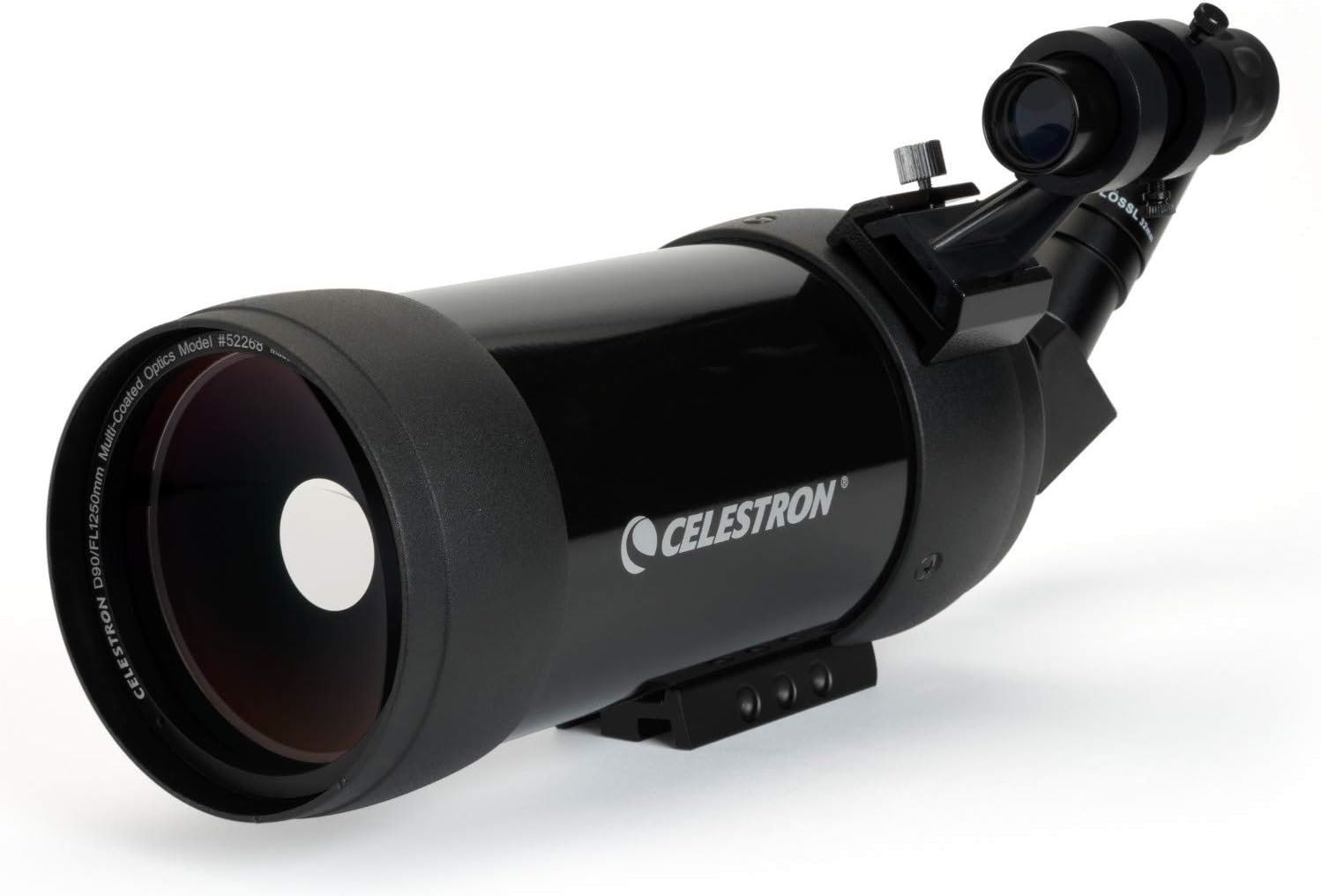
The Celestron C90 Maksutov Spotting Scope combines a 90mm Maksutov-Cassegrain optical system with 39x magnification in a compact, portable design. Ideal for birding, target shooting, and digiscoping, it includes a 32mm eyepiece, 45° erect image diagonal, 8x21 finderscope, and a nylon backpack. Fully camera adaptable and backed by a Limited Lifetime US Warranty, it delivers bright, sharp, high-contrast views wherever your adventures take you.




| ASIN | B0038QYRDO |
| Additional Features | Maksutov-Cassegrain Optical Design with High Contrast Views and Compact Portability |
| Best Sellers Rank | #128,931 in Sports & Outdoors ( See Top 100 in Sports & Outdoors ) #29 in Spotting Scopes |
| Brand | Celestron |
| Built-In Media | 32 mm Eyepiece, 45° Erect Image Diagonal, 8x21 Erect Image Finderscope and backpack |
| Coating | Multi-Coated |
| Compatible Devices | Smartphone |
| Customer Reviews | 4.5 out of 5 stars 373 Reviews |
| Exit Pupil Diameter | 2.3 millimeters |
| Eye Piece Lens Description | Plossl |
| Field Of View | 9.7 degrees |
| Finderscope | 8x21 Erect Image Finderscope |
| Focal Length Description | 1250 millimeters |
| Focus Type | Manual Focus |
| Global Trade Identification Number | 00050234522687 |
| Item Dimensions D x W x H | 15.7"D x 10.2"W x 10.2"H |
| Item Highlight | Ultra-Compact Spotting Scope, Perfect for Long-Range, Visual & Digiscoping Ready, High-Contrast Views, Accepts 1.25" Eyepiece |
| Item Weight | 2.1 kg |
| Manufacturer | Celestron |
| Manufacturer Part Number | 52268-CGL |
| Model Name | Spotting Scope C90 MAK Zoom |
| Model Number | 52268-CGL |
| Mount | Equatorial Mount |
| Number of Items | 1 |
| Objective Lens Diameter | 9 centimeters |
| Optical Tube Length | 7 centimeters |
| Optical-Tube Length | 7 centimeters |
| Power Source | Manual |
| Telescope Mount Description | Equatorial Mount |
| UPC | 050234522687 |
| Unit Count | 1 Count |
| Warranty Description | Limited Lifetime Warranty |
| Zoom Ratio | 39 multiplier x |
C**I
Spotting plus sky views in small package
Purchased this to help my sons see holes in targets 300 yards away, this is perfect and a lot less expensive than many shooting scopes. (The holes are 1/4 inch.) Other shooting scopes may be smaller and thus more portable for seeing game but can cost 10x this price. The accessory smaller finder scope is necessary for aiming this onto most any target as the field of view is tight - this is not a zooming optic. It is easy to set up alignment of finder and main scope - a bit of trial and error with some finger screws. The finder scope in my case had a pushed in objective lens and Celestron is sending a replacement. Their phone support is excellent, APPLE class or like calling Mercedes or Rolls Royce. (A Mak is a 'Rolls Royce' level of optical pleasure.) The person who answers solves the problem. The main optics were excellent out of the box - don't attempt to adjust this. The supplied Plossel eyepiece is ideal with a comfortably wide apparent field of view, even though the telescope is looking at a restricted bit of the world. There was no apparently color fringing or distortion. The eyepiece has enough relief (distance from the eyepiece to me) to allow my eye and glasses to see the full field of view. You need a strong, non-shaking tripod to use this scope - nothing flimsy will give a stable view. Use a solid tripod - even an old wooden one, point this at the stars, planets and moon and have a treat! This is the best view you can get for under $200. First time this shows 4 moons of Jupiter, easily focused along with the planet. It does not show Jupiters's red spot - that would require a lot more magnification, but resolving the moons should give you some sense of the sharpness of the optics. Looking at birds allows a view of colorful feathers and how they are aligned. You can easily count shingles on a house 3000 ft away. It travels easily in a checked bag at Southwest Airlines. If you like the sky views and your tripod cooperates, you will be tempted to buy a larger Celestron for astronomy. For crude aiming, I'd draw a thin white line along the top of the scope or use a thin white tape or targets. If you do decide to buy a bigger telescope for the night sky, the eyepieces work on both!
F**5
Celestron C90 Mak Spotting Scope (Black)
The only other telescope I have owned was a tiny, cheapo K-mart thing that I had when I was 13. With it I was able to make out the moons of Jupiter, however, which was utterly fascinating. Fast forward many years, I just purchased the Celestron C90 scope, and it's a whole 'nother animal. Comes with all the accessories you will need except a tripod, including a handy backpack style soft case. The dovetail mount is drilled and tapped to fit any standard tripod. Comes with 45 degree image erector, Plossl type eyepiece, lens covers, a sighting scope, lens cloth, etc. I bought this unit to use as a terrestrial spotting scope, and for the price it is a remarkable unit. It has a quality look and heavy weight feel that is impressive for a scope in this price range. These catadioptric-style scopes have a couple of real advantages vs. traditional, refractor type spotting scopes. First, the C90 uses common 1.25" astronomic eyepieces, of which there are multitudes of them in the aftermarket to choose from (although the 32mm eyepiece that is included is quite good, this was a nice surprise). Secondly, the C90 is capable of providing very good images at focal lengths (i.e. high magnification) that leave regular spotting scopes in the dust. I did a quick test of the unit mounted on a Bogen tripod and pointed it at Jupiter on a night with about a quarter moon. To my surprise, I could faintly make out the bands on the planet disk itself. With a set of filters I'm sure the color bands would have been even more evident. Views of the moon were contrasty, very bright and quite sharp. The focusing knob, at the rear of the main scope tube, is very precise and has a nice feel/resistance to its motion. To be sure, the C90 would make a dandy backyard astronomic telescope, although a motorized astro tripod would be necessary to truly enjoy star-gazing with it. Informal daytime terrestrial viewing with various eyepieces showed crisp, contrasty images at magnifications twice that of typical refractor spotting scopes in this price range. A bonus: the rear case of the C90 is threaded for cameras using the T-mount system, and given the right tripod and camera setup, can provide quite impressive photographic results. Recommended accessories for this wonderful little scope - a Celestron "zoom" eyepiece, to minimize swapping out single-focal-length eyepieces; also, a sturdy, high-quality tripod of either the camera or the astronomical variety, depending on your needs. SUMMARY: A very capable, sturdy spotting/astro scope for a very attractive price. I'm super pleased with the Celestron C90, and it is a pleasure to own and use.
H**D
Good beginner scope to learn what you don't know.
I am a neophyte with telescopes and decided that for what I want to do, this would be a good entry model for me. I was mostly interested in looking at and photographing the moon, maybe some planets, and possible use it for other celestial background photo work. It was also a shot at getting my feet wet before I plopped down thousands of dollars to find out I got the wrong stuff. Turns out this is a good choice to cut my teeth and learn lessons. The unit is fairly rugged, self-contained, and more or less sealed so you can't accidentally mess something up. It is heavy...too heavy for even the best camera tri-pod. Combine that with the Earth's habit of rotating objects out of your field of view fairly quickly, you need a specifically designed tri-pod to handle it. I got the one from Celestron with the azimuth controls so once I get the moon in the telescopes sights, I can rotate some knobs and keep it in view. That works well without having to invest in a "clock" type mount. Photography can be done a couple of ways without investing in those purpose built units which are big on price tags and low in resolution. The first way is to use an adapter to mount a digital SLR body to the unit. The second is what I did, which is another adapter from Celestron that allows you to mount a point-and-shoot type digital camera behind the eyepiece. I used an Olympus TG-2 which worked really well, once you got everything aligned. In some ways, using the rear display of the camera is easier to find and keep your subject in frame. As for the actual quality of the image, I am not an expert. It seems very crisp to me and I don't seem to see any color issues. What is important is setting the unit up correctly. You need to use some local object to "sight in" the cross-hairs in the spotter scope to match what you see in the telescope. Once that is done, it is far easier to find your astronomical targets. It is still weird getting used to the idea of getting my eyes aligned directly behind the eyepiece and about an inch away from it. I also like that the image is "right side up" like a binocular view rather than the flipped over version most telescopes have. This will allow me to use it for nature viewing as well. This unit will get me through my learning phase until I know better what I want and how much money I am willing to spend. I have attached two photos. One is of the telescope on the tripod with the digital camera adapter. The other is the first photo of the moon I took with it.
L**S
Great Spotting Scope
-Excellent scope for spotting. -I specifically bought this scope as a spotting scope for Yellowstone National Park with the idea that if I needed to, it would be a great portable mediocre astronomical telescope in a pinch. - Eyepiece is sub par. I feel they should include a better widefield eyepiece. I have an Orion Stratus 24mm 68 degree, which is no longer available. However, Baader Hyperion would be great as well. I found the 24mm to be wonderful, but I would like to invest in an 18mm Baader Hyperion to further test the scope. My cheap plossl 18mm was disappointing only because the 24mm Orion Stratus was so bright and had such wide field of view. I found binoculars to be helpful for wildlife targeting and using the scope once I found my target. I was able to clearly see a grizzly and cubs 2 miles out with the included eyepiece, so I'm not docking any points. -Sight scope was sub par as well, but I don't need it to do anything but see where I'm pointing my scope, so it didn't matter to me. You can easily fit a good sighting scope, so I am not docking any points. -Digiscoping with my old K30 Pentax was okay. It's not a professional quality telephoto lens, so my expectations were not high. I did not test with a cell phone yet, but I may update in the future. If you want a professional quality telephoto lens, this is not the one for you. However, if you want to have some memories of the animals you could view or practice with astrophotography, this is a great scope for you. I think this scope is a great budget spotting scope and possibly a decent portable astronomical scope. For the price and versatility, it is a great little scope. I was able to see wolves clearly 1 mile out and some grizzlies 2 miles away. Compared to a top of the line spotting scope, no it's not the best. However, people with a budget spotting scope that couldn't see the wolves and bears were able to clearly see them in my scope. I was pleased with this purchase. If you would like added clarity, get a nicer eyepiece. Find a used eyepiece. Mine is used and worked great. Also, as with any spotting scope. Find a nice used high quality tripod. I had an old used manfrotto with a $60 head. With the combo, it was perfect for my needs.
K**J
Great and affordable Shooting Range Spotting scope
I'm using this at the rifle range for spotting. Super clear out to 200 yds so far. Can easily see .243 hits on Shoot n See target but can also see hits t to the white backing board I use. I'm certain .223/5.56 round hits would also be easily seen at 200 Yds. This was with the 32mm eyepiece included with the scope. I plan to purchase an 8-24 Celestron eyepiece but if you have a 12mm already, that's all probably all you'd need if you don't mind using two or a looking at both close range and distant targets. Field of view is very good. I expect it to work well at 300 yds. Will update soon on that. My C90 sits on a Dolica GX600B200 tripod. I only extend the upper (thickest) legs and sit it to my left as I shoot. The combination of the the C90 and Dolica GX600 makes a solid enough platform. I used the included soft case to transport it. The Dolica tripod I purchased has it's own soft case. Set up and break down is quick enough. The scope is protected enough in the soft case for rolling around in a car, but I wouldn't do any drop tests on concrete. I don't think there's enough protection for a drop from table height to a concrete surface. If that's a concern, look into a separate hard case. I just plan to be careful. After searching for a good spotting scope for the range and trying similarly price purpose build 60mm and 80mm scopes, I'm glad I purchased the C90. Field of view is better than others I've tried and the useful magnification you can get on this 90mm scope is better than the fixed 50x or 60x spotting scopes you'll see. I'll be testing at 500 yds over the summer and I expect good results. Will follow up on that as well. If you need something out to 1000 yds, by best guess is this may be ok, but a 120mm Maksutov might be a better choice.
C**L
This little scope makes a lot of promises but seems to fall short on most of them.
What attracted me to this scope was the potential for double-duty as both a terrestrial spotting scope and a simple way to view the moon and planets on those clear nights. The small size also meant that I could easily take it with me in a backpack when traveling (it actually comes with a light-duty pack). Given the small size and modest price, my expectations were relatively low, but I did expect it to do a reasonably good job for casual use. Spoiler alert, I returned it. First, I found the supplied eyepiece to offer far too narrow a field of view. While I appreciate the high magnification sells scopes, eyepiece supplied simply asks too much of the scope's modest optics. If that weren't bad enough, the high magnification makes it almost unusable on a standard photo tripod, even a really good one. Next, I found terrestrial images to be "soft", with a washed-out appearance. Comparing the image quality of the scope with a telephoto zoom lens on an inexpensive DSLR showed just how inferior the images were. As for astronomy, it was a complete washout for me, because the supplied finder scope was completely useless and couldn't be focused at all on sky objects. Even a few seconds of hunting for planets were frustrating, making the experience complete misery. Before sending it back I contemplated some fixes, like buying a couple of eyepieces or a single zoom model, buying a proper mount and tripod, and swapping out the awful finder scope. Then I came to my senses; why throw good money after bad? I realized that what I was hoping to get with this little MAK was just too good to be true. For what I paid for the scope, I could get a decent pair of binoculars that would outperform it in every way. If and when I do invest in a proper telescope, I'll spend what it takes to get a good one.
G**G
Good Value
This fits the criteria for a light-weight, pick-up and go. The main purpose will be astronomy. I envision plenty of other use cases. I'll stick with the universe. All the components were packed neatly and individually inside the compartments of the carry bag. It took 5 minutes to put together. I had to wait patiently for a tripod (home use) and mini dobsonian stand (road use) to arrive before setting up the finder scope. I also ordered a 90° diagonal for night viewing. The 45° degree is great for birds on the lake, and uncomfortable when pointing towards the planets. The finder scope is fine. It requires a different technique to align your telescope than using a red dot. Complaints in this realm are a matter of preference. Unless you're using a Go-to system, you're never going to point at something you can't see. The views and images are very clear and crisp. My photos through the supplied 32mm eyepiece don't do this device justice. In 5° weather, I opted to point the telescope through double paned windows, a major No-No, but you get the gist. This far, I'm pleased with my purchase
V**A
Some advise for astronomical use
I got this "spotting scope" mainly for astronomical use. The Maksutov Cassegrain design makes it an excellent travel scope, very capable optically, without the color aberration or "coma" of other telescopes. This scope is an excellent implementation of the design, and is optically great. However, there are a few caveats, which I list here: PRO: Because of it's high focal ratio (F13.9), it works great with economical eyepieces. CON: only comes with one eyepiece (32mm, for 56x magnification). To get this as a first telescope, I highly recommend you get the "Celestron 93230 8 to 24mm 1.25 Zoom Eyepiece". They work great together, awesome views of the planets and the moon. PRO: very lightweight, easy to take on hikes, airline carry-on bags, trips to dark skies, etc. Comes with a nice bag. CON: does not come with a tripod. This is it's crux, because for astronomy use not any photo tripod will do. A good astronomy tripod (with slow motion controls or tracking) will cost more than this telescope. It *can* be used with a good travel tripod with fluid head (which is what I use) but this way you sacrifice "ease of use" for portability. PRO: excellent optics, easy to get very high useful magnifications and outstanding views of moon and planets, easy to split double stars, and good views of a few of the brightest nebula. CON: Very narrow true field of view: Maxes at just 1°, in which many of the larger star clusters (like the Pleiades) won't fit. Also, faint nebula look very dim, because of the small 90mm aperture. PRO: fully erecting diagonal makes it easy to navigate the sky, and not "get lost" with inverted/mirrored images. CON: the 45° diagonal is just not suited for astronomical use, because it makes it really uncomfortable to look at things that are very high in the sky (near the zenith). To use this spotting scope as a telescope, you will need to purchase a "90° mirror diagonal" or your neck will hurt. (I got an $18 SVBONY 1.25 90° diagonal from Amazon, and it works) PRO: The finder is nice. Fully erecting, nice aperture, balanced magnification, easy to align. CON: The finder is "straight through". There are "RACI" (right angle) finders that are more comfortable to use, although those are very expensive, so the included finder works fine. PRO: the price of this scope just can't be beaten. It's optical performance per dollar is top notch. CON: Not a full package. Additional purchases of a 90° diagonal and tripod/mount are required. The Celestron C90 was my first telescope, and I'm very satisfied with it. It is best for the planets, the moon, splitting double stars, and a few of the brightest deep space objects (more if you can travel to a very dark sky). If portability or price is paramount, it is an excellent choice. However, for home use, a larger aperture telescope (150mm or more) for a bit higher cost, could serve you better. Note: these pictures were taken with a Motorola MotoG3, they don't do justice to what you see through the eyepiece.
Trustpilot
5 days ago
2 weeks ago