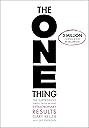
The ONE Thing: The Surprisingly Simple Truth About Extraordinary Results
Product ID: 1415428
🌍Translated into 40 languages
🏆12 prestigious book awards
📈Top #7 in Time Management
Desertcart purchases this item on your behalf and handles shipping, customs, and support to Argentina.
🎯 Focus on your ONE thing, and watch everything else fall into place.
The ONE Thing is a critically acclaimed, award-winning bestseller that teaches professionals how to dramatically improve productivity and life satisfaction by focusing on their most important task. With over 21,000 reviews and top rankings in time management and self-help categories, this book offers practical, actionable advice backed by global impact and proven success.


| Best Sellers Rank | #4,031 in Books ( See Top 100 in Books ) #10 in Time Management (Books) #17 in Job Hunting & Career Guides #21 in Personal Time Management |
| Customer Reviews | 4.6 out of 5 stars 21,936 Reviews |
B**A
Great book
I found The ONE Thing to be an incredibly insightful and motivating read. The concepts are simple, practical, and immediately applicable to both personal and professional life. It really helped me rethink how I prioritize my time and energy. The authors do an excellent job of breaking down the importance of focusing on what truly matters instead of getting overwhelmed by endless to-do lists. The central message is powerful: identifying the one most important task can create extraordinary results over time. The writing is engaging, easy to follow, and filled with actionable advice. I walked away with a clearer mindset, better productivity habits, and a renewed sense of direction. If you're looking for a book that can genuinely improve your focus and effectiveness, this is absolutely worth reading. Highly recommended!
J**E
What I needed to achieve some objectives I had pending!
The ONE Thing” by Gary Keller and Jay Papasan is a transformative guide to achieving extraordinary results through focused effort and prioritization. The central premise of the book is the idea that by concentrating on one single task—the most important one—you can achieve more significant results than by spreading your effort across multiple tasks. The authors emphasize the power of simplicity and the importance of identifying the one thing that will make everything else easier or unnecessary. They provide practical strategies for overcoming distractions, building productive habits, and maintaining focus. Through a combination of research, anecdotes, and practical advice, Keller and Papasan guide readers on how to apply this principle in various aspects of life, including work, personal goals, and relationships. The book’s clear, concise writing and actionable steps make it an accessible and valuable read for anyone looking to boost their productivity and achieve their goals. Overall, “The ONE Thing” is an insightful and practical book that encourages readers to prioritize their efforts and focus on what truly matters to achieve extraordinary results.
C**L
It's good, not amazing. A lot of obvious stuff.
It's a bestseller, so of course it's not a bad read. But a lot of the points are really simple, and not too mind-blowing. It's written as if following the tips in this book will completely change your life... Mehhhh. It's a good read, but I wasn't as enthusiastic as its author, Gary Keller. It covers a lot of really basic things, and gets a little repetitive sometimes. For example: X was famous. X's story is blah blah blah. X was famous because he prioritized and focused. Y was famous. Y's story is blah blah blah. Y was famous because he prioritized and focused. Z was famous. Z's story is blah blah blah. Z was famous because he prioritized and focused. He mentions all the obvious famous people and their stories. Bill Gates. Steve Jobs. Oprah Winfrey. Sam Walton. Geez. Yes, they're famous, and yes they probably prioritized and stuff. But it goes on and on and on. He does have a lot of other points, but by the end I was getting bored. Most of his sentences were words of enthusiasm or repetition rather than new original ideas. And he does have a lot of ideas. Those ideas don't require much explaining though. He probably spends dozens of pages on "focusing" alone. I know that the whole book is about prioritizing, but... geez. A lot of droning on about this whole "ONE Thing" idea. Like I said, it's a great book, but by the end I was getting a little bored. Some other advice is just really basic, like time management, and putting your time into blocks. Thinking big instead of thinking small. They're all good points, but you could sum of the whole entire book in like, one page with bullets. And that's how I feel about the book. It's great, but could be condensed into just a page with bullets. It's like one of those books that's better for skimming rather than deep reading. Just skim the hell out of it, take those "bullet-point ideas" and finish from it.
R**A
Great book about achieving extraordinary results by focusing on what's important
Gary Keller proposes a framework for achieving extraordinary results in work and in life in general. The author’s premise is that extraordinary results are directly determined by how narrow you can make your focus, or more precisely, by focusing on the One Thing. "[Achievers] have an eye for the essential. They pause just long enough to decide what matters and then allow what matters to drive their day. Achievers do sooner what others plan to do later and defer, perhaps indefinitely, what others do sooner. The difference isn’t in intent, but in right of way. Achievers always work from a clear sense of priority." The author explains how getting things done is not a matter of discipline but of developing habits that will help you focus on the task at hand. Discipline is needed to acquire the habit, but we cannot run on discipline in the long term. Achieving extraordinary results requires making extraordinary efforts. In that sense, Keller does not believe in a balanced life as a goal to be achieved or a state of balance, but in counterbalancing your life as an every day reality, an act of balancing. "If you think of balance as the middle, then out of balance is when you’re away from it. Get too far away from the middle and you’re living at the extremes. The problem with living in the middle is that it prevents you from making extraordinary time commitments to anything. In your effort to attend to all things, everything gets shortchanged and nothing gets its due. Sometimes this can be okay and sometimes not. Knowing when to pursue the middle and when to pursue the extremes is in essence the true beginning of wisdom. Extraordinary results are achieved by this negotiation with your time." "One day you finally come to understand that work is a rubber ball. If you drop it, it will bounce back. The other four balls—family, health, friends, integrity—are made of glass. If you drop one of these, it will be irrevocably scuffed, nicked, perhaps even shattered." The book mentions the now-more-known Stanford Marshmallow Experiment by Walter Mischel, which relates the effect of delayed gratification and developing grit with outcome and success in different areas in life. Keller also cites Carol Dweck‘s research on growth-mindsets vs fixed mindsets as an example of how your perception of things strongly affect what you can achieve: "Dweck’s work with children revealed two mindsets in action—a “growth” mindset that generally thinks big and seeks growth and a “fixed” mindset that places artificial limits and avoids failure. Growth-minded students, as she calls them, employ better learning strategies, experience less helplessness, exhibit more positive effort, and achieve more in the classroom than their fixed-minded peers. They are less likely to place limits on their lives and more likely to reach for their potential" Keller’s framework is constructed on applying what he calls the Focusing Question to the different areas of your life: What’s the ONE Thing I can do such that by doing it everything else will be easier or unnecessary? "Productivity isn’t about being a workhorse, keeping busy or burning the midnight oil…. It’s more about priorities, planning, and fiercely protecting your time." "To stay on track for the best possible day, month, year, or career, you must keep asking the Focusing Question. Ask it again and again, and it forces you to line up tasks in their levered order of importance. (…) you can drive yourself nuts analyzing every little aspect of everything you might do. I don’t do that, and you shouldn’t either. Start with the big stuff and see where it takes you. Over time, you’ll develop your own sense of when to use the big-picture question and when to use the small-focus question." Answers to the Focusing Question come in three categories: doable (something that is already within your reach), stretch (at the farthest end of your range), and possibility (an answer that exists beyond what is already known and being done). “Highly successful people”, explains Keller, “choose to live at the outer limits of achievement. They not only dream of but deeply crave what is beyond their natural grasp.” The Focusing Question, however, is not enough. Adopting the mindset of someone seeking mastery is needed (the commitment to becoming your best, and embrace the effort it represents). "More than anything else, expertise tracks with hours invested. Michelangelo once said, 'If the people knew how hard I had to work to gain my mastery, it wouldn’t seem wonderful at all.'" You will also need to deal with the natural ceiling of achievement with a purposeful mindset (not accepting the limitations of our natural approach as the last word), and learn to be accountable for the outcome of your lives (in contrast with being a victim of the situation). This is essential —according to Keller— to achieve extraordinary results. "If you have to beg, then beg. If you have to barter, then barter. If you have to be creative, then be creative. Just don’t be a victim of your circumstances." Almost finishing the book, Keller warns the reader against the four thieves that can stand in our way to extraordinary results. The inhability to say “No” , the fear of chaos —”pursuing your One Thing moves other things to the back burner (…) chaos is unavoidable. Make peace with it. Learn to deal with it”— , poor health habits, and an environment that doesn’t support your goals. I enjoyed reading the book and strongly agree with most of what the author proposes. You can use the framework “as-is” or adapt it to suit your needs
J**E
How this simple but profound question changed my thinking
I read The ONE Thing several days before going into the Grand Canyon for a 5-day solo retreat and took with me a slight variation on the question posed in the book: What is the one thing that, if accomplished, would facilitate every other goal that we have at Values Coach? On the flight to Arizona I wrote out what I thought would be my answer in a journal (it had to do with creating new teaching materials around our core course on personal values). But after living with the question for those 5 days, I came out of The Canyon with a completely different answer - and it is an answer that has gained unanimous support of the rest of the crew. What made the question so powerful was the way in which it forced me to think in terms of priorities - not "either / or" but "what one thing comes first." With that, it became clear that achieving critical mass with another product that had been one of several priorities would make everything else a whole lot easier - and with that, it becomes a whole lot easier to make the commitment to saying "not yet" to those other priorities. Another strength of the book is the persuasive argument they make for blocking off a significant chunk of time each day to work on that ONE Thing priority. As someone with RBADD (Really Bad!) I've read lots of books and articles on focus, several of which the authors quote, but this is the most compelling and practical discussion of the topic that I have seen. And since I am on the road almost every week for at least part of the week, the challenge of blocking off four hours a day for this ONE Thing means some serious rethinking of our business model and my personal life and work choices. One caution: the authors show how this question to identify the ONE Thing can be used in multiple dimensions of your life - professional, financial, family, spiritual, etc. But trying to identify ONE thing in each of those realms at once runs the risk of creating the exact lack of focus that the book is designed to help you overcome. So while it's a useful question in each of those life domains, it would be wise to choose just one to start with and prove to yourself that it works. I give the book 5 stars because it is well researched and well written and makes a unique contribution to a crowded field. If I can follow through on the simple but by no means easy prescription I have given myself as a result of reading it, I will come back a year from now and petition Amazon to allow me to upgrade my review to 10 stars.
E**N
Chat GPT recommended I read this and I’m glad I did.
My AI knows me pretty well and so I asked it what book would help me the most. It’s was Gary Keller’s the One Thing. And my AI was right. Great read to put your dominos in a row.
M**A
Big fan
im a big fan of the philosophy and i even became a coach because i believed it so much.
K**N
Really about focus and self management rather than time management
http://karlocallaghan.com/2015/04/13/the-one-thing-book-review/ The ONE Thing was written by Gary Keller and Jay Papasan and first published in Great Britain in 2013 by John Murray Press, Hodder & Stoughton. The best books usually make the argument that so-called time management is really about choice, focus and self management rather than attempting to manage time. Thousands of books have been written on the subject and I have wasted time reading a few of them - finding bits here and there that work for a while but never quite give me the answers I am looking for. While Covey's The 7 Habits of Highly Effective People made sense at the time and it definitely made me change my thinking, I have found that seven things are too much for my tiny brain to remember! ;) Getting Things Done: The Art of Stress-Free Productivity by David Allen was another book that influenced me a number of years ago. But I would be hard-pressed to remember the five steps he suggests or any other snippets of advice that I could quote today as having become a part of how I manage myself or my time. The ONE Thing is different. In arguing for focus, it really keeps things simple with a very clear and uncluttered approach. Being based on one question repeatedly asked (in very slightly differing ways which could admittedly get old or annoying quite quickly) to drill from big picture to small detail it feels easy to remember and to adopt straight away. For me, it's very reminiscent of the Toyota way of asking Why? five times. I won't ruin the book for those who want to read it, and I'm sure the authors wouldn't be too pleased if I gave away the key question. The authors quote research that says it takes an average of 66 days to form a habit. So even in its simplicity, they are not promising quick wins like so many self-help evangelists do. The ONE Thing is based on a premise provided by a Russian proverb, За двумя зайцами погонишься – ни одного не поймаешь (Za dvumya zaitsami pogonish'sya - ni odnovo nye poimaesh') If you chase two rabbits, you will catch neither. It espouses blocking off time each day to focus on something (not a new idea and one which I have read in many books), which I think ignores relationships. It is not as easy as simply turning down a meeting request from your manager. But it is hard to argue with the logic that time devoted to key goals rather than being bogged down or disturbed by less important stuff has a compound effect. The authors use a domino metaphor and illustrate quite well that from research proven in 1983 that a smaller domino is capable of knocking down a domino fifty percent larger than its own size: starting with a standard domino (which would in turn knock down a domino 1.5 times its size) by the 10th iteration, the domino would be the height of an American football quarterback; by the 23rd, the Eiffel Tower; and the 31st taller than Everest. Their metaphor is not lost on the reader in saying that by working on important things each day in a focused way, we can achieve great things. Ask me in 66 days if I got results!
V**M
5 star
I didnt read this yet, but I have to give 5 star for physical quality, packaging and no damage.
M**T
Un must!
Recomiendo este libro a quien quiera comprometerse con sus metas, sueños y objetivos sin perder el rumbo. Lo volvería a leer mil veces!!
S**R
LIVRO PRÁTICO E CLARO
A tese do livro vai contra a opinião comum, de que as pessoas que executam multitarefas são mais produtivas, e defende com pesquisas e ideias que devemos ter um foco principal na vida, e nos concentrarmos neste valor principal, e sim, essas são as pessoas mais bem resolvidas. Considerei excelente, simples e harmonioso.
H**A
Extraordinary book
Life-Changing Read! Important Points Already underlined & highlighted by pencil mark print & it's advanced technology for readers. The ONE Thing is a powerful book that teaches you how to focus on what truly matters. The concepts are practical, easy to apply, and can significantly improve productivity. The hardcover quality is premium, with excellent print, sturdy binding, and a great reading experience. Highly recommended for anyone serious about personal and professional growth.
O**I
Delivered item not a new article as per purchase
I received the book yesterday and it’s definitely not a new item; the covered is damaged and dirty all over the entire covered of the book. That’s very disappointed because I paid for a new article, obviously I received an item which has been used and is not new. The content of the book is great, therefore I give only 3 stars because of the condition of the item, not because of the book itself.
Trustpilot
2 weeks ago
1 month ago