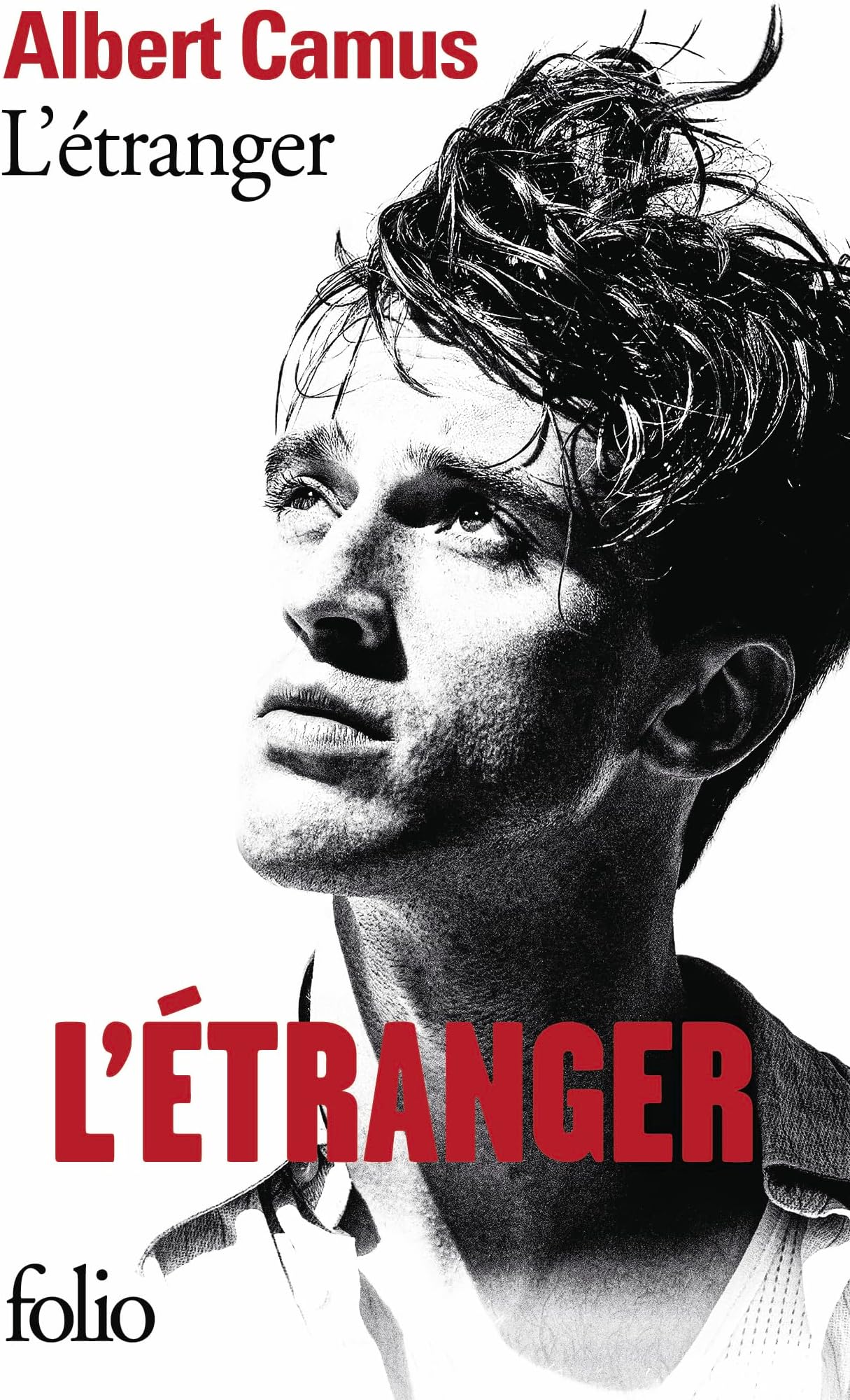
L'étranger (Collection Folio, no. 2)
Product ID: 1210755
Quand al sonnerie a encore retenti, que la porte du box s’est ouverte, c’est le silence de la salle qui est monté vers moi, le silence, et cette singuliere sensation que j’ai eue lorsque j’ai constaté que le jeune journaliste avait détourné les yeux. Je n’ai pas regardé du côté de Marie. Je n’en ai pas eu le temps parce que le président m’a dit dans une forme bizarre que j’aurais la tête tranchée sur une place publique au nom du peuple français… Review: Truly, a novel of the utmost relevance for today… - It is a grim novel. The last word is “hate.” And, in part, it concerns the conflict between the Arab and white European worlds. Albert Camus was a “pied-noir,” a French Algerian of European descent. He was their most famous writer, and would win the Nobel Prize for Literature in 1957. This was his first novel, published in 1942 and set in the 1930’s. The title literally means “stranger,” but is often translated as “The Outsider.” The protagonist is Meursault (the name of a famous wine from the Burgundy region) who requests permission from his boss to attend his mother’s funeral in the town of Marengo (now Hajout), 80 km southwest of his home in Algiers. She had been living in a home for the elderly. Both his decision to place his mother in the home for the elderly (due to limited financial resources) as well his failure to cry at her funeral would mark him as an “outsider,” that is, outside societal norms and an indicator that he refuses to “play the game” (of life). This status would literally have fatal consequences for him. Camus quick, sharp description of the funeral itself reminded me of the pointillism painting technique of Georges Seurat. Meursault has a clerical job, and seems to be drifting through life, self-absorbed, yet without insight into his condition. His girlfriend is Marie, and there are some delightful scenes at the beach, and swimming in the Mediterranean together, filled with the foam, the sun and the salty water. He agrees that he will marry her, but true to form, states that he does not love her. Camus details Meursault’s interaction with a couple of the residents in his apartment building, including Salamano, who mistreats his dog, and Raymond, who mistreats his wife, by beating her, claiming that she is “cheating” on him. His wife is Arab. That fact is the critical catalyst for all that will follow. Raymond’s wife’s brother (and a couple buddies) commence to follow Raymond when they go to the beach. Meursault will ultimately shoot and kill one of the (unnamed) Arabs, adding an extra four bullets into his body for good measure, with a different catalyst for his actions: the sun. The second half of the novel relates to how this plays out in a court of law, with Meursault’s stubborn insistence not to “play the game” dooming him. For example, he proclaims his status as an atheist to a judge who clearly was not. Time and again, Meursault reminded me of the role Tom Courtney played in The Loneliness of the Long Distance Runner . Given how often that those in the more powerful position are absolved of their crimes, it was somewhat of an anomaly for Meursault to be convicted. However, the valid argument could be made that Meursault was merely a “foot soldier” of the powerful, and these pawns are occasionally sacrificed. The French publisher, Actes Sud, has recently published Kamel Daoud’s novel Meursault, contre-enquête (Domaine français) (French Edition) . It won Goncourt’s award for a first novel. It has also been issued in English as The Meursault Investigation . It tells the story Camus related from the Arab point of view. The two novels are instructive tales for our time. In the spirit of “a butterfly wings flapping in China, causing that tornado in Kansas,” which denotes the long, seemingly random links between cause and effect, what of an Arab woman’s face slapped, in the 1930’s, leading inexorably to the latest terrorist attack in Brussels? 5-stars for Camus’ novel, and his initial insights into the matter. Review: Excellent book. - A great book. I have read this book in my 20’s. I loved it then. Now in my 60’s I got more out of it through life experiences. I loved it more.
| Best Sellers Rank | #140,940 in Books ( See Top 100 in Books ) #2,060 in Contemporary Literature & Fiction #10,744 in Genre Literature & Fiction |
| Customer Reviews | 4.5 out of 5 stars 6,599 Reviews |
J**I
Truly, a novel of the utmost relevance for today…
It is a grim novel. The last word is “hate.” And, in part, it concerns the conflict between the Arab and white European worlds. Albert Camus was a “pied-noir,” a French Algerian of European descent. He was their most famous writer, and would win the Nobel Prize for Literature in 1957. This was his first novel, published in 1942 and set in the 1930’s. The title literally means “stranger,” but is often translated as “The Outsider.” The protagonist is Meursault (the name of a famous wine from the Burgundy region) who requests permission from his boss to attend his mother’s funeral in the town of Marengo (now Hajout), 80 km southwest of his home in Algiers. She had been living in a home for the elderly. Both his decision to place his mother in the home for the elderly (due to limited financial resources) as well his failure to cry at her funeral would mark him as an “outsider,” that is, outside societal norms and an indicator that he refuses to “play the game” (of life). This status would literally have fatal consequences for him. Camus quick, sharp description of the funeral itself reminded me of the pointillism painting technique of Georges Seurat. Meursault has a clerical job, and seems to be drifting through life, self-absorbed, yet without insight into his condition. His girlfriend is Marie, and there are some delightful scenes at the beach, and swimming in the Mediterranean together, filled with the foam, the sun and the salty water. He agrees that he will marry her, but true to form, states that he does not love her. Camus details Meursault’s interaction with a couple of the residents in his apartment building, including Salamano, who mistreats his dog, and Raymond, who mistreats his wife, by beating her, claiming that she is “cheating” on him. His wife is Arab. That fact is the critical catalyst for all that will follow. Raymond’s wife’s brother (and a couple buddies) commence to follow Raymond when they go to the beach. Meursault will ultimately shoot and kill one of the (unnamed) Arabs, adding an extra four bullets into his body for good measure, with a different catalyst for his actions: the sun. The second half of the novel relates to how this plays out in a court of law, with Meursault’s stubborn insistence not to “play the game” dooming him. For example, he proclaims his status as an atheist to a judge who clearly was not. Time and again, Meursault reminded me of the role Tom Courtney played in The Loneliness of the Long Distance Runner . Given how often that those in the more powerful position are absolved of their crimes, it was somewhat of an anomaly for Meursault to be convicted. However, the valid argument could be made that Meursault was merely a “foot soldier” of the powerful, and these pawns are occasionally sacrificed. The French publisher, Actes Sud, has recently published Kamel Daoud’s novel Meursault, contre-enquête (Domaine français) (French Edition) . It won Goncourt’s award for a first novel. It has also been issued in English as The Meursault Investigation . It tells the story Camus related from the Arab point of view. The two novels are instructive tales for our time. In the spirit of “a butterfly wings flapping in China, causing that tornado in Kansas,” which denotes the long, seemingly random links between cause and effect, what of an Arab woman’s face slapped, in the 1930’s, leading inexorably to the latest terrorist attack in Brussels? 5-stars for Camus’ novel, and his initial insights into the matter.
A**L
Excellent book.
A great book. I have read this book in my 20’s. I loved it then. Now in my 60’s I got more out of it through life experiences. I loved it more.
R**N
Profond, Étrange et Laconique
Au début ce livre commence très sec et bizarre en décrivant le narrateur et le mort de sa mère. Au cours de la primer partie on essaye d’apprendre qui est le narrateur et pourquoi il s’exprime toujours indifférent. La deuxième partie est plein de jugements par tous et réalisations par le narrateur qu’il ne mélange pas avec la société, qu’il est vraiment différent qu’autrui et que ses amis auraient lui supporter au bout s’il les permettait. Le profond ne vient pas en lisant le livre, mais en réfléchissant sur les événements du livre et quoi qu’en veut dire dans la vie dehors du livre.
R**E
Self-possession or Anomie?
I read this masterpiece in French, but would not insult the crystalline clarity of Camus' prose by attempting a review in the same tongue. Indeed, a review of such a classic is pointless; all that is possible is a personal reaction. I found myself held in horrified fascination as Meursault sleepwalks through the burial of his mother, his job in Algiers, his girlfriend's embraces, and his neighbor's scheme to teach his own mistress a lesson, all under the heat of the desert sun. Even had I not known in advance, I could feel that something bad was about to happen, and it was almost a relief when it did. At least then there would be time to seek some meaning in such a barren life. The meaning comes in the penultimate paragraph when Meursault rails at the priest who visits him in his condemned cell. In a long diatribe, filled with a passion that had been missing in the book so far, the young man proclaims that, compared to the uncertainties of religion, he at least has lived in the surety that the life he has lived from moment to moment has been his and his alone, and that the one validating certainty is the death that comes to us all. Dark though it may be, this comes across as a triumphant cry of self-possession. Camus has written that Meursault is the man who can only tell the truth, who has never mastered the little lies that the rest of us use daily to simplify our social lives. Unwilling to play the game, he remains the outsider, the Stranger. The last word in the book is "haine" -- the hatred he expects from those come to watch his execution; Meursault wears it as a medal of honor. All the way through my reading, I felt my intellectual responses kicking in. The simple style of short declarative sentences, which I gather Camus based on American writers like Hemingway, also seemed to presage the obsessive detail of the nouveau roman. The succession of almost-random events looks forward to the theatre of the absurd. The many similarities to JMG Le Clézio's first novel, LE PROCÈS VERBAL , only underlined the fact that while the later author is full of emotion, Camus describes even love-making in a manner bleached of all emotive content. But all this was a smokescreen to hide my sense of being there with Meursault and hating being there. I somehow missed reading Camus when my college friends were doing so in the late 1950s, so I am astonished to see how totally he captures the spirit of that time that was not even his own. Or perhaps it is a young man's thing, this living for the moment, making choices on a whim, and above all this inability to feel emotion. At any rate, I was there then, and Camus makes me live it all again. At the time, however, it was not self-possession but anomie. It sent me to mental hospital, but also made possible a long search for deeper meaning in how I lived. Camus' terrible masterpiece takes me right back, but at least now I can watch with the knowledge that death is NOT all there is to life.
A**R
Great novel and excellent seller
Excellent novel. A masterpiece. Also, great seller (Foreign Book Illinois).
W**$
Merci
Merci, très bonne
A**R
A pointless novel
I know this is a famous novel, an "existential" novel, as they say, though why they call it that, I don't know. The term "existential" as it applies to this work doesn't clarify anything, as far as I can tell. I ordered the novel and read it in French because I am teaching myself French. Now that I've read I, I'm satisfied that reading about the novel never compelled me to read it in English as "literature." This is a depressing tale about a guy who seemingly sleep-walked through his mother's funeral without showing any emotion. Later, he unnecessarily walks a long way along a beach with a gun in his pocket that he took away from a friend, so the friend would not do anything foolish about a Arab who was threatening him. The protagonist then proceeds to go to find that Arab and shoots him, killing him. He s then arrested and, in the French manner of conducting an investigation and prosecution, he is extensively interrogated to find out if he has any compunction about killing the Arab or any extenuating circumstances. He turns out to be totally inept in protecting himself, and eventually gets convicted and sentenced to death mainly because he didn't show enough emotion at his mother's funeral. A pointless novel.
J**R
We're accustomed to the absurdity
It was my first 'serious' novel to read entirely in French, but reading it in 2024 certainly wasn't as disturbing as it would have been for readers when first published in the 1940s.
M**A
Excelente libro y lectura exquisita!
El libro es para mi hijo y está fascinado con la lectura. Además que llegó en buenas condiciones y muy rápido (a nuestro domicilio), es una maravilla el francés en el cual está redactado. Excelente servicio!!!
M**N
satisfait.
Seul bémol le prix.
C**R
Aktuelle Aufmachung
zusaetzlich Einband, der den neuen Film zum Thema hat
A**O
Superbe
Superbe histoire, quand même facile à lire. Un livre en très bonne condition.
J**R
Un clásico imprescindible
Recomiendo este libro para todo aquel que quiera iniciarse en la obra de Camus y tenga un nivel intermedio de francés (B1-B2), ya que el texto es asequible y fácil de leer gracias a la prosa clara, concisa y precisa del genial Camus; al haber poca intertextualidad, no hace falta tener conocimientos culturales previos para abordar esta deliciosa lectura. Además, esta novela nos hace reflexionar sobre el lado absurdo de la existencia: el gran tema de la filosofía de este autor.
Trustpilot
2 months ago
2 days ago