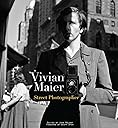
Vivian Maier: Street Photographer
Product ID: 1206726
Desertcart purchases this item on your behalf and handles shipping, customs, and support to Argentina.
The original, instant classic which set the world afire. The first book to introduce the phenomenon that is the life story and work of Vivian Maier. A good street photographer must be possessed of many talents: an eye for detail, light, and composition; impeccable timing; a populist or humanitarian outlook; and a tireless ability to constantly shoot, shoot, shoot, shoot and never miss a moment. It is hard enough to find these qualities in trained photographers with the benefit of schooling and mentors and a community of fellow artists and aficionados supporting and rewarding their efforts. It is incredibly rare to find it in someone with no formal training and no network of peers. Yet Vivian Maier is all of these things, a professional nanny, who from the 1950s until the 1990s took over 100,000 photographs worldwide—from France to New York City to Chicago and dozens of other countries—and yet showed the results to no one. The photos are amazing both for the breadth of the work and for the high quality of the humorous, moving, beautiful, and raw images of all facets of city life in America’s post-war golden age. It wasn’t until local historian John Maloof purchased a box of Maier’s negatives from a Chicago auction house and began collecting and championing her marvelous work just a few years ago that any of it saw the light of day. Presented here for the first time in print, Vivian Maier: Street Photographer collects the best of her incredible, unseen body of work. Please note that all blank pages in the book were chosen as part of the design by the publisher. Review: World-class photographs, but a presentation that doesn't quite match. - The photographs in this book are immensely beautiful; uncannily unique, well-composed, subtle, thoughtful, and genuinely interesting to look at. These are pictures which I have little doubt will change how we think about, look at, and take photographs. Maier's work will become the standard which all other similar bodies of work will be judged by. It is odd and most unfortunate that no attempt was made to get in contact with Maier during her lifetime. Her work was discovered in 2007, and it wasn't until 2009 that she died. This left two full years to allow for even an acknowledgement to her that her work had been found. From what I've read, there is nothing indicating she had any aliments that would have inhibited her from communicating with anyone, even late in her life. The consequence of this lack of communication can be certainly found in this book. While the arrangement of the pictures is decent, it lacks the flow and subtlety that is present with the photographer arranging his own work - or even an artist close to him, who knows something about what the artist thought about the work. While it is known that Maier made narrative films and audio documentaries, it doesn't seem like she explicitly shared any insight about her photographs. This allows for sometimes questionable interpretations about her and her work which is distressing. For example, in the introduction by Maloof, he writes. "...the combination of Maier's intense privacy and lack of confidence in her own photographic prowess nearly resulted in her collection being consigned to oblivion." How in the world does he know that Maier lacked confidence in her work? "Street" photography - and I don't even really like calling it that - is something that requires a huge amount of confidence, both in your pictures and in your integrity as a photographer. There were likely very personal and fitful reasons why she never revealed her work which we will never be able to fathom, and it is meanwhile completely unfair to make statements or even educated assumptions about something we know absolutely nothing about. On the point of arrangement of the photographs: pictures with similar shapes and patterns are put together on a page. This does bring attention to the excellent composition of the images, but this detracts focus from some of the more subtle details in an individual picture. It also makes the work seem repetitive, which both her work and street photography in general is certainly not. Many photographs that dominate two pages feel lonely and distant, and would mend well together with certain other pictures in the book. On the other hand, some pictures which share pages with other images are so quirky that they deserve two pages alone. There is a section at the end of the book full of self-portraits which is well-executed. Printing quality is good with sufficient detail - though a bit dark, and I don't think the warm tone that was chosen compliments the work. Paper stock is glossy and of a good quality, and the construction of the book is solid. The cover is a neutral light gray cloth with the title, author, and publisher stamped on the spine and the initials "VM" stamped on the front cover. End-paper is a quirky orange. Printed in China, as are most photo books these days. I wish that sometime in the future Maloof will hand this wonderful collection over to a trust or company that really knows how to publish photographs, such as the MOMA, so the work gets the presentation that it deserves. I'm exceptionally glad that he was able to unify this collection (after a lot if it got sold off) - and it's obvious that he genuinely cares about this work, but these pictures should be handled by a company or trust which is more accustomed with dealing with this high level of work. The value of this book is great, but do keep in mind that it doesn't hold the level of quality that a "fine art" book would have, published a company such as Twin Palms or Steidl. It is a true pity that Maier could never share thoughts about her work. However, if you hold the mindset of letting the photographs truly speak for themselves, you'll be very pleased with this book. Review: The World Hiding in Plain Sight - Maier is not the first artist whose work was only discovered after their death, but she is the most recent major one. And a major artist she is - these photographs testify to a talent on par with any of the other photographic luminaries of the 20th century. It only adds to the mystique that she took these images as a hobby, wandering the streets of New York and Chicago with the children she was babysitting in tow. As the book points out, not only was no one else aware that she even took photographs, much less ones of this calibre, but apparently Maier herself was unaware of the quality of her work. But for their chance discovery, these works of art could have been lost forever. And what works they are - they bring to mind the eye for the offbeat and macabre seen in Diane Arbus' work, but with a crucial difference. While Arbus' best photographs have been compared to staring down the barrel of a gun, in order to achieve this power, one has the sense that she was not being entirely true to her subjects, that there is a certain betrayal - of using them for her own purposes rather than showing them for who they were. There is none of this dissimulation in Maier's work - the subjects are authentic, captured in the activities of their real lives. As street photography, Maier shares some of Cartier-Bresson's spontaneity and element of surprise, but with a playfulness and humor often not present in his work. Cartier-Bresson used a Leica rangefinder, which has the advantage of rapid focusing, while Maier used a Rollei twin-lens reflex. While the Rollei is slower (focus is with a groundglass), it allows the photographer to face the subject without the camera in front of their face. While many of Maier's photos are clearly candid shots, several must have required her to get to know the subject on some level, however briefly, to gain their confidence and permission. Possibly having children with her made this easier - instead of the dedicated (and necessarily self-focused) solitary street photographer, she may have come across as an unthreatening tourist, taking the photo as a minor diversion from her main activity - which is, in fact, what it was. Several other reviewers have taken the position that John Maloof is milking Maier's legacy for his own personal enrichment. One of Maier's distant relatives has filed a lawsuit seeking a share of Maloof's profits, the outcome of which is unknown at the time of this writing. My opinion is that Maier's work is a clear example of collaboration (one-sided though it is), and if Maloof had not taken the trouble and expense of developing, printing, and publicizing Maier's work, I have no doubt that it would be unknown to this day. I'm reminded of an episode of a television show where a man "discovered" the work of an obscure artist, managed to get the artist's work displayed in galleries, and made a great deal of money from this. The artist's descendants sued him, and during the trial it was revealed that they had used the artist's work they still owned as dropcloths or other mundane uses. The point was made that the only reason the artist was known at all was because of the man's efforts. I see the situation here as analagous - does anyone expect Maloof to do all this work for free, and for what? The enrichment of Maier's third cousin in France who probably never even spoke to her, and may not have even known that she existed? Or should he do this as a "gift to humanity" with no thought for himself? This attitude is unrealistic and in a sense ungrateful. How many other people handled Maier's photographs and thought nothing of them until Maloof stumbled across them? The book's preface asks what surprising, hidden talents the people Maier photographed may have possessed themselves - does Maier's own image possibly exist in the aeuvre of some other hitherto unknown street photographer? Diane Arbus said "there are things which nobody would see unless I photographed them," and Maier reminds us of how much of the world around us we are missing.
| Best Sellers Rank | #401,267 in Books ( See Top 100 in Books ) #93 in Street Photography (Books) #187 in City Photography #235 in Individual Photographer Monographs |
| Customer Reviews | 4.7 out of 5 stars 1,926 Reviews |
D**S
World-class photographs, but a presentation that doesn't quite match.
The photographs in this book are immensely beautiful; uncannily unique, well-composed, subtle, thoughtful, and genuinely interesting to look at. These are pictures which I have little doubt will change how we think about, look at, and take photographs. Maier's work will become the standard which all other similar bodies of work will be judged by. It is odd and most unfortunate that no attempt was made to get in contact with Maier during her lifetime. Her work was discovered in 2007, and it wasn't until 2009 that she died. This left two full years to allow for even an acknowledgement to her that her work had been found. From what I've read, there is nothing indicating she had any aliments that would have inhibited her from communicating with anyone, even late in her life. The consequence of this lack of communication can be certainly found in this book. While the arrangement of the pictures is decent, it lacks the flow and subtlety that is present with the photographer arranging his own work - or even an artist close to him, who knows something about what the artist thought about the work. While it is known that Maier made narrative films and audio documentaries, it doesn't seem like she explicitly shared any insight about her photographs. This allows for sometimes questionable interpretations about her and her work which is distressing. For example, in the introduction by Maloof, he writes. "...the combination of Maier's intense privacy and lack of confidence in her own photographic prowess nearly resulted in her collection being consigned to oblivion." How in the world does he know that Maier lacked confidence in her work? "Street" photography - and I don't even really like calling it that - is something that requires a huge amount of confidence, both in your pictures and in your integrity as a photographer. There were likely very personal and fitful reasons why she never revealed her work which we will never be able to fathom, and it is meanwhile completely unfair to make statements or even educated assumptions about something we know absolutely nothing about. On the point of arrangement of the photographs: pictures with similar shapes and patterns are put together on a page. This does bring attention to the excellent composition of the images, but this detracts focus from some of the more subtle details in an individual picture. It also makes the work seem repetitive, which both her work and street photography in general is certainly not. Many photographs that dominate two pages feel lonely and distant, and would mend well together with certain other pictures in the book. On the other hand, some pictures which share pages with other images are so quirky that they deserve two pages alone. There is a section at the end of the book full of self-portraits which is well-executed. Printing quality is good with sufficient detail - though a bit dark, and I don't think the warm tone that was chosen compliments the work. Paper stock is glossy and of a good quality, and the construction of the book is solid. The cover is a neutral light gray cloth with the title, author, and publisher stamped on the spine and the initials "VM" stamped on the front cover. End-paper is a quirky orange. Printed in China, as are most photo books these days. I wish that sometime in the future Maloof will hand this wonderful collection over to a trust or company that really knows how to publish photographs, such as the MOMA, so the work gets the presentation that it deserves. I'm exceptionally glad that he was able to unify this collection (after a lot if it got sold off) - and it's obvious that he genuinely cares about this work, but these pictures should be handled by a company or trust which is more accustomed with dealing with this high level of work. The value of this book is great, but do keep in mind that it doesn't hold the level of quality that a "fine art" book would have, published a company such as Twin Palms or Steidl. It is a true pity that Maier could never share thoughts about her work. However, if you hold the mindset of letting the photographs truly speak for themselves, you'll be very pleased with this book.
L**N
The World Hiding in Plain Sight
Maier is not the first artist whose work was only discovered after their death, but she is the most recent major one. And a major artist she is - these photographs testify to a talent on par with any of the other photographic luminaries of the 20th century. It only adds to the mystique that she took these images as a hobby, wandering the streets of New York and Chicago with the children she was babysitting in tow. As the book points out, not only was no one else aware that she even took photographs, much less ones of this calibre, but apparently Maier herself was unaware of the quality of her work. But for their chance discovery, these works of art could have been lost forever. And what works they are - they bring to mind the eye for the offbeat and macabre seen in Diane Arbus' work, but with a crucial difference. While Arbus' best photographs have been compared to staring down the barrel of a gun, in order to achieve this power, one has the sense that she was not being entirely true to her subjects, that there is a certain betrayal - of using them for her own purposes rather than showing them for who they were. There is none of this dissimulation in Maier's work - the subjects are authentic, captured in the activities of their real lives. As street photography, Maier shares some of Cartier-Bresson's spontaneity and element of surprise, but with a playfulness and humor often not present in his work. Cartier-Bresson used a Leica rangefinder, which has the advantage of rapid focusing, while Maier used a Rollei twin-lens reflex. While the Rollei is slower (focus is with a groundglass), it allows the photographer to face the subject without the camera in front of their face. While many of Maier's photos are clearly candid shots, several must have required her to get to know the subject on some level, however briefly, to gain their confidence and permission. Possibly having children with her made this easier - instead of the dedicated (and necessarily self-focused) solitary street photographer, she may have come across as an unthreatening tourist, taking the photo as a minor diversion from her main activity - which is, in fact, what it was. Several other reviewers have taken the position that John Maloof is milking Maier's legacy for his own personal enrichment. One of Maier's distant relatives has filed a lawsuit seeking a share of Maloof's profits, the outcome of which is unknown at the time of this writing. My opinion is that Maier's work is a clear example of collaboration (one-sided though it is), and if Maloof had not taken the trouble and expense of developing, printing, and publicizing Maier's work, I have no doubt that it would be unknown to this day. I'm reminded of an episode of a television show where a man "discovered" the work of an obscure artist, managed to get the artist's work displayed in galleries, and made a great deal of money from this. The artist's descendants sued him, and during the trial it was revealed that they had used the artist's work they still owned as dropcloths or other mundane uses. The point was made that the only reason the artist was known at all was because of the man's efforts. I see the situation here as analagous - does anyone expect Maloof to do all this work for free, and for what? The enrichment of Maier's third cousin in France who probably never even spoke to her, and may not have even known that she existed? Or should he do this as a "gift to humanity" with no thought for himself? This attitude is unrealistic and in a sense ungrateful. How many other people handled Maier's photographs and thought nothing of them until Maloof stumbled across them? The book's preface asks what surprising, hidden talents the people Maier photographed may have possessed themselves - does Maier's own image possibly exist in the aeuvre of some other hitherto unknown street photographer? Diane Arbus said "there are things which nobody would see unless I photographed them," and Maier reminds us of how much of the world around us we are missing.
T**N
Great Photo Book
The book represents Vivian Maier’s photo portfolio. Cool and authentic. No text nor description. Pure picture that speaks by it self!
A**K
Fantastic prints by a fantastic photographer
She had to be one of the bravest people on earth, to take the pictures she did of "humans in the wild". Her photos are so honest...you just can't stop looking at them. This book did an outstanding job with the printing of these photos. The clarity is next-level!!!
J**K
Third printing looks ok to me
Even given the astounding story of Vivian Maier, her brilliant work and the reasonable price of the book, sepia-toned prints would not be satisfactory at all. But my book is from the third printing, and the prints are not sepia; blacks are fully black. The most iconic image of all, and one of my all time favorites, is of a woman so very reminiscent of Marilyn Monroe, walking toward a 1956 Chevrolet. It is blurry due to hand-holding at a slow shutter speed, and perhaps out of focus, but those only add to the appeal. The image in the book delivers the impact, if not the print quality, of the exhibition print I saw a year ago in Chicago. That said, it would be interesting to do a direct comparison by taking the book to another exhibition of Vivian Maier's prints.
J**A
A must for every aspiring street photographer.
I've been a photographer for most of my 80 years and wish I'd discovered Vivian Maier's work decades earlier. It's a blessing that her enormous volume of work has finally come to light. It's truly inspiring!
P**N
A powerful set of images
She was an amazing unknown photographer. After watching a documentary on her life, I had to get this book to add to my library. If you are a street photographer and love the old school Black and White images, you will learn by just sitting and absorbing these amazing images. 5-stars. The book is very well printed.
M**Y
I loved it it! A fine book & beautiful collection.
I must be missing something. I absolutely love this book. I have no beef with blank pages or the print quality. Ms. Maier had a phenomenal eye and an incredible knack for capturing compelling people and amazing street scenes. I found the book a delight from cover to cover, and overall, a quality collection well worth the price. I thought the tones were lush, with deep shadows and rich highlights. Yes, some shots more than others. But nothing beyond the normal range of print tones I would expect to see. I have enjoyed paging through this title again and again and yet I still find myself delightfully discovering new details, again and again. That seems a good sign to me and well worth the money in my opinion. Use the "Look Inside" link and judge for yourself, that should give you some idea what to expect. Then do yourself a favor. Toss a copy in your cart!
A**E
Beau livre
Belles qualités d’image et d’impression
I**R
good quality
Overall good quality, good photos, make me think a bit more and watch the street in a different way after reading this.
V**O
maravilhoso
livro maravilhoso e a fotógrafa ainda mais!
ド**ナ
ドキュメンタリー映画で知り購入しましたが、良いスナップ写真集です。
きっかけはヴィヴィアン・マイアー女史の写真が世間に知ることとなった経緯を描いた 『ヴィヴィアン・マイヤーを探して』というドキュメンタリー映画を鑑賞した為でした。 街中の何気ない人々の様子をとても魅力的に切り取られており、写真に関して素人ながら愉しむことができました。 彼女の写真に写る人々もそうですが、数点ある自身を撮影した写真が妙に魅力的に感じました。 良い写真集でした。
P**D
Excellent Quality
I love the story. I love the images. I love the book. It is an excellent representation of Vivian's work. The book is excellent quality, nice quality paper and large images. I have nothing negative to say about physical quality or content. I am only puzzled by the blank pages. SERIOUSLY?? Blank pages in a coffee table photography book? What is that all about?? I am sure they will not do this again in future books. If you are a fan, buy the book. Vivian should be remembered. In my opinion, she is one of the greats. Her street photography is really something. To me, a good photograph makes your mind ask many questions. The more you wonder, the more the image is a certified gem. The book is pretty much filled with these types of images, cover to cover. Some of the images you have already seen online. SO? lol The detail in the book is much better. She used a large format camera and that really comes through with the printed image. For me, the book is a keeper. Buy it, cherish it.
Trustpilot
1 month ago
1 month ago