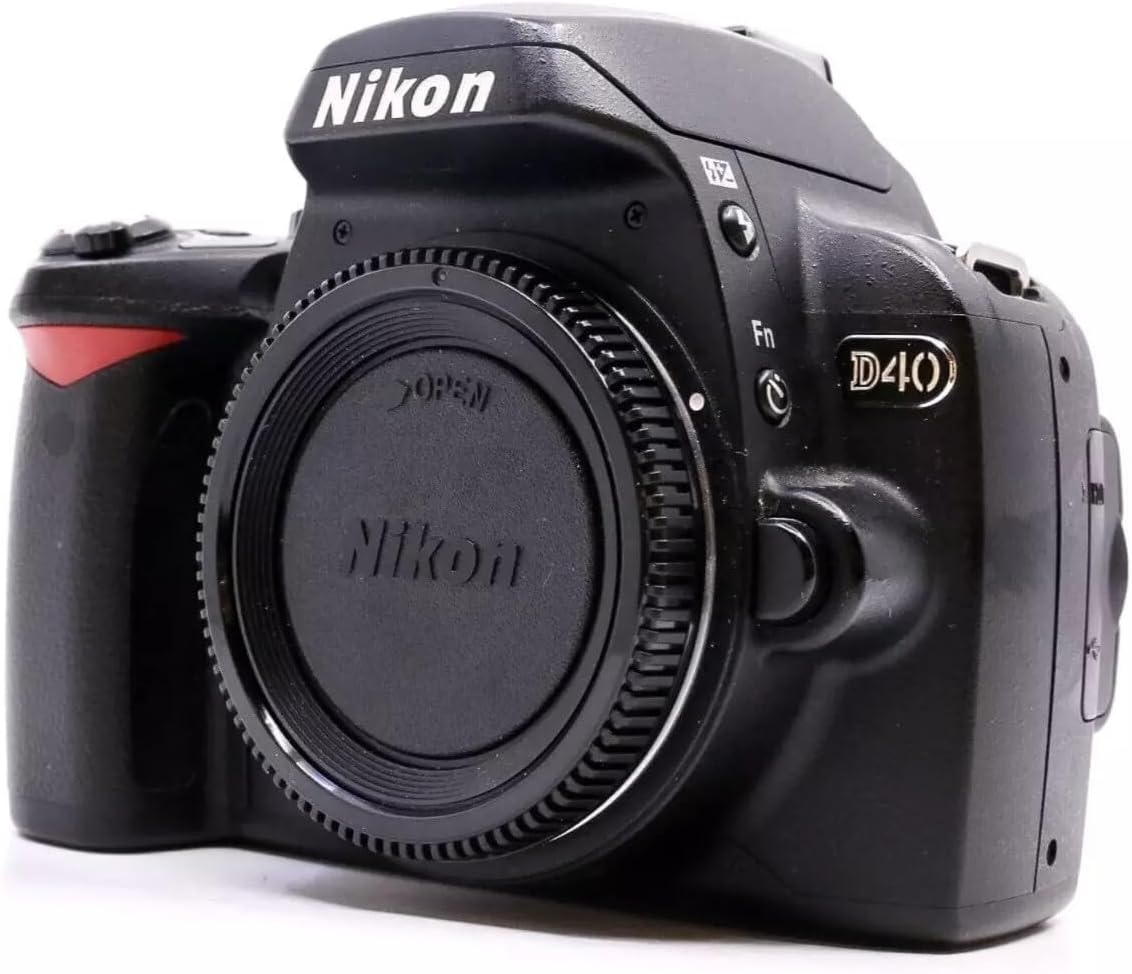
๐ท Capture brilliance effortlessly โ your everyday pro DSLR awaits!
The Nikon D40 is a compact, lightweight DSLR featuring a 6.1-megapixel DX-format CCD sensor paired with a versatile 18-55mm f/3.5-5.6G ED II AF-S DX Zoom-Nikkor lens. Designed for ease of use, it offers fast startup, 2.5 fps continuous shooting, a bright 2.5-inch LCD, and intuitive controls, making it ideal for beginners and enthusiasts seeking high-quality images without bulk. Its built-in flash, advanced autofocus, and in-camera editing tools provide creative flexibility, while the durable design ensures reliable performance for everyday photography.
| ASIN | B000KJQ1DG |
| Age Range Description | Kid |
| Aperture modes | F3.5โF5.6 |
| Are Batteries Included | Yes |
| Aspect Ratio | 1.60:1 |
| Auto Focus Technology | Continuous, Multi-area, Phase Detection, Selective single-point, Single |
| Autofocus | Yes |
| Autofocus Points | 3 |
| Best Sellers Rank | #112,222 in Electronics ( See Top 100 in Electronics ) #151 in DSLR Cameras |
| Bit Depth | 12 Bit |
| Brand | Nikon |
| Built-In Media | Battery |
| Camera Flash | Built-In |
| Camera Lens | 18-55mm f&3.5 - f&5.6 ED II AF-S DX Zoom-Nikkor lens |
| Color | Black |
| Compatible Devices | Nikon cameras with a Nikon F bayonet mount |
| Compatible Flash Memory Type | SD |
| Compatible Mountings | Nikon F (DX), Nikon F (FX) |
| Connectivity Technology | USB |
| Continuous Shooting | 2.5 |
| Crop Mode | DX |
| Customer Reviews | 4.5 out of 5 stars 628 Reviews |
| Digital Scene Transition | True |
| Digital Zoom | 3 x |
| Digital-Still | Yes |
| Display Fixture Type | LCD screen |
| Display Maximum Resolution | 230,000 |
| Display Resolution Maximum | 230,000 |
| Display Type | LCD display |
| Dynamic Stops | 15 Stops |
| Effective Still Resolution | 6.1 MP |
| Expanded ISO Minimum | 200 |
| Exposure Control | Children, Close-up, Landscape, Night portrait, Portrait mode, Sports mode |
| File Format | Compressed NEF (RAW), JPEG (Exif 2.21), DCF 2.0, DPOF |
| Flash Memory Speed Class | 10 |
| Flash Memory Type | SD/SDHC card |
| Flash Modes | Automatic, Red Eye Reduction, Flash exposure compensation |
| Flash Sync Speed | 1/500_sec |
| Focal Length Description | 18-55 Millimeters |
| Focus Features | Nikon Multi-CAM530 |
| Focus Mode | Continuous-Servo AF (AF-C), Single-Servo AF (AF-S) |
| Focus Type | Automatic, Manual |
| Form Factor | Built-in |
| Generation | 1 |
| Global Trade Identification Number | 00018208254200 |
| Hardware Interface | Secure Digital Card, USB |
| Has Color Screen | Yes |
| Image Capture Type | Stills |
| Image Stabilization | Digital |
| Image stabilization | Digital |
| Item Weight | 1.15 Pounds |
| JPEG Quality Level | Basic, Fine, Normal |
| Lens Type | Zoom lens |
| Manufacturer | Nikon |
| Manufacturer Part Number | 25420 |
| Maximum Aperture | 3.5 f |
| Maximum Focal Length | 55 Millimeters |
| Maximum Image Size | 19 Inches |
| Maximum Shutter Speed | 1/4000 Seconds |
| Memory Slots Available | 1 Secure Digital (SD) |
| Metering Methods | Evaluative |
| Minimum Focal Length | 18 Millimeters |
| Minimum Shutter Speed | 30 seconds |
| Model Name | Nikon |
| Model Number | 25420 |
| Model Series | D40 |
| Movie Mode | No |
| Night vision | No |
| Optical Zoom | 3 x |
| Photo Sensor Resolution | 6.1 MP |
| Photo Sensor Size | APS-C |
| Photo Sensor Technology | CCD |
| Real Angle Of View | 42 Degrees |
| Remote Included | No |
| Screen Size | 2.5 Inches |
| Self Timer | 10 Seconds |
| Sensor Type | CCD |
| Series Number | 40 |
| Shooting Modes | Automatic, Child, Close-up, Landscape, Night Portrait, Portrait, Sports |
| Skill Level | Professional |
| Specific Uses For Product | Photography |
| Supported File Format | Compressed NEF (RAW), JPEG (Exif 2.21), DCF 2.0, DPOF |
| Supported Image Format | Compressed NEF (RAW), JPEG (Exif 2.21), DCF 2.0, DPOF |
| Total Still Resolution | 6.1 MP |
| Total USB 2.0 Ports | 1 |
| Total USB Ports | 1 |
| UPC | 018208254200 |
| Video Capture Format | MP4 |
| Video Resolution | 1080p |
| Viewfinder | Eye-level penta-dach mirror |
| Viewfinder Magnification | 0.8x |
| White Balance Settings | Auto, Custom, Daylight |
| Wireless Technology | Yes |
| Write Speed | 2.5 fps |
| Zoom | Optical |
M**A
A Reliable and User-Friendly DSLR
The Nikon D40 6.1MP Digital SLR Camera Kit with 18-55mm f/3.5-5.6G ED II Zoom lens was one of the best DSLR cameras for its time, and itโs easy to see why. The camera strikes a perfect balance between performance and simplicity, making it great for beginners and hobbyists alike. Its 6.1MP sensor delivers sharp, vibrant photos, and the auto-focus lens ensures clear shots with minimal effort. What really stands out is the ease of use. The menus and settings are intuitive, so adjusting shutter speed, aperture, and other controls feels straightforward without being overwhelming. The compact body makes it comfortable to carry around, perfect for everyday photography or travel. Overall, this camera delivers excellent image quality and user-friendly operation, making it a fantastic entry-level DSLR. Whether capturing landscapes, portraits, or casual snapshots, the D40 proves reliable and fun to use.
C**O
What it does
This won't be a list of all the technical statistics as many reviewers have done this very well already. Instead, let's concentrate on how it actually works. First, I wanted a DSLR because they are easier for me to use than point and shoots and of course there are choices with lenses, flashes, etc. I chose Nikon because I have had good luck durability-wise with that brand and Nikon is obviously a premier company. I also have a couple of interesting old Nikon lenses that are usable. Amazon's price with free shipping and all was quite a bit less than I found locally. It arrived quickly and in good shape, as did the extra stuff I got for it. One of these items was the 55-200 VR zoom. If you go this route BEWARE: there are cheap zoom packages that ship the NON-VR version. You want VR. Surely the standard kit lens, which does get excellent reviews, will itself someday be offered in VR form. In fact, since I bought this, you can be sure this will be soon! Some reviewers have advised the use of those impressive bigger, heavier, wider aperture and more costly lenses. Or prime lenses. My take is that the standard DX lenses that were designed for this camera just make it so much more pleasurable to use, work just fine and are appropriate for the use this camera will get. If there are any differences in quality, they are really hard to see, if at all. VR makes low-light photos sharp and in many cases negates the need for wide aperture lenses, and this also means a better depth of field. However, nothing beats big expensive lenses, or big expensive most anything else, actually. It just isn't really necessary for most of the photography people will use this camera for. Cameras like the D40 are best for candid, quick shots and for capturing moments in time that are not repeatable. Bulky equipment just gets in the way and makes it more likely that the camera will be in the closet and not with you. Some people just like the photog life and live to carry around the biggest and heaviest stuff. My thinking is that the $5000 and more DSLRs with their bigger sensors and all would be more appropriate for that use, or spend $35000 and really go for it with a digital Hasselblad. Why not the D40x? I read a zillion reviews that said, in essence, that you can't tell the difference, so why spend the extra? There is a lot of debate about this, but I went with the D40. Some experts, including those that I admire, suggest using special settings, especially those that have to do with how vivid the colors will be. And there are plenty of these settings. I spent a lot of time trying the various manual modes and other shooting options. Just delete them when you are done experimenting. Go to the menu on that big bright and sharp screen and reset when you are done. I messed up some promising shots because I assumed I was in Auto mode and I wasn't. My bad; automatic or not, you still have to pay attention. This is all fun to play with, and, speaking of auto mode, it is pretty darn good. Just set the top dial to auto, leave it there, press half-way down on the shutter button to focus and then fire away. Make sure the lens buttons are set on VR and auto focus. All good. And there are other settings for landscapes, portraits, kids, etc. Again, it is easy to turn the dial to those settings and it is all automatic. The camera's little computer changes things in subtle ways to complement those shots. Nikon has vast technical resources and I figure they have this stuff figured out better than me. If you want special effects, you can do that, but the auto modes are really very good and hard to beat. Flash is fun. The pop-up flash works very well for most any normal use. I also bought the little 400 series add-on flash. This is a nice device that has a bounce feature. The D40 handles all this flash stuff perfectly. Very nice, and automatic. What about the plastic construction of the camera and the DX lenses? Sure, nothing better than those precise old metal beauties, but the DX cameras are all about size and weight. They are molded to be easy to hold and use and I really have no complaints. The camera and lenses are well-built and solid. I keep my old FM-2 around to fondle. What about the complaints that many of the old Nikon lenses will not work on the D40? This won't be a problem for new users because they will just buy DX lenses. If you do have a collection of fabulous old lenses, then it would be best to go up to D80s or the 300. Check on what actually works. The extra cost of the camera will be offset by the "free" lenses. This will be especially important if you have specialty lenses like perspective control, medical, etc. Again, the whole idea of the D40 is that it is light, small and affordable. Sticking a multi-pound lens on it sort of defeats the purpose. I do have two old lenses, a 55mm micro-nikkor macro and a 100-300 with a macro setting. I just set the aperture on a guess, check out the results on the screen and adjust again. These old lenses were made to be manually set, so it is easy to do. Not for fast shots, no VR, but fun to play with. And the results, the actual prints? First, let me say that I am a fan of big contact prints. Nothing else looks sharp to me. A Leica sales guy showed me a big print, around 24" wide, printed to show how good a cost is no object Leica could be. Ahh, sharp for what it was, but just sort of ok for me. I have had a lot of 35mm printed and was always disappointed. Even paid extra at expensive camera stores. All in the 4X6 to 8X10 size. Not that good, to me. Slides were better, but what a pain to view. Frankly, despite 35mm supposedly being equivalent to 25 mp digital, my 6mp photos printed out on my Canon Pixma are just a lot nicer. Nicer colors, sharper, better. Maybe if I sent my 35mm shot out to be printed on ultra exotic media with processing to match... too much for me. If you can, I suggest getting your digital files out to a service that prints them out on actual photo paper on mega-expensive machines. This is very inexpensive and provides ultimate results (reasonably speaking). I download into iPhoto on my old iBook. When I connect the included usb cable, the program recognizes the camera and the download begins when I push "import". Then, if I want to play with the photo, I just drag it into Adobe Elements, do my best, then save it back to iPhoto for storage. I do not use Nikon's software because I don't need to. The D40 does do some processing in the camera, but I am just used to using the computer. It is easier to see on a big screen and of course the photo editing programs give you many more options. There are all sorts of very capable programs to sort and manipulate your photos if you want to go that way. Suggested options: I went with the kit lens and the 55-200 VR (see my review on that lens) and that is not a bad combination. A better one would be the wide zoom and the 18-200 VR. That, however, is $2K worth of lenses. I got the little remote. I am a fan of polarizing filters, but I already had one. Digital cameras are especially good at macro work and Nikon offers a new macro lens and a neat special flash system to go with it. Not cheap, but super capable and the results are great. I do not like the D40's limitations on remote triggering and remote flash. To fire off the camera you can use that nifty little remote, but the sensor for it is on the front of the camera. Fine for most uses where you are in front of the camera, but heck, a timer works for that. These cameras do not accept cable releases. I will try to make a reflector out of aluminum foil and see if that works. The old Nikon D70 had the capability of triggering remote flashes. That was a neat feature. With the D40 you have to buy one of Nikon's more expensive flashes, or a triggering device. I would like to try some creative flash photography, but the cost is pretty high. Too bad. Note that UPS will call you the day before because they want you to be there for delivery. Too small and expensive to just leave on the porch. You might want it delivered to your work. Also, be aware that it does not come with the little flash memory card, so order one at the same time. I got the Sandisk Ultra II 2.0 gb. It seems to work just fine. It is a brand that Nikon recommends, so... The D40 is easy to use, light and capable for any normal situation. It downloads easily and the photos are as good as current technology allows in this price range. Highly recommended.
C**N
Great Camera
The Nikon D40 is a great lightweight digital SLR. I previoiusly owned a D50, and the D40 is lighter and more compact. I have only shot a few hundred pictures so far, but the image quality is excellent. There are some reports that this camera tends to overexpose some high contrast shots. I have noticed this but I DON'T consider it a problem. The camera tends to expose for the darker parts of the image thus overexposing the lighter parts. This is not an issue unless your subject is in the lighter part of the shot. In most cases the subject in high contrast shots is in the shadows or is backlit so the subject actually ends up being well exposed. This turns out to be a real plus for a majority of people because they don't consider the placement of their subject relative to available light. It makes perfect sense that Nikon would have calibrated an amature DSLR meter this way. I have owned a lot of cameras and none of them have exposed shots perfectly 100% of the time. It is very easy to use exposure compensation on this camera to correct for any under or overexposure that you don't like. It's a digital camera so take as many shots as you want and just delete those you don't like. The D40 is very well built and the ergonomics are great. I can see all of the viewfinder with my glasses on (DSLRs require the user to look through the viewfinder versus the LCD screen to frame shots). The LCD screen is larger and brighter than the one on the old D50. The camera has enough features and flexibility for the beginner up to the professional photographer. Set it on auto and almost all shots will turn out great, or you can fiddle with all sorts of settings to your heart's desire. All of the negeatives or cons that I have seen for this camera in various reviews are related to things that few people will care anything about. Do some research and see for yourself. The most important thing to consider is image quality, and this camera does great in that area as do most digital SLRs. The D40's flash combined with Auto ISO is great. All flash shots I have taken have turned out very well exposed. I even took some flash shots of my house from across the street and they turned out perfectly exposed. Auto ISO set the ISO to 1600 on these shots, but the image quality was just fine. High ISO shots taken with DSLRs are almost as good as low ISO shots taken with point and shoot cameras. You cannot use megapixels to compare image quality between point and shoot cameras and DSLRs. My 6 megapixel D40 has far better image quality than my 7 megapixel Canon 850. Color and saturation are similar (the things that make people say "ooh, pretty picture"), but there is no comparison when it comes to noise and resolution (things that most people don't really notice or care about when looking at your pictures). You are wondering why I purchased a 6 megapixel DSLR when there are several on the market with higher pixel counts. There are three reasons: 1) price, 2) size and weight (very important if you carry the camera around all day or travel with it), and 3) the difference in image quality between 6 and 12 megapixels is miniscule and something that absolutely NO ONE would notice by looking at my pictures. If you take two identical shots with a D40 and a higher megapixel DSLR and blew them up to 8x10 or even 11x14 the average person wouldn't notice a difference, and more importantly...they wouldn't care. Color, saturation, and composition are much more important than small differences in resolution. These things are determined by the subject and the photographer, not megapixels. Some of my favorite digital pictures were taken with a 2 megapixel camera I owned several years ago. Save your money on megapixels and use it to take your significant other out for a nice dinner.
N**H
The little DSLR that could...Incredible photos at an excellent price. Yes, you want this camera
Excellent photos, easy to use, comfortable to hold, and FAST! This is one great camera, especially for the price. For a little more than many mid to high-end point and shoots, this camera packs a lot of technology into it's small price tag. But for the beginning DSLR user, that technology works in the background so just set it to AUTO and fire away, and you've got the best pictures you have ever taken. You will wish you made the move from point and shoot to DSLR sooner! I did a lot of research before choosing the D40, and all the reviews seemed to point to this one as the best entry-level DSLR, and in the 7 months I have had this camera, I have not been disappointed. Thousands of pictures later, I echo many other positive reviews here - this is one of THE best electronics purchases I have ever made. So many people have asked about my camera after seeing my photos (quite a few have even asked if I am a professional photographer). Several have since bought their own D40s :) For me, one of the huge annoyances with a point and shoot is the time between shots - waiting and waiting for your camera to recharge the flash or write the data to the memory card. Not a problem with a DSLR. The D40 starts up quickly, is fast between shots, and allows you to take more photos without flash. In the beginning I used the "scene modes" and Auto, and Auto no Flash, but my interest in photography has grown since using this camera and I use the manal and semi-automatic modes now. This camera is great for BOTH casual and enthusiast users. Stick to AUTO and get great shots OR learn about photography techniques and delve into all of the camera's different settings for more difficult lighting situations, etc. Once you have your D40, if you find yourself getting interested in photography, you may want to collect some additional gear over time. Here is a list of some accesories I have acquired to use with my D40: LowePro Rezo 170 Camera Bag (Not ugly. Works great. Holds D40 plus camcorder or D40 plus flash, 2 lenses and room to spare.) Nikon SB-400 flash (Yes, you eventually want this. Small, lightweight, inexpensive. Saves your camera's battery power and recharges more quickly. Use it to bounce light off the ceiling for indoor photos. It looks so much better you will never use regular non-diffused front-on flash again. Get rechargeable AA batteries, I love the Sanyo Eneloops and I am slowly replacing all my AAA and AA batteries in the house with these). Nikkor 55-200mm VR zoom lens (Inexpensive, works great. Get the VR version, not non-VR version. Nikon sometimes does a $[...] [...] with this lens when you buy the camera and lens at the same time. That makes it super cheap). Nikkor 50mm f/1.8 lens (This is getting repetive, but this lens is cheap. Great value. Amazing low light, no flash pictures. I love natural light and this lens is my favorite for those situations where you don't have that much light available to you. One big drawback is that it is Manual focus on a D40, but over time you learn. Get the Nikon HR2 lens hood to go with it). Nikon ML-L3 wireless remote (Inexpensive, works well. Easy way to take family group shots for your Christmas cards). Sandisk Ultra II Sd Card (Have not had any problems with lost data. Transfer your images frequently to your computer and use your camera to reformat the card each time to minimize your chances of corrupt data or data errors). Sigma EX DG 52mm Multi-Coated UV Filter (No problems with this filter). One last thing, during my research I considered getting the Canon Rebel counterpart. To me the Nikon has several advantages - better menus (Canon's menu looks archaic and crude in comparison), better selection of affordable lenses, flash and other accesories, better ergonomics, better color rendition, auto ISO. Both camera companies are great and both cameras are capable of nice photos, but the D40 is much easier to use, and at the time I bought it, significantly cheaper I am completely happy I went with Nikon over Canon, and now that I have more experience in the DSLR world I look forward to upgrading to a bigger, more complex D300/700 eventually. But I know will still use my little D40 as well! One more last thing, if you are still unsure and want to know how to use this camera before buying, you can check the Nikon Digitutor online videos: [...]
D**R
Outstanding camera and lens, great value
Wow. I've had this camera and lens for two days, and I love it already. It is my first DSLR, so I can't compare it to others. I got into photography eighteen years ago, with a Canon AE-1 Program, then bought a Nikon N6006 a couple years later. I used that N6006 all over the place and for all kinds of stuff (nature, wildlife, travel, portraits, art and jewelry, a wedding, etc.), some for personal fun and some professionally. It was great and I loved it. I sold that camera a couple weeks ago, along with the lenses. Now, I have the Nikon D40. Hallelujah, praise the lord, welcome to the new era in photography. I don't know where to start. - 730 high res, high quality shots one a single $22 2Gb SD card (not included) - Quick, quiet, and accurate auto-focus (the new Nikon AF-S silent wave technology, motor is in the lens, not the camera, and it is nearly silent. No "searching" back and forth like on my old N6006, either.) - Beautiful pictures! - Light weight, no more heavy camera and lens to hang from my neck. - 3D Color Matrix Metering seems to work great, I've tried some unusual lighting situations and I was very happy with the results. This is the high quality, inexpensive, easy to use, always ready camera of my dreams that never gets in my way. Now, I get to think about pictures, not equipment. That's exciting, and a little frightening, too. Great shooting, my friends! -------------------------- Update: One week later: Ok, so I did decide to think about equipment for awhile. As I said, you can use this camera in a number of fully automatic modes and get great results. Nonetheless, this camera is a deep and powerful photography machine. I spent the last week experimenting with the camera and reading a lot of literature, user group postings, etc. online. As probably with all dSLR's, you can go deep into image processing parameters like white-balance, noise reduction, tone, brightness, and contrast curves. I have taken the time to learn about these things (since I shot mostly B&W film, before, I never thought about much of this.) The white-balance control, alone, makes a huge difference in color quality (especially with indoor lighting). Also, unlike a digital point and shoot, the D40 can output RAW files (in the Nikon NEF format). It's a bit of work to learn how to work with these files and get the right tools (Adobe Photoshop and Adobe Lightroom being excellent choices), but it can be worth it. Using the RAW NEF files, you can get total, after the shot control over all the parameter curves I described above. You can even adjust exposure (by up to 1~2 f-stops) after the fact! Like I said, that's a bit more advanced of a topic, but know that you can do that, if you want to. Basiclly, if you're an old pro film shooter or if you're a digital point and shooter, this camera would be great. You can start in fully automatic mode and have fun taking pictures. Then, as you get the courage and desire, start learning about the different modes and features and gradually switching them from auto to manual. The D40 gives you that choice on an individual basis with every feature, so you choose how much the camera is in control and how much you are in control. Pair this camera with a good image processing software package (I'm using IrfanView as my viewer and Adobe Photoshop Elements for processing, great software on a slim budget), and go as deep you want to go.
P**E
Excellent camera for a bargain price
The D40 is a great way to step up from a point-and-shoot camera to a DSLR, whether you want to expand your creative possibilities, experience excellent image quality in a wide range of lighting, take pictures of action without the annoying shutter lag, pose as a professional photographer, or all of the above. First, I like the light weight of the camera. It allows me to easily carry it around wherever I go, along with a few compact lenses, always ready to capture the moment as it happens. That's a huge image quality advantage over an expensive camera and a bag-full of exotic lenses that you left at home because it was too heavy to drag around. Secondly, this camera has plenty of smart features which enable less fiddling around with the settings and allow me to focus on taking the picture. Some examples I like are: * Customizable ISO-Auto function allows me to set the maximum ISO and minimum shutter speed I want, thereby eliminating the need to manually adjust ISO for different lighting conditions. * After a picture is taken, it automatically gets displayed on the LCD for review, making adjustments, or deleting, without having to manually switch to playback mode. * A customizable Menu for easy, fast access to features I use often without digging thorough every available item. I can leave the critical adjustments like white balance and picture presets, while hiding those I use once and forget, like date/time, language, etc. * RGB histogram in playback mode lets me gauge if I need to adjust the color balance or if a certain color channel is clipping. Much more useful than a single-channel histogram. Some other notable advantages, compared to the competition: * The AF-assist lamp facilitates low light focusing. On cameras without the lamp, you'd have to use the annoying flash strobe. * 1/500s x-sync means I can use the flash with shutter speeds up to 1/500s, effective for freezing motion or using the flash to balance out the shadows in harsh sunlight. Other cameras in this class usually only go to 1/200s. The 6MP resolution is plenty for making great-looking 8x12 prints, and puts less space-clogging pixels on the memory card. Image quality is very good from ISO 200 - 1600, and I regularly use ISO 1600 in low light with great results. Included kit lens is sharp all around, and is perfectly adequate for making great-looking photos. Ergonomics of the camera are outstanding for its small size - it fits in my hand comfortably and doesn't make my fingers feel cramped. There are, however, some limitations about this camera which may or may not be a big deal, depending on how you use it, such as: * It lacks an autofocus motor in the camera body, meaning autofocus only works with AF-S lenses - those with an internal focus motor. Not necessarily a problem since all the newer Nikon lenses are AF-S, but Nikon also has a number of great, inexpensive, older AF lenses, and on the D40 these will be manual focus only. * The built in flash cannot be used as a master to control additional wireless flash units. You'd need to buy a wireless flash controller for that. * With only 3 AF points, you have to focus and recompose before taking the picture if your subject is outside these 3 points. Not a problem for me since I do this naturally, but something to keep in mind if you're used to a point-and-shoot camera. * There are no buttons for directly changing white balance, image size/quality and ISO. There is, however, a customizable Fn button which I assigned to adjust white balance, and with ISO-Auto activated, I rarely miss having these buttons. * 2.5 fps continuous shooting is too slow for getting multiple shots of fast-paced sports or other action. If you're not shooting those kind of scenes often, then it's not a problem. Overall, this is an easy to use, well-designed camera which offers superb image quality at a relatively low price, and with plenty of features that make it easier to get great shots, instead of getting in your way. Seasoned photographers who need the AF compatibility with older lenses or are shooting fast-paced action should consider the higher end camera models, but for a casual hobbyist or enthusiast, the Nikon D40 is as a highly recommended camera.
N**O
The Nikon d40 With 18-55mm Lens
Here is my Un-Biased review. I have owned the Nikon D40 for around eight months, so i know quite a bit about this camera. There are definitely a few things i like, and a few things i do not like about this camera. I will go over them briefly and discuss a few other things. Here are the Pros ( good things in simpler terms ) * You get the versatility of changing lenses to get different effects. you can get telephoto lenses, super-fast lenses, super-wide angle lenses, and so forth. You do not get this maneuverability with a point and shoot camera. This camera being a Digital SLR is an advantage in and of itself. * The cameras delivers very good image quality, better than any point and shoot camera on the market. The images are very sharp, and all of the details are vividly shown, when compared to more expensive Digital SLR cameras, it's obviously not the best of the best, but it is good nonetheless. * The size of the camera is perfect for what it is. It fits nicely in your hand, and feels nice in it. The camera is made of plastic, and does feel a little cheap, but that is expected. People may argue that some of your fingers are left out in the grip, but that is not an issue to me. Here are the cons * With the Nikon D40/D40x/D60 cameras you can not Autofocus AF lenses. AF lenses need Motors built into the camera to Autofocus, and the D40/d40x, and the D60 do not have that motor. They do, however, autofocus AF-S lenses, which have a motor on their own. So, if you love autofocus, and have a few AF lenses, you may want to consider the D80 at least. * The camera only has six megapixels. This isn't a major disadvantage but you definitely notice it when you crop the images, so if you love macro photography, you may want to consider a higher-end camera. To the average day-to-day photographer, this won't be an issue, but for serious Photography, it is definitely a factor. * The performance at higher ISO's is horrible. At ISO 3,200, the images are practically unusable. You even see tremendous noise at ISO 800. If you are considering the D60, it is even worse. For low-light photography this is not a good camera. * No dust-reduction facilities. Yup, you are going to get dust in there eventually, and you are going to have to clean it manually with the D40, which can be dangerous if you are inexperienced, and you may have to pay to have it done, so this is definitely a con in my eyes. If you are looking for an entry-level Digital SLR camera i suggest that you spend a little more on the D60, you are going to get a few more features ( a VR lens, Dust Reduction, etc ) which are very useful. I would even suggest the D90 if you really want your money's worth. This is a good camera, but when compared to others it's not the ' best '. If you are an average person who just wants Amazing pictures and don't worry about ' professional ' things, this camera would be fine.
G**R
Great camera - but aspiring serious shooters should consider disadvantages
The sheer quantity of excellent reviews already posted here for the D40 would leave me nothing to add were it not for the possibility that my perspective might be useful to a certain subset of possible buyers. I purchased the D40 as a first DSLR, but not as a first SLR. As a former film SLR shooter getting back into SLR photography after a long absence, I was convinced by the many very positive reviews of the D40 that it would provide an excellent entry point. Ken Rockwell's rave reviews, in particular, had a strong influence on my decision, as did many of the favorable reviews posted here. In retrospect, for somebody in my position, I think that perhaps some of the D40's positives have been slightly overstated, and some of the negatives slightly understated. I would suggest that any prospective purchasers who feel they might aspire to any level of seriousness in their photography should give careful consideration to whether the D40 will be truly satisfactory to them beyond the short term. In my case I owned the D40 for about a month before deciding that the D90 would have been a better choice. I made the swap and find myself much better off for it. Things to consider: - Every review points out that the D40 can only autofocus using Nikon's latest (and most expensive) AF-S lenses. I optimistically underestimated the degree to which this would quickly become a handicap for me. Yes, these are Nikon's best lenses, but the reality is that in practice you will be able to do much more, much sooner, at much lower expense, if you are willing and able to use older "D" and "G" type AF lenses along with one or two of the newer AF-S lenses. As one example, perhaps the second or third lens most semi-serious shooters would want to buy for a DSLR is something along the lines of a 50mm f/1.8 prime. Cheap and excellent, Nikon's 50/1.8 will immediately give you creative options that don't exist in any AF-S lens, at any price. Other excellent lenses, like the 85mm f/1.4, 85mm f/1.8, 80-200mm f/2.8 zooms, 28-200mm "G" zoom, and various third-party and wide-angle options, either don't exist yet in AF-S form, or cost so much more to buy that a casual hobbyist like myself would have a very hard time justifying the expense. - High ISO (low light) performance. One of the great advantages of digital over film is the improvement in light capture that has come along with it. Low light, hand-held photography can be done now that was really completely impossible just a couple of decades ago. The D40 did not really allow me to experience this benefit as fully as I'd expected. I found an ISO setting of 800 on the D40 to be the maximum "good quality" setting, and noticeably less clean than the "base" ISO of 200. My informal impression is that the D90 is between one and two stops better. Combine that with the D90's ability to use faster lenses at lower cost than the D40, and the practical reality is that I can shoot equivalent quality photos in one-quarter to one-eighth the light with the D90 than with the D40. That is a tremendous advantage and much more than I had anticipated prior to owning the two cameras. - Availability of D-Lighting on D90-and-up Nikons. In my admittedly short experience D-Lighting is a feature of such tremendous value that by itself it might be enough to justify the extra expense of the D90. D-Lighting is able to control the contrast between light and dark areas in a scene, which has always been one of the primary difficulties facing any photographer. This feature might be of even more use to a less serious photographer than to a serious one since it will invisibly improve almost any casual picture made under sunlit conditions. On the D90, under harsh sunlight, I set D-Lighting to "Extra-High" and get very useable photos that would be throw-aways with the D40. In most other conditions I leave it turned on but set to "Auto." - The lack of a second (front) control dial. Another surprise for me. One dial, as the D40 has, allows you to quickly set one parameter at a time, such as shutter speed or white balance. Two dials allow you to set two separate, usually related, parameters at once. I didn't realize how great an impact this would have on the camera's overall usability. For example, in setting white balance the rear wheel chooses the white balance preset (auto, sunny, cloudy, etc) while the front trims it (tweaks the basic setting to slightly warmer or cooler, six steps each way). Or, during image review the front wheel changes to the previous or next image, while the front wheel changes the display (one click to the right for an rgb-histogram, for example, then one click back to the left to return to the full-sized image). In almost every setting, display and shooting mode the second wheel adds significant flexibility and speed to the camera's handling. - 6mp sensor. It is true, without a doubt, that excellent photos of almost any kind can be made with a 6mp sensor. I am happy with 6mp for 90% of my photograhy. However, I still found the jump to 12mp beneficial. One thing to keep in mind is that the flaws inherent in every part of the image capture and reproduction process add to one another, each only subtly, but the additive effect of cumulative imperfections makes all the difference in the quality of the eventual reproduced image. Although it's impossible to quantify, going from a 6mp to a 12mp sensor might be the equivalent of going from a good to an excellent lens, while at the same time raising the limits of what the excellent lens can produce. It is also much cheaper than the difference in cost between, say, a full complement of good, "consumer" lenses and first-rate "pro" lenses. The bottom line is that each step in the process is important and each step varies from perfection. Doubling the actual resolution with which the image is captured is worthwhile, and worth paying for. By contrast there are a couple of features the D40 has that I miss on the D90. The most important is the D40's fast 1/500 flash sync speed, which makes it possible to use fill flash with larger apertures under brighter conditions, and to extend maximum flash range under many conditions. The D90 makes me choose between depth-of-field-isolation and fill flash when conditions are bright as I can't get both. Less important but also helpful is the D40's ability to be set so that the rear screen automatically comes on between shots. Simply tap the shutter (to wake the camera or cancel the review of the previous image, if active) and the display shows you all the camera's vital settings at the same time in one place, and lets you change most of them with just a couple more button-pushes. It is very intuitive and quick to use, and I wish the D90 had it. In most regards I found the D40 to be a superb camera and every bit (more, really) as good as I had been led to expect. It feels wonderful to use and it makes excellent photos, or at least is capable of it (the rest being up to the user.) If it were not for the lack of a focus motor on the D40, I would still recommend it highly for even aspiring serious SLR users, as the other factors can all be worked around or are only of importance under certain conditions. However, the reality for any photographer serious enough to eventually acquire a variety of lenses is that, by the time they buy their third or fourth lens for the D40 they will have spent as much or more on their equipment than they would have had they started one rung up with a D90. Viewed from this perspective, the various functional advantages of the D90 come essentially without cost even though they do, at least for me, add significant value. For casual photographers who will be satisfied with one or two lenses, or for more serious photographers looking for a second, lighter camera for part-time use, the D40 represents an excellent value and would be in my view a five-star camera. For people on a strict budget who are willing to wait patiently for the functionality that will come from additional lenses, the D40 could also be an excellent (and perhaps only) choice. Only people looking at the D40 as an entry point to an eventual comprehensive collection of SLR gear need to consider whether the D40's disadvantages outweigh its lower cost. These people might find themselves, as I did, better off paying more from the start for something along the lines of a D90 - or, alternatively, considering an older used D80/200, etc. as their entry point instead. Yes, the D40 is an upgrade compared to those cameras in some ways, but with a used D80 you can start getting the lenses you want right from the beginning, then upgrade the camera later.
P**A
Genial calidad precio.
Es de segunda mano pero estรก muy bien.
Trustpilot
1 month ago
3 weeks ago