We remain fully operational. Our teams are working around the clock to ensure your deliveries continue safely.

Descargar la aplicación


Servicios al cliente
Sobre nosotros
Copyright © 2025 Desertcart Holdings Limited
Descargar la aplicación
Buy anything from 5,000+ international stores. One checkout price. No surprise fees. Join 2M+ shoppers on Desertcart.
Desertcart purchases this item on your behalf and handles shipping, customs, and support to Argentina.
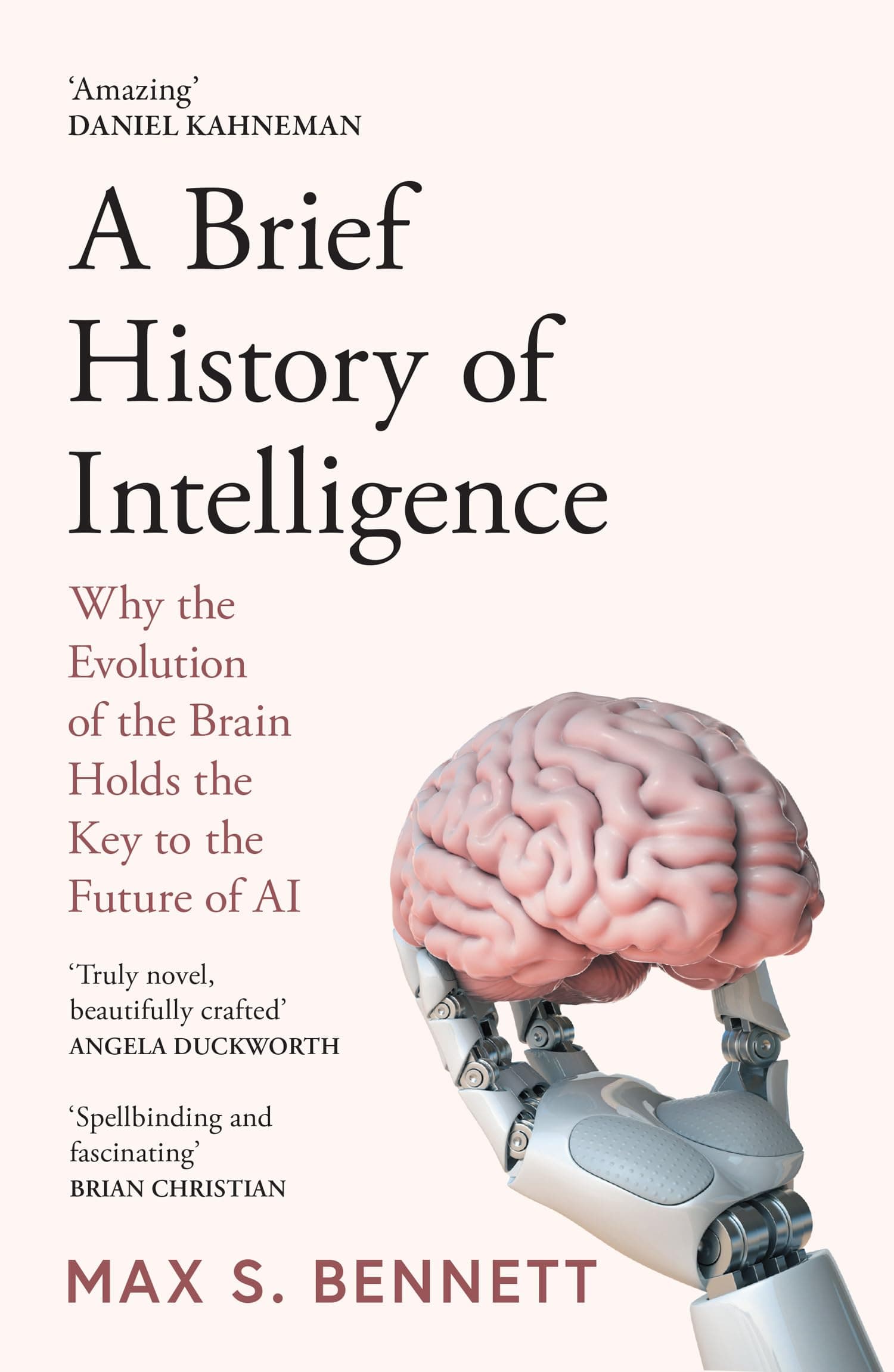
A Brief History of Intelligence: Why the Evolution of the Brain Holds the Key to the Future of AI : Bennett, Max: desertcart.co.uk: Books Review: Detailed easy-to-follow account on how our brains evolved - From Bilaterians, to vertebrates, to mammals, to first primates, to early humans and modern humans. The book captures five breakthroughs (transitions) on the key features of the brain of those species mentioned that govern their survival, with detailed neuroscience and mixed bag of deep learning and reinforcement learning accounts in explaining how the brain works. The book is simply a refreshing read, provided I am solely a recent self-taught AI researcher without much background in neuroscience. It encourages me to go on and read more about the brain while I have more time, as I have now become more knowledgeable in those topics, which were once too scary to enter. Review: Fascianting read about animal, human and artificial intelligence--highly recommend - This was a fabulous read. How did animal brains evolve, and what does this mean for the development of artificial intelligence. Why can "simple" animals easily do things AI can't, yet, and how did those systems evolve, layer by layer, up to the apex animal that is us? This book answers those questions--at least the ones we have answers to--in a highly entertaining and enlightening way. I really looked forward to reading this book each time, and it made me think more deeply about what makes us--animals and humans--unique relative to our silicon inventions. I can't recommend it enough!
| Best Sellers Rank | 11,619 in Books ( See Top 100 in Books ) 1 in Apes & Monkeys 4 in Neurology 5 in Human Evolution |
| Customer reviews | 4.7 4.7 out of 5 stars (1,036) |
| Dimensions | 12.9 x 3.8 x 19.8 cm |
| Edition | 1st |
| ISBN-10 | 0008560137 |
| ISBN-13 | 978-0008560133 |
| Item weight | 294 g |
| Language | English |
| Print length | 432 pages |
| Publication date | 10 Oct. 2024 |
| Publisher | William Collins |
P**Y
Detailed easy-to-follow account on how our brains evolved
From Bilaterians, to vertebrates, to mammals, to first primates, to early humans and modern humans. The book captures five breakthroughs (transitions) on the key features of the brain of those species mentioned that govern their survival, with detailed neuroscience and mixed bag of deep learning and reinforcement learning accounts in explaining how the brain works. The book is simply a refreshing read, provided I am solely a recent self-taught AI researcher without much background in neuroscience. It encourages me to go on and read more about the brain while I have more time, as I have now become more knowledgeable in those topics, which were once too scary to enter.
M**S
Fascianting read about animal, human and artificial intelligence--highly recommend
This was a fabulous read. How did animal brains evolve, and what does this mean for the development of artificial intelligence. Why can "simple" animals easily do things AI can't, yet, and how did those systems evolve, layer by layer, up to the apex animal that is us? This book answers those questions--at least the ones we have answers to--in a highly entertaining and enlightening way. I really looked forward to reading this book each time, and it made me think more deeply about what makes us--animals and humans--unique relative to our silicon inventions. I can't recommend it enough!
"**"
Superb
Bennett is not a biologist but by adopting the framework of intelligence he somehow manages to integrate the work of many biologists into a compelling whole, at least as far as human evolution is concerned. Along the way he makes many seemingly obvious yet interesting points which somehow others forgot to mention. Which means of course that they weren't too obvious in the first place! I purchased the audiobook as well as the print edition however I do not recommend the audiobook because the reader continually fails to emphasize the appropriate words, making it harder to follow. Better for a non-fiction work if the author reads it.
N**Y
Great gift
It was a gift for my partner, he loved it
T**Y
An excellent book
One of the best books I have read; notes, glossary, references and Bibliography are provided at the end which are vey useful
C**S
What intelligence is all about
This book explains more about intelligence than anything I’ve ever read. And it does so from refreshingly novel perspectives. The main thrust is evolutionary. Even the humble nematode worm which inhabits the sea bed and has only 302 neurons, has enough intelligence to turn towards what it wants and away from what threatens it. That is the first advance on the humble coral and shows that the choice between good and bad (valence) was there almost from the beginning. The book is set in 5 sections, cataloguing the advances made by bilaterians, vertebrates, mammals, primates and humans. I hadn’t realised for instance that though fish can recognise objects they have no ways of recognising places: doing this from different approaches needs better insight. Bennett is not a professional scientist but an AI entrepreneur. And he highlights parallels between the way AI has advanced in the last 70 years and the advances of intelligence over 40 million years of evolution. Often AI researchers have learned from the natural world. But ChatGPT has not yet incorporated step 4, the ability of primates to mentalize, modelling the aims and plans of others, despite its vast knowledge of language, the focus of step 5. It explains its sometimes puzzling shortcomings.
R**M
Stunning, enlightening, informative Book
Taking us from the emergence of life to the modern human brain through 5 breakthroughs this was a wonderful book telling a unique story. Very well laid out, the Author is a clear concise and articulate communicator. I haven’t enjoyed a book this much in a long time. Highly recommended
C**,
Engaging and thought provoking
Excellent, thought provoking Has become a reference book
V**I
Leitura densa e muito rica nos detalhes da evolução humana
P**E
Fantastic book a must read to understand where we come from and how AI could impact
K**E
This book covers the evolution of human intelligence by describing 5 crucial breakthroughs, and how each built on the earlier ones. It’s a fascinating approach and I found it really enlightening. For example, in the 5th breakthrough, how human language acquisition and use distinguishes us from our close primate relatives. The scope of the book is huge – very impressive that it took only a year to write. Two points to mention: The concept of ‘intelligence’ isn’t defined anywhere in the book that I could find. I think it should be, given that it’s the basis of the book. We all know what it means, sort of, but different people would probably explain it differently. Similarly, an entry in the Glossary for 'eukaryote' could be helpful. The mixing of systems of units looks awkward – for example in Figure 1.4, microns together with inches. I think it would be better to stick with metric to be consistent with scientific writing (and use in many parts of the world).
D**N
Exzellent Book! Recommendet for all who are interested in basic questions of live on earth. Good writing style, excellent structure and content. Probably will get one of my top 15 Books ever.
A**R
Excellent book describing biological evolution of brain from single cell creature billion years ago to today's human. Loved the summaries of breakthroughs and the end of each chapter and the good connection to AI. Breakthrough #6 will be superintelligence with AI. The paperback quality seems pretty good.
Trustpilot
Hace 3 días
Hace 2 semanas