
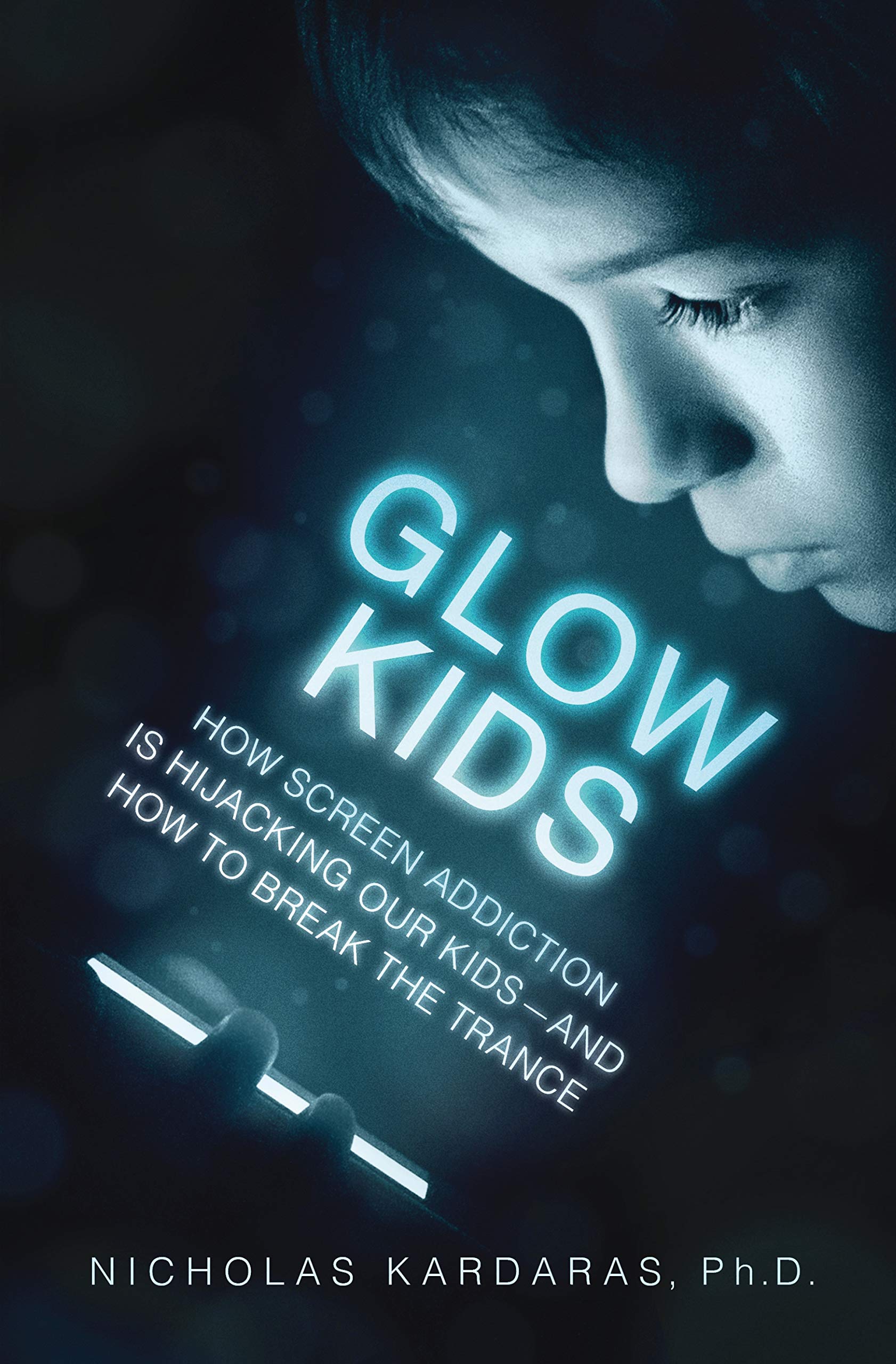
Glow Kids: How Screen Addiction Is Hijacking Our Kids - and How to Break the Trance [Kardaras, Nicholas] on desertcart.com. *FREE* shipping on qualifying offers. Glow Kids: How Screen Addiction Is Hijacking Our Kids - and How to Break the Trance Review: What Kids are exposed to! - Kardaras, N. (2016). Glow kids: How screen addiction is hijacking our kids--and how to break the trance. St. Martin’s Press. Nicholas Kardaras is a psychologist, author, speaker and expert on mental health, addiction, and the impacts of our digital age. Kardaras opens talking about emails he receives from parents describing "good kids who had become hooked on their devices and became aggressive and often violent when their parents attempted to cut back or limit their screen time." This book is aimed at "informing parents about the clinical and neurological dangers that excessive screen exposure can have on their kids." The term Glow Kids refers to children's screen habits within which he found a "gender divide" observing, "if video games are digital cocaine for boys, then social media and texting are the electronic equivalents for girls." Kardaras asserted that video games and social media are high attention designed to garner and maintain attention and pleasure seeking through variable rewards. Symptoms of technology addiction include neglecting responsibilities, social withdrawal, mood changes, depression, loss of interest, and even aggression - all contributing to the potential for a failure to launch, the inability to transition to adulthood. Kardaras acknowledges that parents offer several reasons for continuing technology use: (a) I don't want my kids to get behind, (b) the horse is out of the barn, as in, it's too late, (c) I want them to have a phone in case I need to get hold of them, (d) it will help them learn through all the information available, and (d) It's not as bad as people say, an outright denial that there's a potential for a problem. He provides evidence against each reason as to why these reasons are less valid in comparison to the potential danger to kids. Well researched, he includes a checklist for parents to discern whether their child might have a screen addiction and his website includes a bibliography of cited sources related to tech addiction. This would be a good book for those interested in addiction, history of technology, technology use in education, and gender variances related to technology adoption and challenges. Review: Astonishing and life altering - This book provides a thoughtful and in depth presentation of the problem we are all facing today as parents. If you had any doubt about whether your common sense observation is correct about the fact your kid could have a tech addiction; this book presents indisputable evidence that your gut feeling is correct. Dr. Kardaras presents an evidenced based case citing scientific study after scientific study to prove the point that we, as a society, are already deep inside the rabbit hole. We have been systemically and purposely deceived by sometimes well intentioned but oftentimes greedy group think corporate heads that placed tech into the hands of our young children. As a physician, and the father of three boys ages two through 11, I have seen first hand the addiction in my kids. The facts presented by Dr. Kardaras will hit you like a ton of bricks. THIS IS ADDICTION--100% It is not often that I read a passage in a book that literally stops me in my tracks and rocks me to my core. Again, as an MD, I've read 100's, if not 1000's of medical texts and articles. Don't get me wrong, you do not need any degree other than common sense to get the point of this book. It is all explained very well so that anyone will get it. But when he speaks of Little Johnny sitting in the corner with his iPad, seemingly in intense quiet concentration and focus. So much that one might say, "Look at how focused Little Johnny is, concentrating so hard on his game." But as Dr. Kardaras pointed out and I can concur from other medical research, Little Johnny 's brain is being damaged by the onslaught of hyper-stimulation. Although he looks so focused and concentrating, his ability to focus and concentrate is actually being destroyed by the hyper stimulation to his cerebral cortex. That was the passage that stopped me cold. How many times have I seen my own kids mesmerized in apparent concentration while their higher order brain centers were being bombarded with sequential rewards and temptations. I literally got sick to my stomach. The second part of the book presented a treatment plan. I implemented this in my life and successfully broke my kids addiction. I used the not well known "Restrictions" functions on their iPad and iPhone device and restricted everything. I confiscated all tech and sent them into painful withdrawal. 6 months later, I am happy to say my older one doesn't even remember or care if he has his phone or not, their grades have improved and although they think this is a punishment, which I keep telling them it's not; we are a much better off family unit. This book will change your life if you think you have kids that are addicted to their devices. Thanks Nick
| Best Sellers Rank | #297,296 in Books ( See Top 100 in Books ) #61 in Medical Child Psychology #74 in Substance Abuse Recovery #112 in Popular Child Psychology |
| Customer Reviews | 4.7 4.7 out of 5 stars (1,326) |
| Dimensions | 6.37 x 1.06 x 9.59 inches |
| ISBN-10 | 1250097991 |
| ISBN-13 | 978-1250097996 |
| Item Weight | 1.05 pounds |
| Language | English |
| Print length | 288 pages |
| Publication date | August 9, 2016 |
| Publisher | St. Martin's Press |
A**N
What Kids are exposed to!
Kardaras, N. (2016). Glow kids: How screen addiction is hijacking our kids--and how to break the trance. St. Martin’s Press. Nicholas Kardaras is a psychologist, author, speaker and expert on mental health, addiction, and the impacts of our digital age. Kardaras opens talking about emails he receives from parents describing "good kids who had become hooked on their devices and became aggressive and often violent when their parents attempted to cut back or limit their screen time." This book is aimed at "informing parents about the clinical and neurological dangers that excessive screen exposure can have on their kids." The term Glow Kids refers to children's screen habits within which he found a "gender divide" observing, "if video games are digital cocaine for boys, then social media and texting are the electronic equivalents for girls." Kardaras asserted that video games and social media are high attention designed to garner and maintain attention and pleasure seeking through variable rewards. Symptoms of technology addiction include neglecting responsibilities, social withdrawal, mood changes, depression, loss of interest, and even aggression - all contributing to the potential for a failure to launch, the inability to transition to adulthood. Kardaras acknowledges that parents offer several reasons for continuing technology use: (a) I don't want my kids to get behind, (b) the horse is out of the barn, as in, it's too late, (c) I want them to have a phone in case I need to get hold of them, (d) it will help them learn through all the information available, and (d) It's not as bad as people say, an outright denial that there's a potential for a problem. He provides evidence against each reason as to why these reasons are less valid in comparison to the potential danger to kids. Well researched, he includes a checklist for parents to discern whether their child might have a screen addiction and his website includes a bibliography of cited sources related to tech addiction. This would be a good book for those interested in addiction, history of technology, technology use in education, and gender variances related to technology adoption and challenges.
D**G
Astonishing and life altering
This book provides a thoughtful and in depth presentation of the problem we are all facing today as parents. If you had any doubt about whether your common sense observation is correct about the fact your kid could have a tech addiction; this book presents indisputable evidence that your gut feeling is correct. Dr. Kardaras presents an evidenced based case citing scientific study after scientific study to prove the point that we, as a society, are already deep inside the rabbit hole. We have been systemically and purposely deceived by sometimes well intentioned but oftentimes greedy group think corporate heads that placed tech into the hands of our young children. As a physician, and the father of three boys ages two through 11, I have seen first hand the addiction in my kids. The facts presented by Dr. Kardaras will hit you like a ton of bricks. THIS IS ADDICTION--100% It is not often that I read a passage in a book that literally stops me in my tracks and rocks me to my core. Again, as an MD, I've read 100's, if not 1000's of medical texts and articles. Don't get me wrong, you do not need any degree other than common sense to get the point of this book. It is all explained very well so that anyone will get it. But when he speaks of Little Johnny sitting in the corner with his iPad, seemingly in intense quiet concentration and focus. So much that one might say, "Look at how focused Little Johnny is, concentrating so hard on his game." But as Dr. Kardaras pointed out and I can concur from other medical research, Little Johnny 's brain is being damaged by the onslaught of hyper-stimulation. Although he looks so focused and concentrating, his ability to focus and concentrate is actually being destroyed by the hyper stimulation to his cerebral cortex. That was the passage that stopped me cold. How many times have I seen my own kids mesmerized in apparent concentration while their higher order brain centers were being bombarded with sequential rewards and temptations. I literally got sick to my stomach. The second part of the book presented a treatment plan. I implemented this in my life and successfully broke my kids addiction. I used the not well known "Restrictions" functions on their iPad and iPhone device and restricted everything. I confiscated all tech and sent them into painful withdrawal. 6 months later, I am happy to say my older one doesn't even remember or care if he has his phone or not, their grades have improved and although they think this is a punishment, which I keep telling them it's not; we are a much better off family unit. This book will change your life if you think you have kids that are addicted to their devices. Thanks Nick
A**R
Such eye opening information!
Wow this book was an eye opener, every parent needs to read this book !!
S**H
If your concerned for your kids spending go much time online then this will give you a better insight on the effects. Fab thought provoking book
L**E
It's a very relevant topic that people are not paying enough attention get. Dr Kardaras brings a lot of research indicating the adverse effects of technology and how to get free of those bad habits.
L**2
Un bon livre sur l'effet des écrans de façon générale.
A**O
Although I totally agree with the Philosophy of the author and enjoyed much the preface, the book itself is highly disappointing. 1. There is no real structure. 2. He repeats the same again and again but doesn’t offer good arguments. He neither present convincing objections to his view to be refuted. 3. The worst part, in my view, is the total lack of care in choosing his sources. Sometimes he mentions “research says” and doesn’t provide the sources. Other times he refers to newspaper articles and alike! Really terrible and unacceptable from someone who holds a PhD. 4. He claims to be one of the biggest experts on addictions but he doesn’t really present credible credentials. The book is messy. Often generalizes from his own (limited) experience. Sometimes he refers to research based on studies using-literary-17 people! Lack of care in preparing the book. It seems that he was in hurry to publish it. Overall I am very disappointed. Although I totally agree with the objections against the usage of screens, the book is unconvincing due to the lack of care and professionalism one would desire. For people interested in the topic, I definitely recommend Desmurget’s book or, if one can read Spanish, Francisco Villar Cabeza. Both are far better than this one.
S**N
Glow Kids is absolutely amazing. I bought the 2 great books...."Glow Kids" and "Irresistible: The Rise of Additive Technology and the Business of Keeping us Hooked" By Adam Alter for many of the people at my workplace. Both should be bought for birthdays and Christmas presents and for all members of your family, friends and work makes. Cell phones and video games have turned social society into a selfish, zombie like low self esteem reality all over the place. These 2 books are the only ones ever written about this societal crisis. Facebook depression, social comparison, dopamine tickle and cliffhangers all contribute to addictions. The same chemical that is triggered when we pro create and consume food is the same chemical that gets released when we watch TV, use our cell phones and play video games, drink alcohol, do drugs and even consume chocolate. Dopamine + environment = addiction. Why is Ontario suing facebook and Snapchat for $5.5 billion when we could get all the students to read Nicholas Kardaras 's "Glow Kids" and Adam Alter's "Irresistible" and write an essay, short term paper or do a group project presentation for the class. Introduce a media literacy training course for students and level the playing field. These are the 2 best written books of our era simply because of the huge negative impact cellphones and video games have had on our lives. The bus and subways are chalk full of cell phone zombie kids, cell phone zombie adults and cell phone zombie seniors. Read both and give both as gifts to the people you care about. Please please please do this right now. Thank you kindly for allowing me to share my views on these important topics.
Trustpilot
Hace 1 semana
Hace 1 semana