
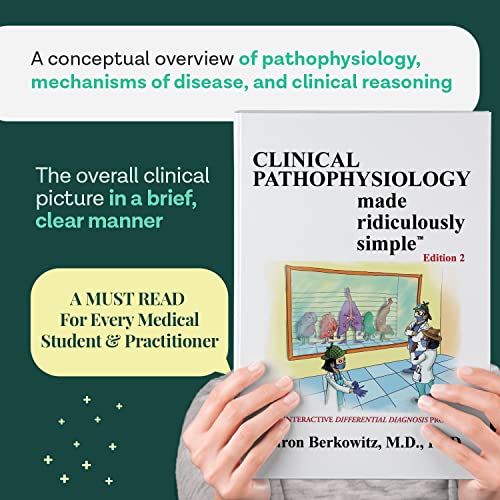





Buy MedMaster Inc Clincal Pathophysiology Made Ridiculously Simple by Berkowitz, Aaron online on desertcart.ae at best prices. ✓ Fast and free shipping ✓ free returns ✓ cash on delivery available on eligible purchase. Review: The best book to keep in order the storm of mnemonic notions in the medical student's head! Definitely a lovingly readable book. Review: This book is genuinely a good find. It has very simple yet detailed - thorough explanations that provide an exceptional learning experience. Highly recommended


| Best Sellers Rank | #212,425 in Books ( See Top 100 in Books ) #103 in Radiology #1,096 in Basic Medical Sciences #19,397 in Higher & Continuing Education Textbooks |
| Customer reviews | 4.6 4.6 out of 5 stars (2,363) |
| Dimensions | 21.84 x 27.94 x 1.78 cm |
| Edition | second |
| ISBN-10 | 1935660446 |
| ISBN-13 | 978-1935660446 |
| Item weight | 476 g |
| Language | English |
| Print length | 222 pages |
| Publication date | 1 June 2021 |
| Publisher | Medmaster |
R**C
The best book to keep in order the storm of mnemonic notions in the medical student's head! Definitely a lovingly readable book.
S**.
This book is genuinely a good find. It has very simple yet detailed - thorough explanations that provide an exceptional learning experience. Highly recommended
W**N
so much more readable and understandable than my professor ... most students on my course (human sciences) use this book. It's physiology, it's pathology and it relates to real people. A Winner
L**A
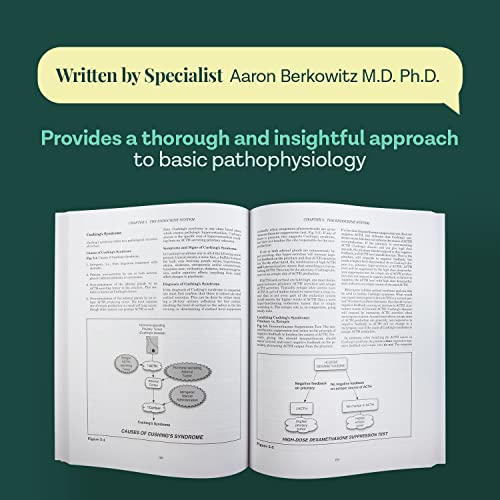
I like the easy to grasp style the book is written. Definitely for beginners but good for recap as well. The included diagrams help solidify the concepts behind the written text. The book arrived damaged as per photos, doesn't affect me but if it was a gift purchase I would be a bit disappointed. The packaging was just a satchel and should have probably been wrapped around in cardboard.
W**D
I am a nursing student who learns things by understanding them on a deep level (causes, patterns, connections) rather than by memorizing isolated fragments. So this book is excellent for someone like me. Unlike the assigned textbook for pathophysiology, this book begins its survey of the clinical problems that can affect each body system with a "big picture" preview--and always in the simplest, clearest language possible. Here, for instance, is how the pulmonary system chapter begins: "What problems could affect the alveolar sac and/or airways? 1. The sac is already filled with something other than air. 2. The sac does not open adequately. 3. The sac is unable to expire adequately due to either obstruction of the airways or decreased elastic recoil of the sac itself." The rest of the chapter simply fills in the details of these three possibilities. Moreover, the book is filled with extremely useful devices for remembering and organizing the information presented. There are on virtually every page very clear diagrams, pictures, or formulas that capture a central concept in a memorable figure. For instance, a figure depicting the renal system, with blood supply, nephron, and collecting system (ureter, etc) uses little pointing hands to show the classification of kinds of acute renal failure: prerenal, intrinsic, and postrenal. Second, the book has many helpful mnemonics. For instance, "aldosteRoNe causes Reabsorption of Na (sodium)." Finally, the book provides detailed but wonderfully clear and simple explanations of virtually every pathophysiological problem, including many of the major diagnostics for distinguishing them. Moreover, it frequently uses questions in the text to give the reader a chance to think about the problem. For instance, in discussing hyperthryroidism, the author points out the two main mechanisms: "The thyroid over-secretes thyroid hormone (primary) or the pituitary over-stimulates the thyroid to secrete thyroid hormone (secondary). One needs only one lab value to distinguish between primary and secondary hyperthyroidism. Which one? Think about negative feedback. If the thyroid itself secretes lots of hormone 'without being told to,' this would increase negative feedback on the pituitary. So in primary hyperthyroidism TSH will be low." Plainly, one cannot come to this book without an adequate background in basic anatomy and physiology. Nor does the book presume to provide detailed coverage of everything, as Guyton and Hall do. But it is the best short overview of pathophysiology I have ever seen, and it helped me tremendously in understanding and therefore thinking critically about clinical problems.
Trustpilot
Hace 2 meses
Hace 2 semanas