We remain fully operational. Our teams are working around the clock to ensure your deliveries continue safely.

Descargar la aplicación


Servicios al cliente
Sobre nosotros
Copyright © 2025 Desertcart Holdings Limited
Descargar la aplicación
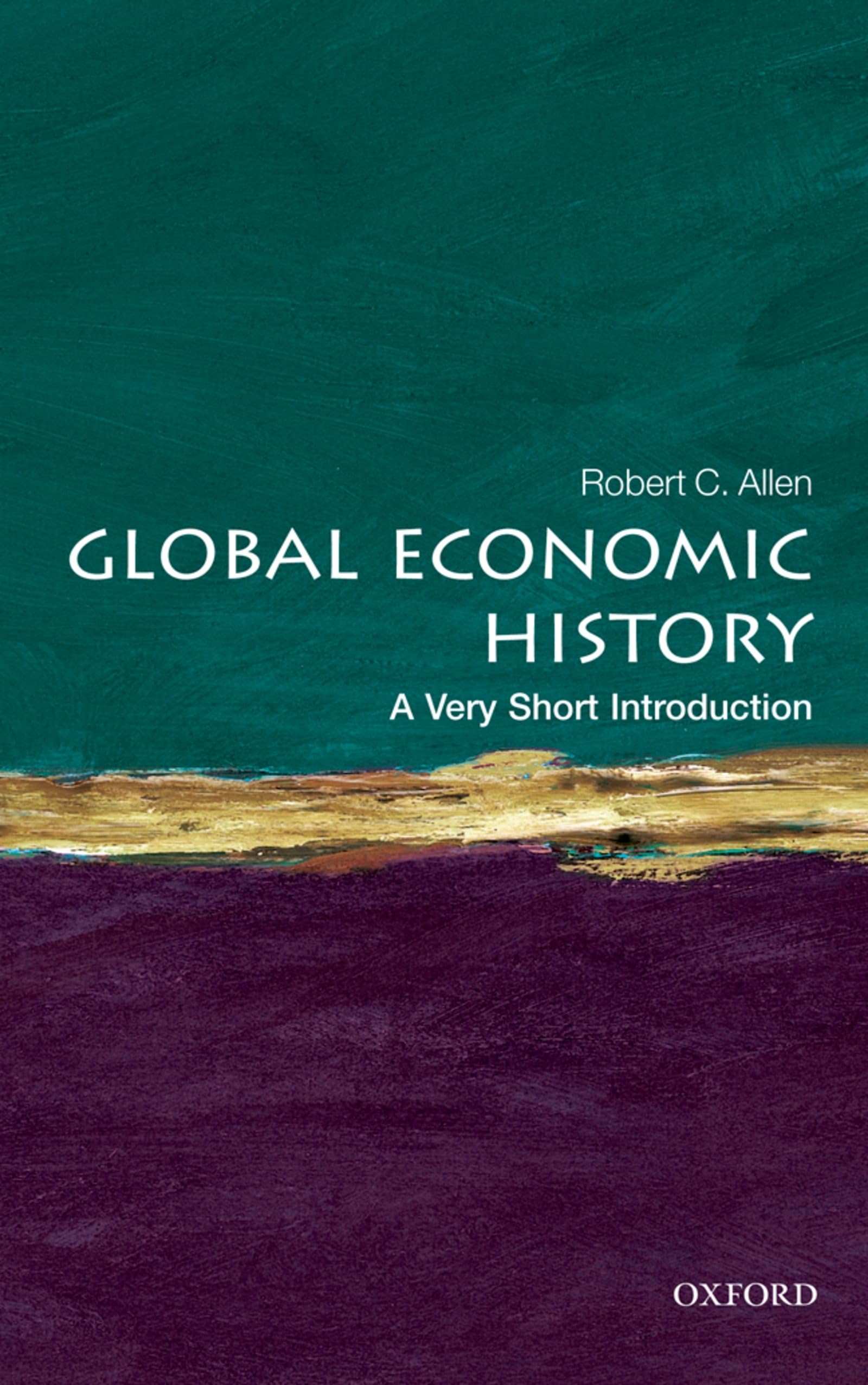
Global Economic History: A Very Short Introduction: 8601300148366: Economics Books @ desertcart.com Review: Well written and relevant to today's political solutions - The author writes with a style where he consistently gets to the point with compelling facts and commentary. I found this book to cause me to reflect on what the US (or any country) needs to focus on to thrive, as well as to further increase my appreciation for the decisions made by our country's leaders over its first 100 plus years. While we have gotten a lot wrong, and still do, we got a lot right. If we focus on what we did right, we should be able to convince ourselves to do more of the same in the future. One example is education, how our approach to universal education gave us so many advantages. This book also gives one a sense of how lucky we were in many ways with inherent advantages one could argue we squandered. My thoughts are that one reason we are where we are today is that our founders were far more intellectual and influenced by great thinkers of the day (e.g. Scottish Enlightenment), whereas today we are simplistic, closed minded, and afraid to be bold with new approaches. Seems like we will have to go down further before we wake up and begin to dialogue as was done in the past. If we don't, my fear is whole generations will come out cynical and poorly prepared for the new world. This book seems to have answers to create an environment where future generations can develop the skills needed to thrive and compete with other countries, or even other generations who were given a head start. In sum, I found this to be one of the more enjoyable and enlightening reads. Review: A very good first read on global economic history - This is just what the title says, a very short introduction. The author clearly has a point of view that he argues in favor of, and his arguments appear convincing, although sometimes one suspects that there may be much more to the story, and some important questions are left open, as pointed out by Ronan "Connecticut Guy". On balance, though, for a short book discussing wide ranging topics, the author does a very good job. I had never before read a book on global economic history, and I feel it was well worth reading this one, and that I learned a lot from it.



| Best Sellers Rank | #928,394 in Books ( See Top 100 in Books ) #102 in International Economics (Books) #249 in Economic History (Books) #418 in Macroeconomics (Books) |
| Customer Reviews | 4.5 4.5 out of 5 stars (419) |
| Dimensions | 6.8 x 4.3 x 0.5 inches |
| Edition | 1st |
| ISBN-10 | 0199596654 |
| ISBN-13 | 978-0199596652 |
| Item Weight | 2.31 pounds |
| Language | English |
| Part of series | Very Short Introductions |
| Print length | 170 pages |
| Publication date | November 15, 2011 |
| Publisher | Oxford University Press |
G**N
Well written and relevant to today's political solutions
The author writes with a style where he consistently gets to the point with compelling facts and commentary. I found this book to cause me to reflect on what the US (or any country) needs to focus on to thrive, as well as to further increase my appreciation for the decisions made by our country's leaders over its first 100 plus years. While we have gotten a lot wrong, and still do, we got a lot right. If we focus on what we did right, we should be able to convince ourselves to do more of the same in the future. One example is education, how our approach to universal education gave us so many advantages. This book also gives one a sense of how lucky we were in many ways with inherent advantages one could argue we squandered. My thoughts are that one reason we are where we are today is that our founders were far more intellectual and influenced by great thinkers of the day (e.g. Scottish Enlightenment), whereas today we are simplistic, closed minded, and afraid to be bold with new approaches. Seems like we will have to go down further before we wake up and begin to dialogue as was done in the past. If we don't, my fear is whole generations will come out cynical and poorly prepared for the new world. This book seems to have answers to create an environment where future generations can develop the skills needed to thrive and compete with other countries, or even other generations who were given a head start. In sum, I found this to be one of the more enjoyable and enlightening reads.
H**C
A very good first read on global economic history
This is just what the title says, a very short introduction. The author clearly has a point of view that he argues in favor of, and his arguments appear convincing, although sometimes one suspects that there may be much more to the story, and some important questions are left open, as pointed out by Ronan "Connecticut Guy". On balance, though, for a short book discussing wide ranging topics, the author does a very good job. I had never before read a book on global economic history, and I feel it was well worth reading this one, and that I learned a lot from it.
K**.
To the Point History with Good Explanations of Possible Reasons for the Current Economic Situation
Very interesting book. At least, if you like reading about how countries industrialized, and the theories on how to effectively do so. Allen does a good job of explaining a rather convincing theory that high wages drove investments in high-capital labor saving devices/methods, which forms a positive feedback cycle, as the high-capital devices allow wages to increase, and so higher-capital devices can be introduced economically. He also gives good accounts of other theories of how economic history such as staples (use a "staple" product to grow by exporting it), and industrial planning. He tackles every area of the world and pretty much every time from 1500 (mostly focusing on Europe for the early times). Japan, Russia, Korea, Taiwan, and China get special mentions for accomplishing the catch-up of GDP/capita with Western Europe, with some thoughts on how and why. Overall, just an interesting viewpoint as to how the world has gotten where we gotten. Allen does a good job of pointing out problems with theories and also accepting that no simple explanation will probably due. He ends with "The best policy to effect economic development, therefore, remains very much in dispute," which I think is a fitting ending for an area with so many uncertainties.
M**I
vigorous global economic history
Robert C. Allen wrote whole global economic history vigorously. A thin book has a substantial contents. His profound knowledge overwhelms us, passing on his strong message. He divides the last 500 years, when countries developed differently in prosperity, into three periods, the mercantile era, the catch-up and the big push. He paid attention to real wages, which tells the standard of living in the region of each period. He claims cheap labour takes off incentives from businesses to invent or adopt machinery to raise productivity. Allen thinks Globalization, technological change, and economic policy have become the immediate cause of unequal development, while admitting certain roles of institutions, culture, and geography in it's background. Globalization spurred northwestern Europe forward but held southern Europe back, while demanding additional labour, agricultural revolution, energy revolution, and high level literacy. The Industrial Revolution became a turning point in the world history for it's inaugurating the era of sustained economic growth. Why The Industrial Revolution started in Britain is explained by profitability. Considering Britain's high-wage and cheap-energy economy as a result of political, cultural and geometrical context at that time, business in England found using technology as profitable. All of today's rich countries were involved in creating entirely new industries made in the late 19th century. High wages induced more capital-intensive production that led to higher wages. The Western countries enjoyed an ascending spiral of progress, while today's poor countries missed the elevator. Technical change with globalization prompted de-industrializing the ancient manufacturing economies of the empires in the east of Europe. The industrialization of the USA depended on four supportive policies which constituted "the standard model" for economic development in the 19th century; mass education, expanding the market, a national bank, and a tariff. Allen thinks these four policies were the necessary conditions to industrialize, though not always were enough. The different development trajectories of North and South America are rooted in geography and demography. The abundance of free land on the frontier generated high real wages in North America. Sub-Saharan Africa lacked preconditions for modern economic growth, like productive agriculture, diversified manufacturing, and the institutional and cultural resources, which kept Africa poor for so long. While Europe and North America had pushed ahead of the rest of the world, Tsarist Russia, Japan, and Latin America tried to apply "the standard model," however, less fruitful. The large economies that have broken out of poverty in the 20th century have to make a grand design of the big push which requires a planning authority to coordinate the activities and ensure it's being carried out. Soviet, Japan, China succeeded in this by government intervention. What to do for Africa, Latin America, and the rest of Asia, to close gaps with the West. Allen concludes the best policy to effect economic development to these countries remains in dispute.
D**U
Comme toujours dans cette collection, une synthèse claire, bien rédigée et appuyée sur des références. Il s'agit d'une histoire appuyée sur des données économiques remontant aux temps modernes.
M**P
Gives global economic history, briefly. Very good for students as well as professionals.
A**N
I've read about 50 of the the VSI series and this was one of my favourites. I work in finance, read a lot of economics, and studied economics modules at uni, so it was a positive surprise to learn so much from this book, with the author covering times and countries that are often overlooked. I found the writing style excellent and it was a joy to read, and I have recommended it to many friends since.
A**R
The content is good but not the book, it's reprint of the original book but it's too small and color of print is not good for reading, the binding is also very sloppy. I need to return this book.
J**E
The book is a collection of facts rather than having a story to tell. It was so hard to follow the author's thought process as he was jumping from one topic to another without providing proper transition. It however has lots of interesting facts
Trustpilot
Hace 2 meses
Hace 3 semanas