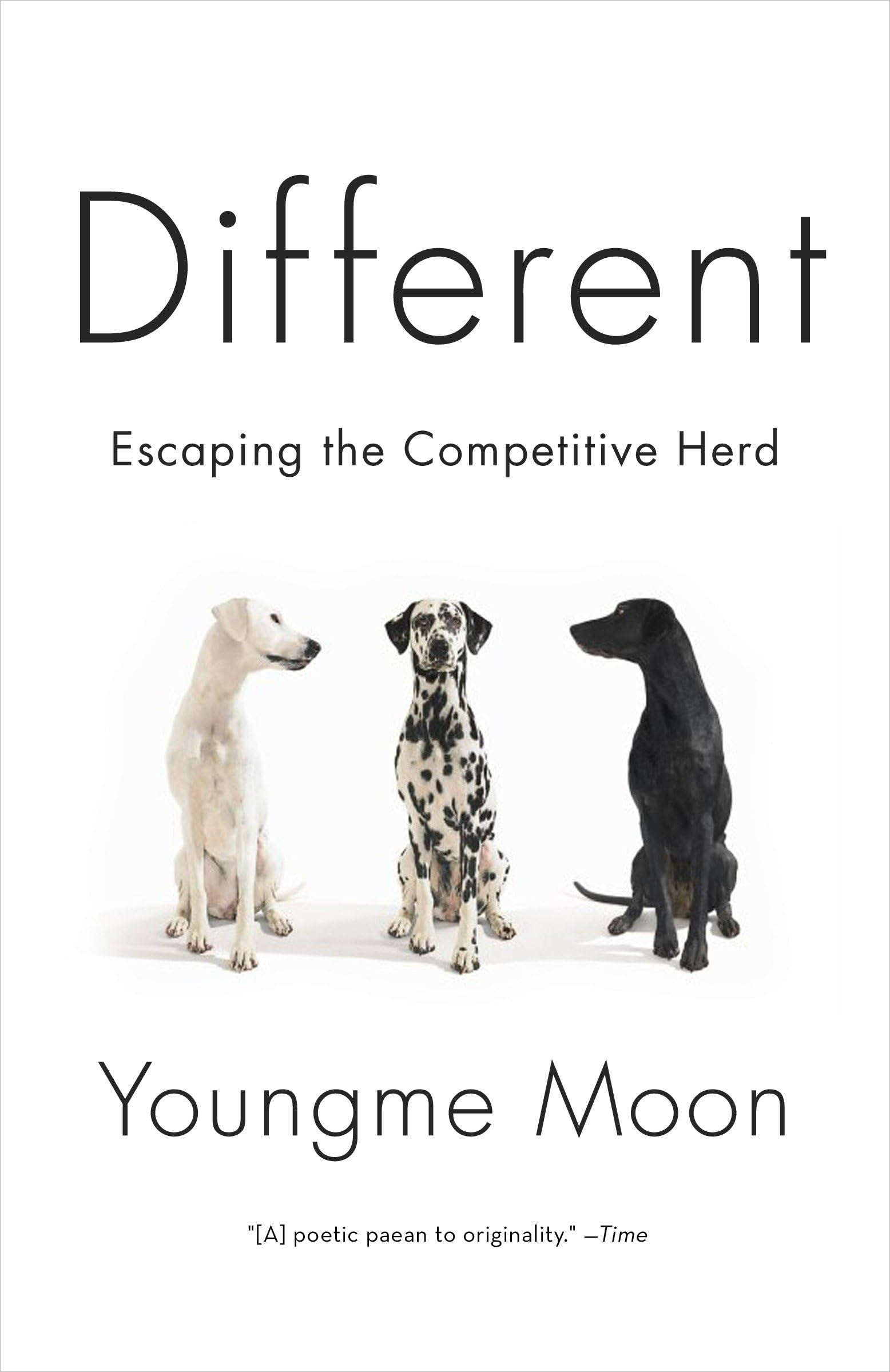
Different: Escaping the Competitive Herd
J**N
As Powerful and Important as Collins, Gladwell, and Covey
Youngme Moon is not only one of the most popular professors at Harvard Business School and the recipient of the student association award for teaching excellence, she has insights into business and life that are unlike anything I've ever experienced. She is the author of Different, the new book called that will blow you away.Differentmay well break into the business vernacular as powerfully as Jim Collins' Good to Great and Built to Last and Malcolm Gladwell's The Tipping Point and Outliers. Her insights are just as powerful and counter-intuitive and her storytelling and language are breathtaking. What I love about Different is that it's like two books interwoven into one coherent narrative. One is a brisk marketing strategy volume that any CEO and marketing officer should read if they want to understand, perhaps for the first time, why despite their best efforts and 24x7 pace they often feel that are running so hard just to stay in place. The second book, though, is interlaced throughout, and is for me personally, even more impactful. Youngme offers the clearest explanation I've seen of the world we live in and why we often feel numb by all the dazzling technology, abundance, and utter convenience with which we find ourselves. Or why, as parents it's hard to understand how it is that our kids don't appreciate "how lucky they are." Youngme says aptly that Different is "a book for people who don't read business books."Here are just a few of the gems offered up in Different:* There will always be a place for brands, or people, or things that are hard to come by. "Restraint," she writes, "can be the new desire." Value is created by being mindful of what we have in abundance and then offering something that is scarce. She implores businesses to offer a break from that which is profuse.* Apple, Harley Davidson, and other iconic brands lack internal consistency, which is what gives them such resonance. "They defy reductionist logic," she explains, "the same way as we do, the way our own internal lives are marked by multiple and contradictory truths that clash and combine, creating asymmetries in every direction."* Human behavior is complicated and studying or writing about it doesn't make it any less so. The "truth" can be elusive. "People are hungry for familiarity. No, sometimes they're starved for change. Yes, people are impatient for progress; no wait, sometimes they yearn for the simplicity of the past. Yes, people are desirous of more, no wait a minute, what they actually want is less."* Monotony can be just as sapping as over-exertion. "The secret to cheating old age," she quotes one of the subjects in her book, "is to stay a moving target." Stillness seems to have the effect of easing the senses until it dulls them. We need some stability and motion. "We need activity to help us feel our synapses firing again."Youngme Moon's Different will show you how differentiation is much more than a marketing tactic, it is a way of thinking. It is a fundamental mind-set and a way of living that derives from respecting, observing, and absorbing people and the world around you.
T**R
Light and non-prescriptive...but it will get you thinking
As I started reading this book I initially felt that this was a book written by an academic with limited commercial marketing experience putting forth old concepts using a new, invented language based on anecdotal evidence from a limited group of students, family and friends.Indeed, an experienced brander will recognize that when Youngme Moon talks about the competitive herd engaging in organic collusion she is really talking about brand managers who assess their brands and work toward ensuring that they remain competitive on consumer-expected points of parity within their categories. She invents language such as "augmentation-by-addition" that is really nothing more than the old, familiar concept of adding Plus-1 features. When she talks about "reverse positioned brands" you may become infuriated thinking to yourself that she is really talking about brands that truly understand their core brand values and realize what their customers want and then merely strip away features and product attributes that don't really matter to their customers in order to narrow and strengthen their brand promise.As I kept reading I found myself thinking broader and deeper about why she wrote her words and what conditions caused her to become somewhat cynical of modern branding.I conclude that she is commenting on a commercial world in which every product category is crowded with brands and options that are all relatively good choices. She is describing the challenge faced by marketers and branders when they have to find the most subtle of ways to try to differentiate when all available options look basically the same to everyone except a few category aficionados who take the time and effort to distinguish between the most trivial points of difference to make their decisions. After all, if a strong brand is to serve as a shortcut for some perception of value then there should be no need for anyone to be forced into becoming a category aficionado to find small differences in the first place. This book isn't just about shaping consumer perceptions, it is also about product development philosophy.Youngme is describing a corporate environment in which the pressure to seek ever-increasing sales and profit forces marketers to constantly seek ways to eek out the slightest bit of competitive advantage in order to try to experience a slight increase in sales over the short-term while knowing the whole time that the competition will copy the concept or catch up very quickly. My favorite quote in the book comes on page 124 when she states that, "less is more only when more has become a commodity" and that is the whole point. More features, more benefits, more slight points of differentiation have become commodities because incremental tweaks have become the expected norm.This book will prompt you to notice brands that seem comfortable in their own skins and that do not seem to get caught up in the vicious cycle of incremental improvements and over-hyping of trivial points of differentiation. By the end you'll be refreshed by they way Youngme has found a way to tell us that it is OK to create brands that stand for some core brand values that don't compromise just to slightly improve the next quarterly sales report or satisfy investors' short-term expected rate of return. You'll start thinking about ways to simplify your brand and zig while others are zagging. You'll start to daydream about what your brand would look like if you got off the competitive treadmill, took the time to reflect and get back to basics for the long-term rather than getting caught in the vicious cycle of responding to your competitors' moves. When your brand is constantly striving to match competitive moves you'll wind up with a brand that is a jack of all trades and a master of none that looks just like every other brand in your category.This book will make you think. You will assess whether or not you've allowed your brands to evolve in a fog of marketing myopia to the point where they really aren't making specific promises of value anymore.While not loaded with findings from research, case studies or literature review this book will have you challenging your basic assumptions about what a strong brand should do and how one should act. As such, it is well worth the purchase price.~~Review by the author of the e-book, "How to Build and Manage Your Brand (in sickness and in health)."
Trustpilot
Hace 2 días
Hace 2 meses