We remain fully operational. Our teams are working around the clock to ensure your deliveries continue safely.

Descargar la aplicación


Servicios al cliente
Sobre nosotros
Copyright © 2025 Desertcart Holdings Limited
Descargar la aplicación
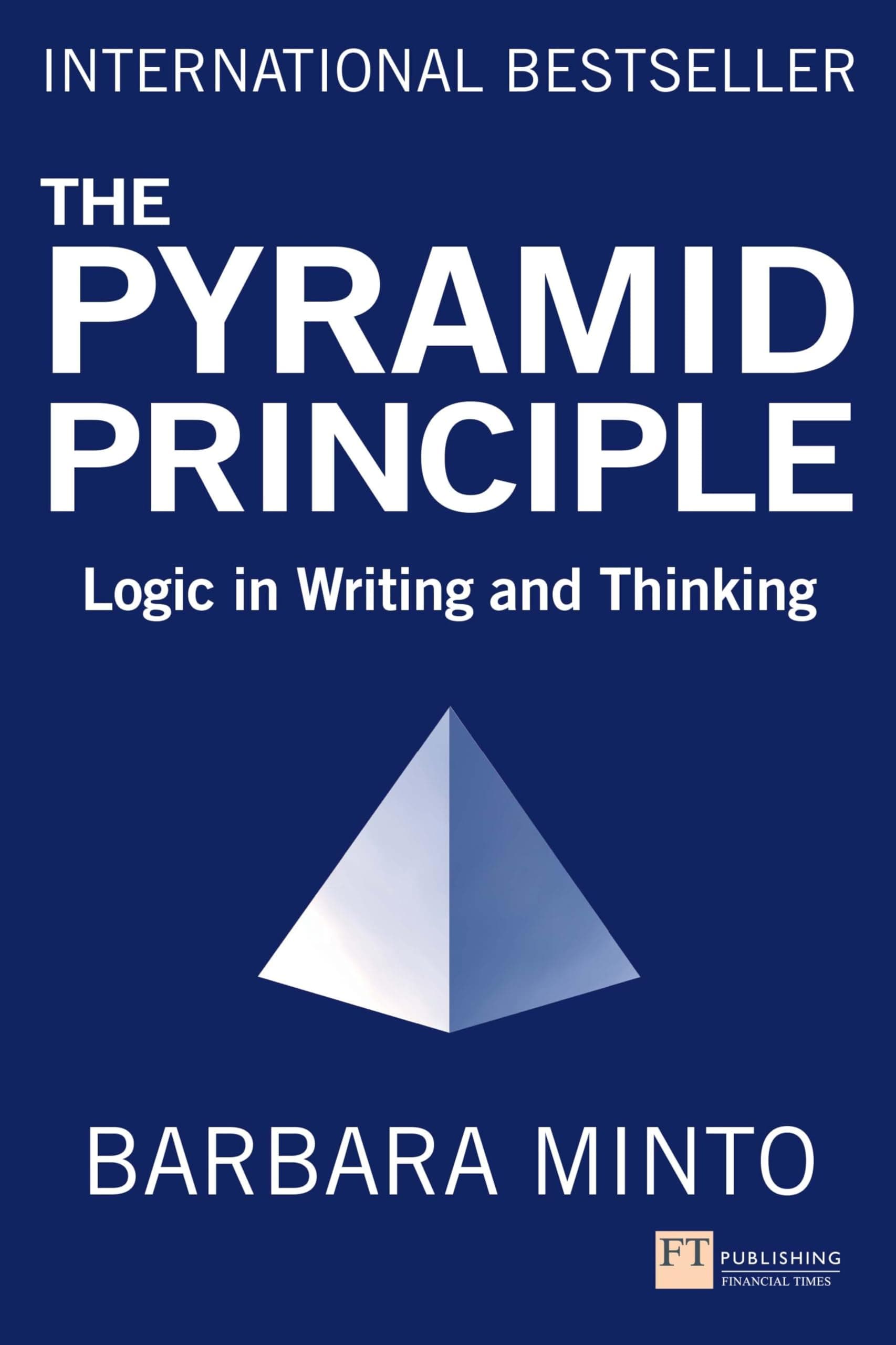
Pyramid Principle, The [Minto, Barbara] on desertcart.com. *FREE* shipping on qualifying offers. Pyramid Principle, The Review: Solid and timeless book for thinking and presenting your issue solving ideas - Solid and timeless book for thinking and presenting your issue solving ideas. Great for corporate careers and i wish i read early in in life. Review: excellent primer on writing well - great book. should be required reading for any freshman in college.
| Best Sellers Rank | #10,054 in Books ( See Top 100 in Books ) #1 in Technical Writing Reference (Books) #9 in Running Meetings & Presentations (Books) #119 in Business Management (Books) |
| Customer Reviews | 4.2 out of 5 stars 327 Reviews |
A**E
Solid and timeless book for thinking and presenting your issue solving ideas
Solid and timeless book for thinking and presenting your issue solving ideas. Great for corporate careers and i wish i read early in in life.
C**H
excellent primer on writing well
great book. should be required reading for any freshman in college.
O**.
Low quality photos, not up to Kindle standards
First off, the book is great which is why I have given it three stars. I would have given it no stars because it's the worst digital book I've ever seen! It's not even a scan, it looks like a pirated version that was put together with photos with an old Nokia phone. Just horrible. It's so blurry at times, you can barely make out the text. The margins are misaligned, the pages are not straight, etc. I'm surprised this meets Amazon's standards, honestly. Let's get a proper version up!
L**E
Not helpful
1. The author presents information in a very complicated way. He prevalently uses long sentences that are not very readable; uses words that are seldomly used in everyday life. 2. The author addressed people with he/him, excluding anyone else! 3. Overall I find this book to be hard to follow and does not provide the help I am looking for.
F**I
Visual Thinking Classic
Barbara Minto's book, "The Pyramid Principle," continues to be a business communication classic and I am glad it remains in print and continues to be reissued as in this edition. See my remarks related to an earlier version which continue to remain relevant. Foundational Work In Visual Thinking - This reviewer first became acquainted with Minto Pyramid Principle concepts and diagrams when part of leading consulting firms where we were exposed as part of efforts to improve our proposal and presentation efforts. Eventually having the opportunity to go back and look at her book in detail showed how helpful it can be in a number of ways. While she explains her approach in detail, a careful reading, also provides additional background and context that might not be evident at a casual glance. A brief introduction reveals that Barbara Minto was the first female consultant hired by the famed McKinsey consulting firm in 1961. One of her initial tasks was to improve European operation consultant writing skills. Recognizing this need was more widespread in the firm, she started developing the method described and refined in the various editions of her book to clarify thinking and expression. Those familiar with McKinsey or who have read books about McKinsey and its approach to problems solving such as those by Ethan Rasiel and Paul Friga can see parallel's with Minto's work, e.g. rotate their issue and decision tree examples 90 degrees and they resemble Minto Pyramids. It seems that since the first edition of her work preceded theirs by more than a decade the Pyramid Principle was one of the first to describe the McKinsey approach (see Duff McDonald's "The Firm: The Story of McKinsey and Its Secret Influence on American Business" that mentions Minto's contribution). In any case, Minto explains the rationale and steps in applying the Pyramid Principle in both in writing and presentations. The reasons and benefits of a "visual thinking" approach are detailed. Later in the book, she also explains ways this "abductive" method, as first coined by Charles Sanders Pierce, differs from deductive and inductive methods. Throughout the book there are other nuggets to be mined. While there are more recent guides to presentations that have been popular with consulting firms in recent years such as Dan and Chip Heath's "Made to Stick," Minto's Pyramid Principle continues to be a classic in its own right. Become familiar with the Pyramid Principle as a foundational means of clarifying your thinking and presentations.
M**N
Too complicated to follow
Book has many great points. But explanation for recommend principles is too difficult for not native speaker. Some provided text examples are too complex to grasp.
P**D
Poor printing quality - lots of blank pages
I really like the book, the information is very useful, but the book has a lot of blank pages. Starting around chapter 4, the book has a pattern of two printed and two missing pages. So far based on what I’ve noticed, the book is missing at least 10 pages. This is really disappointing as I am enjoying the book, but it is certainly hard to read with so much missing content.
A**R
Great Content - Poor Publishing
Looks and feels like a $1 book. The version I got (in America) is only authorized for resale in India... which is a bit odd, because this definitely seems like the official version. Text goes too close to spine. Sticker on cover looks cheap. I'd heavily recommend the book to a friend, but I'd advise them to either buy a used hardcover version off of this listing or try to find a new one.
Trustpilot
Hace 4 días
Hace 3 semanas