☀️ Harness the sun, own your power—start your solar journey today!
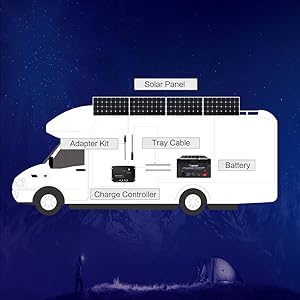
The Renogy 200W Monocrystalline Solar Starter Kit delivers efficient, reliable off-grid power with 22% cell efficiency and smart 4-stage PWM charging compatible with multiple battery types. Designed for easy installation, it includes all necessary components and offers system expandability up to 400W. Built with durable materials and advanced heat dissipation, this kit is ideal for RVs, boats, cabins, and remote applications seeking quiet, sustainable energy independence.


| Best Sellers Rank | #10,165 in Patio, Lawn & Garden ( See Top 100 in Patio, Lawn & Garden ) #72 in Solar Panels |
| Brand | Renogy |
| Customer Reviews | 4.6 out of 5 stars 6,125 Reviews |
| Efficiency | 22% |
| Included Components | cable |
| Item Weight | 37 Pounds |
| Material | Aluminum |
| Product Dimensions | 6.45"L x 4.31"W x 1.76"H |
M**Y
All RVs should have one
I am a RV Technician, and a good solar panel is the first thing I add to my personal RVs. Keeps the battery charged, and regardless of usage my battery(1 full one is all I need) is fully recharged by 2:00 the next day, I don't have to remove it during winter as charged batteries will not freeze. The benefits of battery health, and the need for fewer batteries are worth the cost of at least one solar panel. Mono-crystaline panels are well worth the cost, as amorphous panels loose their efficiency after a few years - google it. Mono-crystaline also work in well overcast and low light conditions, as well as performing better in a fixed mount setting. I got the 100 W kit with 30 Amp controller (plan to add more later) with the nice mounting brackets. Simple to install, with the caveat that you need to be smart enough to unscrew the leads before you try inserting and tightening the wires (I saw a review that slammed the quality of the controller because the wires would not screw down tight). I like the 20' of supplied wire (only needed about 8 on my RV, then 25' of 10/2 Romex from controller to battery). I get 15.4 V with sun direct overhead, and the controller knocks it down to 13.1 V to head towards the battery (I get < 0.1 V line loss in my configuration) Good price for the kit, and a well thought out contents. You need to supply the runs to battery and/or load, or use what is left from the 20' supplied. Brackets are super, as I have had to make my own in the past - not fun. Overall a great kit that I wish everyone had installed on an RV, especially those who call me and complain about $200 and up to replace batteries after a winter without removing or recharging them. Particularly important now with the 12 V slideouts - not fun if you dry camp and have to crank them in by hand (remove a lead to motor first, else they will backfeed the 12V system)
V**Y
excellent performance for me
This panel works great. I have (4) panels total now on two different solar setups. I started experimenting with solar on some rural land to charge a 35aH battery 24/7/365 for general use. Performance has been great and I expanded from 1 to 2 panels there but still need to upgrade my battery size. Charging and maintaining using these panels and the controller has been flawless. No issue. Easy to setup and keep my 12v battery charged and recharged in any season. This past fall, I bought a second setup of 2 panels and controller to use in my workshed. It's all assembled and ready to go and I will get a battery and install there when winter is over.
S**P
Quality and Reliable Name, Great Price and Perfect Product for my application
Renogy 100 Watts 12 Volts Monocrystalline Solar Starter Kit w/100W Solar Panel + 30A PWM Negative ground Charge Controller + MC4 Connectors +Tray Cable+ Mounting Z Brackets for RV, Boat I purchased this to install on the Roof of my Jeep wrangler (overland built) to serve as a way to charge an auxiliary deep cycle battery which powers my permanently mounted ARB fridge as well as all the camp LED lights and recharge phones and electronic equipment. I was fairly new at this solar thing but did a ton of research on the subject before settling on this. There are tons of off-brand products in this category as well as a vast array of pricing options, both higher and lower than this set up. However, after careful consideration and countless review reading and youtube watching, I decided that this set up was best suited for my application. The problem: I built my Jeep to do some overlanding and one thing that I cannot live with is my ARB fridge which is permanently mounted in the kitchen which sits in the back of the car. The car doesn't have a dual battery system and so the fridge is/was plugged into the cranking battery which is not optimal as you do run the risk of the fridge draining your cranking battery and leaving you stranded (NOTE: Fridge does have a shut off feature which measures the voltage of the battery and turn itself off if said voltage is below "x" volts. Also my Jeep is a standard so I can push it / get a quick tow to get it started and I do always have a battery pack / starter as a precaution...). The solution: Getting an auxiliary battery to supply the fridge (and other accessories) and a solar panel to keep this battery topped off while at camp and on the road. I chose Renogy after my many hours of research because of the name brand recognition and the the many reviews that seem to point at a great company with solid products and good support. So far I can say that the reviews are 100% correct in that I made the right choice. The package arrived well wrapped and precisely as advertised. The panel is solidly built and all the cabling provided is the correct gauge with the proper connectors. I really wanted to get a name brand Charge controller after reading that cheaply made units can both be highly inefficient and could be dangerous. In hindsight I probably would rather the version of the solar charge controller than has the integrated LED screen providing the charging and consumption metrics but price point on this project was met with the simpler unit. I am using some third party units to measure charging metrics and load usage which is fine but does require more wiring. The panel comes with all the brackets to install in on a flat surface and my guess is that 90% of the time people will need to do some custom installation of sort so these brackets, although perfectly adequate for a flat install are useless to me at the moment. All the connections are well made and this gives me no reason to believe that they will not last a long time. Right now in full sun and FLAT on my roof rack (note: flat is not optimal as the sun is never perfectly perpendicular to the panel and a 45 degree angle would be better to adjust for the that) the panel does produce about 5.5/6 AmpH and about 24 volts which according to what I calculated will be more than adequate to keep the smaller deep cycle (35amp hour) battery I am using topped off and run all the accessories I want to run off of it. I intent to post photos of the set up once it's complete as well as add to this review when i have had a chance to use the system to a greater extent.
A**E
Good solid product, solar panel works fine
Received this product in timely manner. Well packaged. All pieces in this kit were there. Easy installation of the cables to the charge controller and battery. It helps to have a wire/cable stripper tool. Put the solar panel into full sunlight and got about 20v output. In shade or indirect light, got about 15v output. I used this with 12v deep cycle batteries in parallel to keep them charged. I noticed that the volts of the solar panel measured at the charge controller drops about 5v to match whatever the volts on the batteries happen to be at the time and slowly increase as time goes on the panels slowly charge up the batteries. Not sure if this is normal or not. Also not sure how much power the charge controller uses for its power. Maybe it drains the batteries overnight ever slightly that could be keeping the batteries from being fully charged. Also, noticed that even with the batteries left in this configuration for a week w/o any use that the "battery full" light never comes on, as I would expect, it usually stays at "battery at right level" or "under-charged." Not sure if that is an issue with the charge controller or batteries. Also, wish the charge controller would have LCD/LED numbers to indicate volts and amps for the solar panel and battery terminals instead of that single digit display for the load feature, which I don't think most people use and it's confusing. Update: Aug 7, 2014 I was able to use amp meter to check the current output. Using a branch connector, I had two of these units connected in parallel. In full sun, I got almost 6 amps going into the charge controller, which is about 3 amps per solar panel. I was a little disappointed, expecting to get 5 amps each. In shade or indirect sunlight, the amps dropped way down, to less than one amp... maybe about 50 milliamps and the charge light on controller showed green (meaning a charge, albeit slowly)... so the lesson here is to get a good charge, you really need to have direct sunlight (or even cloud is okay), just no indirect (eg, in shade, etc)... I can't imagine the branch controller limiting my current (eg, I doubt it has any resistance )... Overall, still a good product (in terms of the 100v solar panel itself).
W**Y
Renology 100W solar photovoltaic module with charge controller.
This is a top-shelf panel constructed with obvious pride, and is the second I've purchased via Amazon for battery charging on an RV. It is relatively light-weight, yet sturdy, and is ideal for the applications that I selected it for; mounting on the front of the RV on a piano-type hinge, supported by gas-assist struts when deployed. It is securely dogged-down for travel on rubber bumper "feet" mounted to the bottom edge, and can be raised and made fast to any angle up to about ten degrees above the horizontal for best exposure, depending upon where the rig is parked and the angle of the solar ecliptic.The mounting location on the front of the RV trailer is actually over the front window and window cover, but does not impede the operation of the window when the panel is deployed. I selected this installation method both for short cable proximity to the charge controller and my batteries, the convenience of mounting the charge controller under cover close to the batteries, and to permit the installation without additional roof penetrations for the mounting hardware. I have just completed the actual mount, and have not yet connected the module, but the first application has worked flawlessly, and the module's output was as advertised. I was able to purchase most of the associated hardware through Amazon, although this time I have opted for much lighter-weight capacity gas struts, as the 60# capacity struts were way over-kill. I utilized structural aluminum bar and tube stock for the hinge attachment carrying point, which I attached to the front of the trailer with robust screws and embedded in epoxy. It is possible that some similar applications would require actual through-bolting with a backing plate or equivalent reinforcement. The charge controller employs a nifty programmable load center, which will be useful for a motion-detector security light/porch light arrangement.This controller would be perfect if it incorporated a clear dust cover. The fact that Renogy has assembled a complete solar-electric charging module kit greatly simplifies the installation, and as mentioned at the outset of this comment, the quality of manufacturing is truly outstanding, and is very reasonable priced on a cost-per basis. Backed by Amazon's superb point-of-sale and delivery, I'm glad I chose Renogy for my first and second go-rounds, and I will certainly do so again! Davitt M. Armstrong
D**K
Dry-campers delight; a well documented, small and easy set up solar system
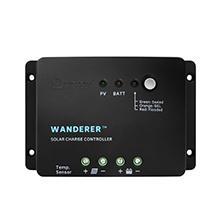
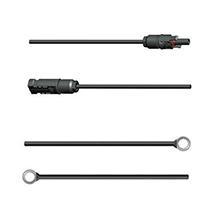
Very pleased with the quality of the product and installation documentation. The panels and charge controller are simply great quality. From the reviews I read before buying, Renogy stands behind its system and responds to troubleshooting customers - a big plus over competition in my purchase decision. A DIYer, I wired the Wanderer Charge Controller into the bedroom of our travel trailer to have immediate access to the system status (and to keep it dry), plus two ammeters; one to monitor solar charge rate to a battery bank and one to monitor our power draw from the same battery bank. That gives us the ability to see the automated doings of the Wanderer, which is really a superb quality charge controller. The system package came with everything necessary, except in-line fuses, to get hooked up to our battery bank (four deep cycle 12-volt flooded cell marine batteries with about 300 amp hour storage capacity) and to run the power cable leads about 8 feet away from the trailer. I purchased an additional 50 feet of power cable (on Amazon - Unlimited Solar's - Solar PV Cable Set with 2 x 50FT MC4 Wire Exntensions - 10 AWG) to be able to place the panels away from shade we might park the trailer in. The MC4 connectors are what Renogy uses and are compatible with other vendor MC4 extensions. For now we are laying the panels on the ground; I will build an adjustable stand for future camping trips. So far everything works great, panels have been in 7 hours of sun per day on two camping trips and kept us charged up for daily 12-volt use (lights, water pump, an electronic ignition propane fridge with a constant 12 watt/0.8 amp draw, propane furnace ignition and fan, CO2 detector). We have shifted our lights to LED's (lower power draw bulbs), but I expect this setup would keep up with higher incandescent bulb's power draw in camping spots with ideal panel exposure. I also plan to have a 200 watt AC inverter in the mix and expect that will be adequately supplied by the system. We really like camping away from campgrounds, in BLM deserts and National Forests, so this is a great set up for us. I will recommend to friends!
C**B
So far, so good.
12.09.2016 Had this for a couple years. It's been dropped and blown over by the wind. No harm, no foul. Very impressed. Continues to supply solid power. Also, the charge controller continues to perform well. No complaints, and still cannot beat the price! 08.05.2014 Received promptly. Great packaging. I haven't actually installed yet. (Will update later) I fabbed up a portable mount with a tripod and some steel angle iron. In initial testing I found an output of 20 volts outdoors in partial shade/overcast. I brought it inside my garage and found 15 volts output. So far, so good. More to come... 08.13.2014 Installation was easy. The hardest part is just figuring out how to run the wires and where to mount the controller. The controller went in the forward cargo bay. I used 10awg wire. I also routed the output to an 800 watt Whistler pro inverter. Ran it like a champ. I put a volt meter behind the inverter so I can keep an eye on it from inside the TT. (Will get a volt/amp meter for the panel output later) I fabbed a scaffold on it to mount to a large tripod. I also took some large tent spikes to nail the tripod down. Be sure to use them BEFORE the wind picks up. :) Also, attached an aluminum handle on it just to make carrying easier, as I am not mounting to the TT. Took it out over the weekend in my TT. I dropped the batteries (210 AH) down to let's say about 80%. Ran all the lights, took a couple showers, music, ran the furnace, the works. This panel had them back up full charge in less than half a day. I had intermittant clouds later in the day, but it still did well. It did get knocked over by a wind gust. Fell flat on it's face into cinder rocks. Which scared me to death, but it was fine. No scratches or cracks. Overall, quality seems excellent. Function appears to be precisely as described. I am very happy with this unit. We will see how the panel and controller fare over time.
O**A
Technology has made solar installation simple and fun, you can do it!
Technology has made solar system simple and fun. I am installing this 100W solar kit on my 8x12 storage shed turned into playhouse. Battery is installed out of reach of child and DC 12V runs throughout playhouse. No inverter is used for kids safety. Hope my review can save you some time of research or experts here can point out what I did wrong. Material preparations: 1. Battery - Purchased Amazon recommended 35AH SLA solar battery at Amazon.com 2. Fuses - In-line ATC fuse holders(3x) and 7.5A fuse pack(of 5pcs) for $12 at local auto parts store 3. Wires & wiring tool - Wire strip kit with connecting parts for $6 at local Homedepot 4. Switches - Don't know where to purchase DC switches(Maybe Amazon or Local electrical stores have it), but Homedepot has AC only switches. Those are rated at 15A/270V for AC only. Because electrons move in one direction only in DC current, AC switch rating has to be de-rated for DC application(divided by 10 for voltage so it is good for my application). 5. Roof flashing - 4 pieces of metal sheet($0.46 each at Homedepot) and roof sealant. 6. Lights - LED lights for indoor and outdoor purchased at Amazon.com. 8AA battery powered utility CFL (I soldered wires at +/- end of battery holder and use DC only). In hinder sight, I should purchase some E26 or E27 base 12V LED bulbs, these are reasonably priced at Amazon.com. Installation: 1. Test everything work fine before actual installation, it will be too much hassle if we need to un-mount solar panel from roof if anything is wrong after installation. Pay attention to order of connect/disconnect battery and PV. Always connect battery first and disconnect battery last. 2. Attach mounting kit to panel. Measure locations of mounting brackets. Seal underneath of roof flashing, place roof flashing under upper roof shingle(Just as if the flashing is a piece of shingle). Put on panel and screw brackets on to roof(Flashing is in between). Seal brackets and screws. 3. Follow charger manual to connect wires. Operation: Nothing to say here, 100W free solar energy is plenty for a playhouse. The quality of panel, charger, mounting kit all looks good. Manuals: Easy to follow, but it appears to be written by engineer rather than by doc writer. It assumes everything are self-explanation by large icons on charger(Which is true if user looks carefully). There are some tiny arrows on charger to tell which LED/Connectors are represented by icons. Tech Support: I emailed tech support twice, one regarding fuse selection, the other regarding battery LED blinking which means battery full(But manual says "SLOW FLASHING". Their use of "Flashing" and "Blinking" are not consistent throughout the manual). In both cases, I got responses within 24 hours. Overall, a five 5 star product and tech support.
Trustpilot
Hace 2 días
Hace 2 semanas