We remain fully operational. Our teams are working around the clock to ensure your deliveries continue safely.

Descargar la aplicación


Servicios al cliente
Sobre nosotros
Copyright © 2025 Desertcart Holdings Limited
Descargar la aplicación

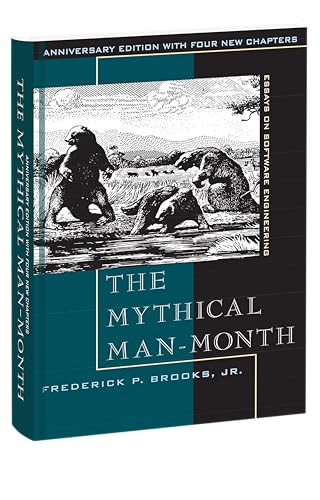

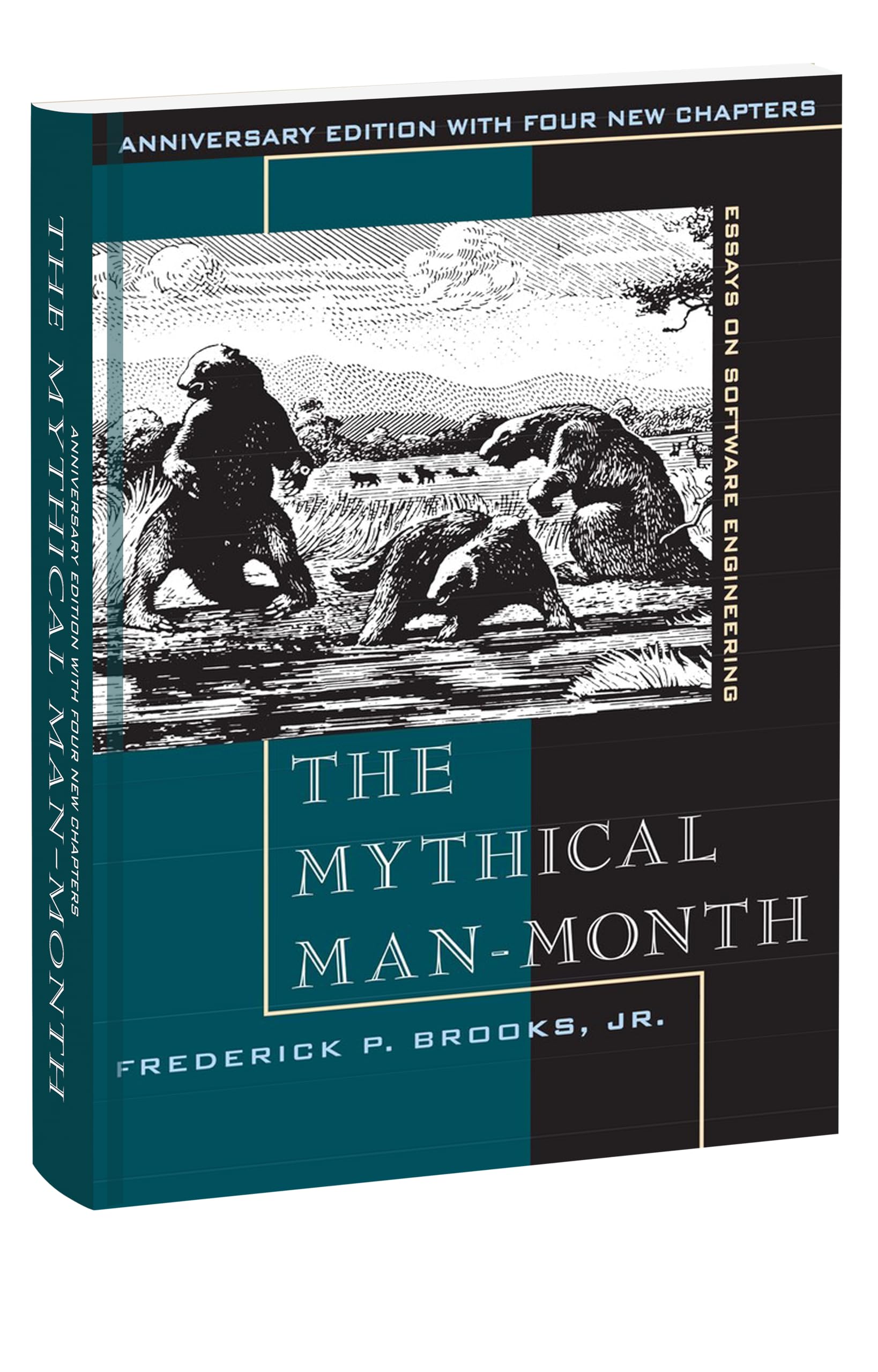
📘 Own the software engineering bible that managers swear by — don’t get left behind!
The Mythical Man-Month Anniversary Edition is a revered collection of essays by Frederick Brooks Jr., offering foundational insights into software project management and human factors in engineering. This edition features four new chapters, including the seminal 'No Silver Bullet' essay, and is a must-have for IT professionals seeking to elevate their leadership and productivity. With same-day dispatch and no-quibble returns, it’s a risk-free investment in your career’s intellectual arsenal.

| ASIN | 0201835959 |
| Best Sellers Rank | #23,923 in Books ( See Top 100 in Books ) #2 in Microprocessor & System Design #15 in Software Development (Books) #46 in Computer Software (Books) |
| Customer Reviews | 4.5 4.5 out of 5 stars (1,764) |
| Dimensions | 9.07 x 6.11 x 0.75 inches |
| Edition | Anniversary |
| ISBN-10 | 9780201835953 |
| ISBN-13 | 978-0201835953 |
| Item Weight | 1.05 pounds |
| Language | English |
| Print length | 336 pages |
| Publication date | August 2, 1995 |
| Publisher | Addison-Wesley Professional |
T**N
Wonderful; Essential!
Oddly, I was reminded of this classic work whilst reading Chris Date's otherwise quite unremarkable tome, "The Third Manifesto". Date and Darwen cite this classic text admiringly. And this may be the most important contribution to have emerged from their efforts. Having toiled in the Information Technology field for decades, I was, of course, familiar with many of the gems of wisdom that were first articulated by Brooks in this classic book. But it was a true joy and revelation finally to read the book itself from cover to cover. Among the pearls of wisdom contained within these pages are the following: Adding people to a late software project tends to make it later. While it takes one woman nine months to give birth, nine women cannot accomplish the same task in one month. (Hence, the concept of the mythical man month. People and time are not interchangeable commodities.) The factor most dispositive of success in software engineering is conceptual integrity. The first duty of the manager is create a concise and precise written plan. Communication, and its attendant, organization, require as much skill and careful consideration as any other aspect of technical project leadership. There are many, many more wonderful insights contained within the corpus of this outstanding book. While dated, no doubt, the truths that emerge from careful consideration of this important work are that overcoming problems of human interaction are really paramount to success in any task as complicated as software engineering and that the discipline of software engineering is perhaps one of the most wonderfully rewarding career paths open to creative and serious folks even today. This outstanding book rightly deserves an honored place in the library of any person who would succeed in a career in information technology now, or in the future. Yes, it deals with human factors that some may argue can be overcome by technology. But, as Brooks so cogently demonstrates in his wonderful essay on the "silver bullet", the search for the final solution to the problem of software engineering is very much like the hope to slay the mythical werewolf with a silver bullet in that it is a search for an enigma to deal with a chimera. It can't realistically hope to succeed. Finally, in assessing the timeless importance of this classic, we are reminded of the sage advise of that great philosopher, Arnold Schwarzenegger, that, when working with people, everything is political. Yes, the human factors always do matter. And Dr. Brooks has illuminated those human factors of software engineering in a manner both satisfying and edifying. Pick up this timeless classic. Absorb the teachings. And watch your productivity and effectiveness in the discipline soar. God bless.
T**R
Influential Classic on Software Development: A Must-Read
This is an excellent compendium of knowledge about software development, particularly in relation to project management and efficient team organization. Though it covers more topics than just those, it really demystifies and sheds light on why managing software development is so different and so much more difficult than any other industry. If you have any interest in philosophy, computer science, or good writing, this book is well worth your time. If you are interested in two or three of them, it's a must-read. This is a classic in the software development space and has been extremely influential for many years. Mr. Brooks' writing style is impeccable; he carefully dissects and examines each topic, with the wit and wisdom merited by such a technical field, yet he does it without using a lot of double-speak or unnecessary "fluff" - not a true text but rather a collection of essays, each chapter comes across as a polished, finished product, well-focused on a single topic. This particular edition is also highly recommended. It contains four additional chapters: No Silver Bullet, yet another influential essay by Brooks that was not in the original edition; an overview of all his points (the entire book) in an easy-to-digest format; his thoughts 20 years on from writing the original, and how the industry has changed in that time; and finally, his responses to various criticism he has received over the years specifically in response to the "No Silver Bullet" essay. This is an excellent purchase and a great read.
N**D
A classic - somewhat dated, but required reading nonetheless
The Mythical Man-Month is Frederick Brooks' seminal collection of essays vis-a-vis software engineering. From the title, one would imagine that the tome's unifying thesis revolves around the discredited idea that adding more engineers to a project will enable the project to be completed in fewer months, or, to put it another way, that the length of a project's schedule is a linear function of the number of workers assigned to that project. Using graphs based on mathematical formulas and on research conducted by other specialists, Brooks neatly dismantles the person-month myth - demonstrating, in fact, that in many projects (particularly if complex interrelationships are required or if the project is behind schedule), adding more bodies often increases the time required for completion. Despite what the title suggests, however, the above-mentioned topic is but one of many covered by this work. Other topics include the distinction between the "essential" and "accidental" elements of software design; the distinction between building a computer program vs. designing a "programming a systems product" (and the ninefold difference in complexity and time between the two); the quest for software engineering's elusive "silver bullet"; the importance of documentation; the surprisingly small percentage of time that actual writing of code occupies on the timeline of a typical software-development project (as contrasted with time needed for testing and debugging); large teams vs. small "surgical teams" (and why the latter isn't always the answer for all projects); the "buy versus build" dilemma; and many others. Much of the material in the first several chapters of the book appears obsolete (although there are still valuable principles that can be gleaned). However, in chapter 19 (a kind of "retrospective" chapter added 20 years after the original publication date), Brooks amends much of the out-of-date material, e.g., his earlier views on program size and space metrics (rendered all but irrelevant in this age of multi-gigabyte memory), and the degree to which the (albeit hard-to-predict) personal computer explosion and the growth of the Internet. However, even since the time of the book's revision (1995), further explosions have taken place in the computing industry - most notably with regards to Web 2.0, the ubiquity of data-driven Web applications (these even obsoleting many shrink-wrapped products), Web services, and development methodologies such as Agile and XP - that even chapter 19 may seem a little out-of-date to the modern developer. In spite of this, the principles of the book are still applicable: the chapters on estimation, team size, and the dismantling of the person-month myth are enough to make this tome required reading for developers and managers alike - especially the latter.
G**A
Letto molti anni fa all'inizio della carriera, l'ho visto in offerta usato e ho voluto comprarlo per la mia libreria. Racconta molte cose che dovrebbe essere ovvie a tutti, ma purtroppo ancora oggi si incontrano professionisti del settore a cui mancano decisamente le basi.
O**R
At the beginning was the belief that the more you are to participate in a task the fastest it goes. It did not last very long, and Humanity has learnt that a crowd in the office does not help. However, there still remains the computer programming community that seems to believe that more is best since it measures programming effort as the product of time and number of programmers. This old essay (20 years old, but still refreshing) shows how it is wrong, but more generally it delves on non technical sources of failure or success in programming projects. Techniques have progressed but human factors still remain, and that is why this book is always a must-read.
L**E
16 + 4 excelentes ensayos de Brooks sobre ingeniería de SW que no pierden actualidad. Imprescindible para luchar contra el «lado oscuro».
Y**G
Too difficult for a new graduate
A**N
Mr. Brooks and his team needed 5000 man years from 1963 to 1966 to create OS/360. Peak head count was 1000 persons. Today we ask the question: was this massive amount of labor necessary? I think so. Today the art of operating systems is much advanced. But at Brooks time, he had to break new ground, fast and in good quality. He and his very large team did write history, like Prof. Corby (Corbató) did with Multics. Next to Brooks law I like his scheduling rule most: 1/3 planning, 1/6 coding, 1/4 component test and early system test and 1/4 system test, all components in hand. In my projects I used the surgeon team, Mill's Proposal. It worked again and again.
Trustpilot
Hace 3 días
Hace 2 días