We remain fully operational. Our teams are working around the clock to ensure your deliveries continue safely.

Descargar la aplicación


Servicios al cliente
Sobre nosotros
Copyright © 2025 Desertcart Holdings Limited
Descargar la aplicación
Buy anything from 5,000+ international stores. One checkout price. No surprise fees. Join 2M+ shoppers on Desertcart.
Desertcart purchases this item on your behalf and handles shipping, customs, and support to Argentina.
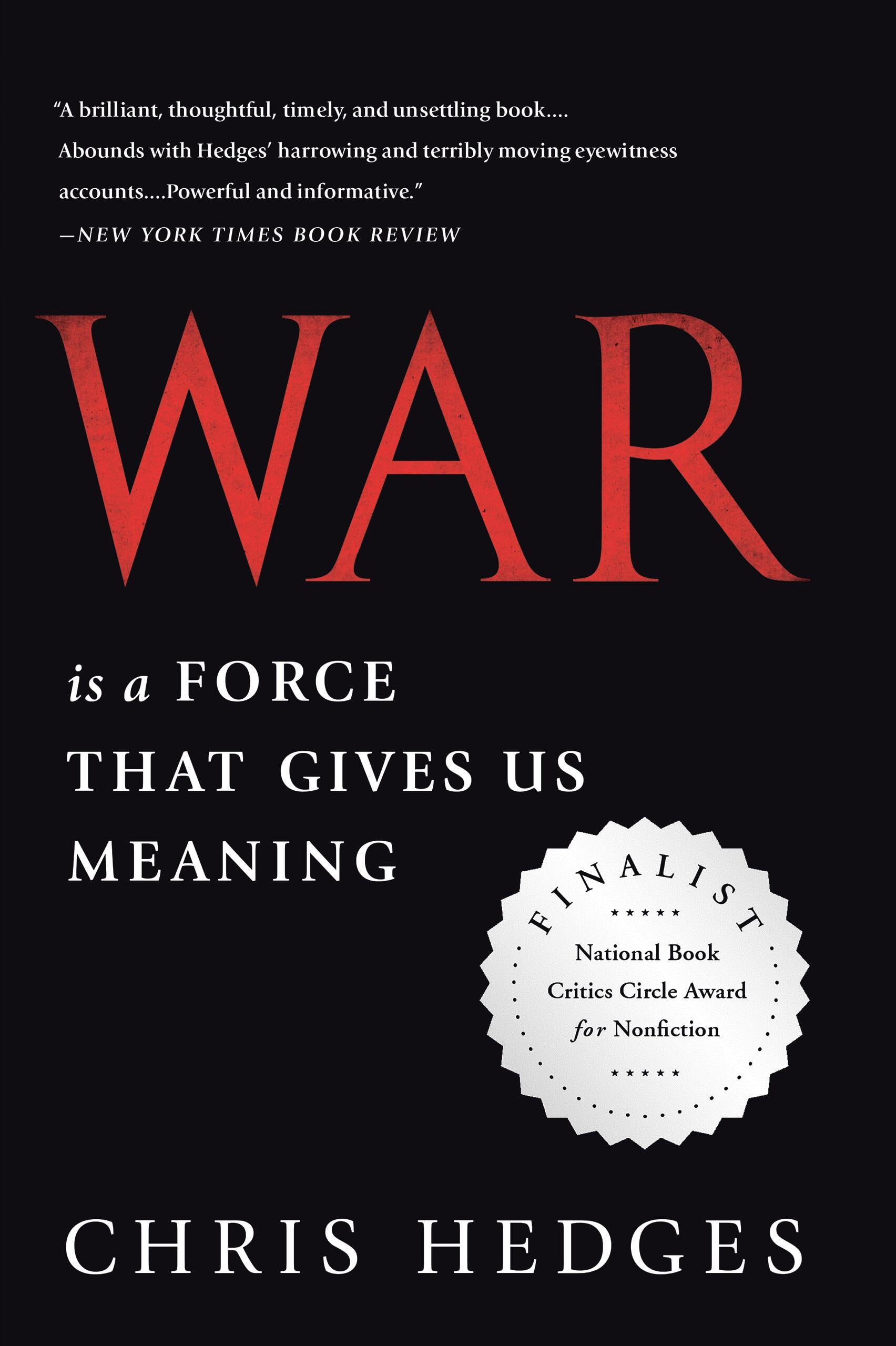
desertcart.com: War is a Force That Gives Us Meaning: 9781610393591: Hedges, Chris: Books Review: A little disorganized, but powerful - Judging by the title, you might think that this books speaks in favor of war. Absolutely not! In fact, it is a very powerful condemnation of war. The author had led an eventful life. He was a war correspondent who covered many conflicts in many parts of the world. He had seen his share of death, had many close calls and suffered human cruelty. This book is his attempt to understand the appeal of war. Despite universal condemnation of war (at least in principle), war has always been and still is a presence in human affairs. It continues to fascinate us and even attracts us. Why? If war is so wicked, why does it persist? Sure, there are some psychopaths out there who like war because it gives them a chance to indulge their darkest desires and achieve power, but the blame cannot be solely laid at the feet of few madmen. The sad fact is that war really does have its attractive qualities. "Truth is the first casualty of war," as the saying goes. That is true. The rulers need to first sell war to their people. Even the most totalitarian regimes do not start war out of the blue. Elaborate propaganda operation is first mounted to convince us that the enemy is evil, or at least in some way worse than us. People with whom we had no quarrel before suddenly become our enemy. They are portrayed as wicked and inferior. Differences, no matter how small and irrelevant, are brought up time after time as evidence of their otherness. Whatever bad things a few of them did, they are used to condemn all of them as evil. Some of these differences and bad deeds are no doubt true, but propaganda exaggerates them and even manufactures more if what is out there is not enough. At the same time, propaganda tries to convince us that we are the good guys and superior to the enemy. In other words, we are on the side of angels and they fight for Satan. In case of religious wars, this might literally be the official position. Quite often it is not enough to say that the other side is evil and inferior. They must also pose a grave threat. After all, if they were evil and inferior, but meant us no harm, then most people would not care enough to travel over there and fight them. But if they pose a threat to us, then not only we have a right to fight them, we even have a duty to. A man has to protect his country and loved us after all. Strangely, while individuals might resist propaganda, the masses often fall for it. There is powerful allure in accepting the propaganda. If we believe the lies, then suddenly we become heroes fighting the good fight against forces of darkness. We protect our loved ones from a wicked enemy. We see friends and neighbors support a cause and we feel the pull to join them to gain a sense of belonging. The psychological need to fit with a group and to be accepted is a powerful human desire. For those who are directly exposed to combat, aside for the horror and fear there is also excitement. The fight or flight response kicks in and our bodies are flooded with adrenaline. Even fear has its exciting properties. How else do you explain people enjoying horror movies? Soldiers experience intense comradeship and are often and are held as heroes. It is hard to be exposed to this kind of adoration and not have your ego flattered. Civilians feel a bond with their fellow civilians if their side is winning. If their side is losing and they are exposed to violence, this bond grows even stronger as they must together endure hardship and death. War has its dark attractiveness, but it is also a lie. It is like heroin. It makes you feel fantastic when you are under its influence, but at the same time it is destroying you. Eventually it will leave you a pathetic, sad shadow of what you were, and then it will kill you. War inverts values. What was once good is now bad and vice versa. Showing kindness and protecting human lives is generally speaking considered as a virtue. But in war showing kindness and protecting the lives of the people on the other side is almost a crime. War dissenters (who are essentially people who say that you should not hurt fellow human beings and look for peaceful solutions) are vilified and called traitors. They might be charged with crimes, imprisoned and even killed. On the other hand, people who kill, maim and hurt the enemy and destroy their property are made to look heroic. What before was rightfully called mass murder and criminality, now is the desired behavior. When the war is over, when the lies are exposed, silence and fantasy reign supreme. As people realize the evil and foolishness in which they indulged, they become ashamed and prefer to keep quiet about it. Not only people don't want to talk about it, they prefer not to hear about it. When some few brave individuals speak out, they are ignored. When there is no way to hide the truth, the evil is excused. Atrocities committed by our own side are written off as ugly necessities of war or laid at the feet of few "bad apples". And it is quickly pointed out that the enemy committed atrocities too. Apparently, their evil justifies our evil. But the silence is not enough. The society is faced with a problem. The old lies don't work anymore, but the truth is too painful to face. So new lies are invented. People replace old fantasy with new fantasy. Generals might say that they lost the war because politicians stabbed them in the back. Politicians might say that it was the country's allies who stabbed them in the back. Or the other side had won because they "cheated". (As if war was a sport with set rules.) This new fantasy prevents healing on both sides, thus sowing the seeds for the next conflict. While the current generation might have learned its lessons, those lessons are not passed down to the new generation. New generations grow up believing the fantasies, and one day they will march to war. This is, grossly, the author's thesis, although sometimes he does not lay it out as clearly. The book is written purely from heart and emotion. The impression from the text I got is that this is an emotional outburst and purging of a troubled soul. This is fine by me. It makes the book only more powerful. I have read some anti-war books in the past, but never anything so powerful. I have only one complaint. The author grimly states that in his opinion there will always be war (I agree) and that sometimes wars are necessary. But he does not elaborate on what he would consider a justifiable war. Taking into account how strongly anti-war his book is, it would be interesting to know in what circumstances he would approve of war. Review: The insanity of war - Chris Hedges has written a deeply thoughtful and thought provoking book on the insanity of war. Myths and identified are exploded. Realities are presented, at times, in graphic detail. Yet the book is an odd duck in some ways. Despite references to and quotations from the classics of literature, it is not an academic work; but neither is it a journalistic work. It is largely introspective; and in this sense, reminds me of the work of Joan Didion. The title offends me as it asserts a truth I wish to deny. Yet, as combat veteran, having looked closely at the dead--of my brothers and of those we killed--having stared into vacant eyes looking off to some unseen horizon, I cannot deny the truth he asserts: War is a Force that gives us meaning. Fortunately, it is not the ONLY force, and needs not be THE force, as he makes clear toward the end. Indeed, a subtitle could be "Love is THE force which gives us true meaning. I find the reviews of some of Hedges' critics rather amusing, and strongly suspect they have never worn the uniform, much less served in combat. If they did, they would realize some of their criticisms are, well, stupid. This book, for example, is not anti-patriotic, though neither is it "patriotic", at least not in any usual sense of the word. Hedges' argument is our loyalties should not lie, at least not exclusively, not decisively, with any nation or government. Our patriotism should not be blind, nor should it be a means of manipulation. Rather, it should be grounded in love and understanding. Though Hedges does not say this specifically, I think he would agree that true patriotism entails both love of country AND love of humanity. To view our "enemies" as the epitome of evil, to present them as fanatics with no respect for human life, is to lower ourselves to the level we ascribe to them. Such false beliefs are inherently self defeating. Cucolo does not seem to understand, as some great Americans have, that war is a narcotic, that patriotism often is used and abused by those who, themselves, have an inadequate understanding of humanity, and, therefore, inadequate respect for human life, who will sacrifice a nation's best for empire or to salve their own demented egos. Having stood much closer to war than Cucolo probably sits to the screen showing John Wayne movies, Hemingway understood this: "There is noting sweet and fitting in dying for your country. You will die like a dog for no good reason." John Quincy Adams also understood what Cucolo apparently does not: "And say not thou, `My country right or wrong'; nor shed thy blood for an unhallowed cause." Real patriotism, true patriotism is far more than flying a flag outside one's home. As Hedges argues, we are conditioned to believe war is some great cause, possessing some noble meaning that transcends us, that gives us some noble purpose in life far greater than anything we are likely to accomplish on our own, living our lives of anonymous insignificance, of "quiet desperation". War gives us the opportunity for heroics, to have our names, or at least the cause in which we served, inscribed in the annals (or should I say anals?) of history. War summons up the courage ordinary men fear they lack. That "red badge of courage" shouts we ARE courageous, if not heroes. What else can we say of men willing to leave hearth and home, to kiss their loved ones good-bye, "leaving on a jet plane", not knowing if they will return again, even if in a box, gift wrapped? What greater love is there, can there be than to lay down one's life for one's country? Certainly I understand this. Why else would I have marched off--as a volunteer--to fight in a war I actively opposed, and believed (then and now) to be an illegal, immoral, "unhallowed cause"? In his last chapter, Hedges talks of how war is a false god. Life seems more "real" in combat. Things do get distilled down to very simple terms--life and death. Soldiers, especially those standing victorious on that day's battlefield, are as gods. As one of my brothers, imprisoned after the war because he had become too addicted to the violence of war, bringing that violence home where what he did in the Nam to great praise from his commanders was unacceptable, said: "We strode the earth as gods, dispensing life and death at will." And we did. Hedges identifies three things that stand in contrast to the false meaning of life provided by war--meaning (purposefulness) of life, happiness and love. To those whose souls are possessed by Thanatos--as Cucolo's may be--to talk of love is to talk of weakness: Love is the sentiment of weak women; war is what MEN do. They could not be more wrong as anyone who has served in combat knows. We LOVE our brothers, even if, as Hedges argues, it is not a complete love; for it is a love forged by a false god. Major Michael O'Donnell, himself one of those "gentle heroes (we) left behind", clearly understood this as he wrote in his poem, "Vietnam": "Be not ashamed to say you loved them though you may or may not have always." But anyone who has lain on a battlefield with bullets, mortars, rockets crashing around surely knows, we have never felt our love for our parents, our siblings, our girlfriends or wives--not before, nor since--so completely, so intensely as those moments when we faced death in battle. Hedges has written a profound book, full of meaning and purpose, for anyone willing to open their minds to the possibility war is an inherently insane, inherently immoral narcotic. There are no winners in war, none, only savagery and inhumanity and destruction of the soul; and we need to know this without having to learn it first hand.


| ASIN | 1610393597 |
| Best Sellers Rank | #133,999 in Books ( See Top 100 in Books ) #152 in Philosophy of Ethics & Morality #188 in Violence in Society (Books) #324 in Political Commentary & Opinion |
| Customer Reviews | 4.6 4.6 out of 5 stars (555) |
| Dimensions | 5.75 x 0.5 x 8.25 inches |
| Edition | Reprint |
| ISBN-10 | 9781610393591 |
| ISBN-13 | 978-1610393591 |
| Item Weight | 2.31 pounds |
| Language | English |
| Print length | 224 pages |
| Publication date | April 8, 2014 |
| Publisher | PublicAffairs |
W**Z
A little disorganized, but powerful
Judging by the title, you might think that this books speaks in favor of war. Absolutely not! In fact, it is a very powerful condemnation of war. The author had led an eventful life. He was a war correspondent who covered many conflicts in many parts of the world. He had seen his share of death, had many close calls and suffered human cruelty. This book is his attempt to understand the appeal of war. Despite universal condemnation of war (at least in principle), war has always been and still is a presence in human affairs. It continues to fascinate us and even attracts us. Why? If war is so wicked, why does it persist? Sure, there are some psychopaths out there who like war because it gives them a chance to indulge their darkest desires and achieve power, but the blame cannot be solely laid at the feet of few madmen. The sad fact is that war really does have its attractive qualities. "Truth is the first casualty of war," as the saying goes. That is true. The rulers need to first sell war to their people. Even the most totalitarian regimes do not start war out of the blue. Elaborate propaganda operation is first mounted to convince us that the enemy is evil, or at least in some way worse than us. People with whom we had no quarrel before suddenly become our enemy. They are portrayed as wicked and inferior. Differences, no matter how small and irrelevant, are brought up time after time as evidence of their otherness. Whatever bad things a few of them did, they are used to condemn all of them as evil. Some of these differences and bad deeds are no doubt true, but propaganda exaggerates them and even manufactures more if what is out there is not enough. At the same time, propaganda tries to convince us that we are the good guys and superior to the enemy. In other words, we are on the side of angels and they fight for Satan. In case of religious wars, this might literally be the official position. Quite often it is not enough to say that the other side is evil and inferior. They must also pose a grave threat. After all, if they were evil and inferior, but meant us no harm, then most people would not care enough to travel over there and fight them. But if they pose a threat to us, then not only we have a right to fight them, we even have a duty to. A man has to protect his country and loved us after all. Strangely, while individuals might resist propaganda, the masses often fall for it. There is powerful allure in accepting the propaganda. If we believe the lies, then suddenly we become heroes fighting the good fight against forces of darkness. We protect our loved ones from a wicked enemy. We see friends and neighbors support a cause and we feel the pull to join them to gain a sense of belonging. The psychological need to fit with a group and to be accepted is a powerful human desire. For those who are directly exposed to combat, aside for the horror and fear there is also excitement. The fight or flight response kicks in and our bodies are flooded with adrenaline. Even fear has its exciting properties. How else do you explain people enjoying horror movies? Soldiers experience intense comradeship and are often and are held as heroes. It is hard to be exposed to this kind of adoration and not have your ego flattered. Civilians feel a bond with their fellow civilians if their side is winning. If their side is losing and they are exposed to violence, this bond grows even stronger as they must together endure hardship and death. War has its dark attractiveness, but it is also a lie. It is like heroin. It makes you feel fantastic when you are under its influence, but at the same time it is destroying you. Eventually it will leave you a pathetic, sad shadow of what you were, and then it will kill you. War inverts values. What was once good is now bad and vice versa. Showing kindness and protecting human lives is generally speaking considered as a virtue. But in war showing kindness and protecting the lives of the people on the other side is almost a crime. War dissenters (who are essentially people who say that you should not hurt fellow human beings and look for peaceful solutions) are vilified and called traitors. They might be charged with crimes, imprisoned and even killed. On the other hand, people who kill, maim and hurt the enemy and destroy their property are made to look heroic. What before was rightfully called mass murder and criminality, now is the desired behavior. When the war is over, when the lies are exposed, silence and fantasy reign supreme. As people realize the evil and foolishness in which they indulged, they become ashamed and prefer to keep quiet about it. Not only people don't want to talk about it, they prefer not to hear about it. When some few brave individuals speak out, they are ignored. When there is no way to hide the truth, the evil is excused. Atrocities committed by our own side are written off as ugly necessities of war or laid at the feet of few "bad apples". And it is quickly pointed out that the enemy committed atrocities too. Apparently, their evil justifies our evil. But the silence is not enough. The society is faced with a problem. The old lies don't work anymore, but the truth is too painful to face. So new lies are invented. People replace old fantasy with new fantasy. Generals might say that they lost the war because politicians stabbed them in the back. Politicians might say that it was the country's allies who stabbed them in the back. Or the other side had won because they "cheated". (As if war was a sport with set rules.) This new fantasy prevents healing on both sides, thus sowing the seeds for the next conflict. While the current generation might have learned its lessons, those lessons are not passed down to the new generation. New generations grow up believing the fantasies, and one day they will march to war. This is, grossly, the author's thesis, although sometimes he does not lay it out as clearly. The book is written purely from heart and emotion. The impression from the text I got is that this is an emotional outburst and purging of a troubled soul. This is fine by me. It makes the book only more powerful. I have read some anti-war books in the past, but never anything so powerful. I have only one complaint. The author grimly states that in his opinion there will always be war (I agree) and that sometimes wars are necessary. But he does not elaborate on what he would consider a justifiable war. Taking into account how strongly anti-war his book is, it would be interesting to know in what circumstances he would approve of war.
S**N
The insanity of war
Chris Hedges has written a deeply thoughtful and thought provoking book on the insanity of war. Myths and identified are exploded. Realities are presented, at times, in graphic detail. Yet the book is an odd duck in some ways. Despite references to and quotations from the classics of literature, it is not an academic work; but neither is it a journalistic work. It is largely introspective; and in this sense, reminds me of the work of Joan Didion. The title offends me as it asserts a truth I wish to deny. Yet, as combat veteran, having looked closely at the dead--of my brothers and of those we killed--having stared into vacant eyes looking off to some unseen horizon, I cannot deny the truth he asserts: War is a Force that gives us meaning. Fortunately, it is not the ONLY force, and needs not be THE force, as he makes clear toward the end. Indeed, a subtitle could be "Love is THE force which gives us true meaning. I find the reviews of some of Hedges' critics rather amusing, and strongly suspect they have never worn the uniform, much less served in combat. If they did, they would realize some of their criticisms are, well, stupid. This book, for example, is not anti-patriotic, though neither is it "patriotic", at least not in any usual sense of the word. Hedges' argument is our loyalties should not lie, at least not exclusively, not decisively, with any nation or government. Our patriotism should not be blind, nor should it be a means of manipulation. Rather, it should be grounded in love and understanding. Though Hedges does not say this specifically, I think he would agree that true patriotism entails both love of country AND love of humanity. To view our "enemies" as the epitome of evil, to present them as fanatics with no respect for human life, is to lower ourselves to the level we ascribe to them. Such false beliefs are inherently self defeating. Cucolo does not seem to understand, as some great Americans have, that war is a narcotic, that patriotism often is used and abused by those who, themselves, have an inadequate understanding of humanity, and, therefore, inadequate respect for human life, who will sacrifice a nation's best for empire or to salve their own demented egos. Having stood much closer to war than Cucolo probably sits to the screen showing John Wayne movies, Hemingway understood this: "There is noting sweet and fitting in dying for your country. You will die like a dog for no good reason." John Quincy Adams also understood what Cucolo apparently does not: "And say not thou, `My country right or wrong'; nor shed thy blood for an unhallowed cause." Real patriotism, true patriotism is far more than flying a flag outside one's home. As Hedges argues, we are conditioned to believe war is some great cause, possessing some noble meaning that transcends us, that gives us some noble purpose in life far greater than anything we are likely to accomplish on our own, living our lives of anonymous insignificance, of "quiet desperation". War gives us the opportunity for heroics, to have our names, or at least the cause in which we served, inscribed in the annals (or should I say anals?) of history. War summons up the courage ordinary men fear they lack. That "red badge of courage" shouts we ARE courageous, if not heroes. What else can we say of men willing to leave hearth and home, to kiss their loved ones good-bye, "leaving on a jet plane", not knowing if they will return again, even if in a box, gift wrapped? What greater love is there, can there be than to lay down one's life for one's country? Certainly I understand this. Why else would I have marched off--as a volunteer--to fight in a war I actively opposed, and believed (then and now) to be an illegal, immoral, "unhallowed cause"? In his last chapter, Hedges talks of how war is a false god. Life seems more "real" in combat. Things do get distilled down to very simple terms--life and death. Soldiers, especially those standing victorious on that day's battlefield, are as gods. As one of my brothers, imprisoned after the war because he had become too addicted to the violence of war, bringing that violence home where what he did in the Nam to great praise from his commanders was unacceptable, said: "We strode the earth as gods, dispensing life and death at will." And we did. Hedges identifies three things that stand in contrast to the false meaning of life provided by war--meaning (purposefulness) of life, happiness and love. To those whose souls are possessed by Thanatos--as Cucolo's may be--to talk of love is to talk of weakness: Love is the sentiment of weak women; war is what MEN do. They could not be more wrong as anyone who has served in combat knows. We LOVE our brothers, even if, as Hedges argues, it is not a complete love; for it is a love forged by a false god. Major Michael O'Donnell, himself one of those "gentle heroes (we) left behind", clearly understood this as he wrote in his poem, "Vietnam": "Be not ashamed to say you loved them though you may or may not have always." But anyone who has lain on a battlefield with bullets, mortars, rockets crashing around surely knows, we have never felt our love for our parents, our siblings, our girlfriends or wives--not before, nor since--so completely, so intensely as those moments when we faced death in battle. Hedges has written a profound book, full of meaning and purpose, for anyone willing to open their minds to the possibility war is an inherently insane, inherently immoral narcotic. There are no winners in war, none, only savagery and inhumanity and destruction of the soul; and we need to know this without having to learn it first hand.
H**H
Ich lese Chris Hedges Bücher und Artikel seit etwa 2011 regelmäßig, zumeist auf seinem Blog auf Thruthdig, und habe seither auch diverse seiner Bücher erworben. Während ich auf dieses Buch (Ersterscheinung 2003, während des Irak-Krieges) erst relativ spät gestoßen bin, hat es doch in den zehn Jahren seit der Ersterscheinung nichts von seiner Aktualität verloren. Hedges Analyse des Krieges als einer Art Droge, die die Wahrnehmung verzerrt und eine Art Sucht verursachen kann, ist heute, zehn Jahre später, da wir offenbar in einen Krieg der USA mit Syrien hinein schliddern, aktueller denn je. Und Hedges zeigt präzise auf, wie auch die Wahrheit im Krieg nebensächlich wird, wie der Krieg scheinbar Sinn stiftend wirkt... eine gute Imprägnierung gegen derartige Mechanismen. Unbedingt empfehlenswert!
T**M
Chris Hedges sums up the tragedies of war and why people become come consumed by it. It also tells how it chews people up and spits it out. The book is relevant today with the conflicts in the Middle East, Ukraine and Africa as it was when he wrote in close to 25 years ago. Worth the read.
B**F
Very, very politically correct book. Nothing new and really captivating to learn and enjoy. Its quite obvious why the author and this title were so highly admitted and placed by the mainstream medias and critics. You can read stories like this in thousands even without the need to spend money and paper on buying books... But it will be a lesson to me for the next time I spot the name of this author...
G**L
Now the idea of War has become very popular again it would be healthy to read Chris Hedges book. It deals with all the important matters concerning war and thankfully does not mention the strategic aspects of war that the newspapers, politicians and military people now discuss on a day to day basis. Hedges book describes at length the effect war has on the people who suffer from it and often can not escape from it. He describes vividly too how it destroys soldiers lives. At the end of a war very little is achieved except death, destruction and unhappiness.
K**R
In a manner that only Chris Hedges can provide, war is described precisely for what it is; HELL. No, he does NOT say that there are never times that this is the only recourse, nor does he say that all countries should defund their security budgets. But what he does say is frighteningly horrible (and true). War is the most dehumanizing act that we commit on ourselves and while it becomes an addictive narcotic for some it is a psychologically destructive force for all others. The 'whys' of our internal impulse to wreck havoc on others remains undefined while the false national propaganda that leads us on these mercenary quests are quite evident; the irrational quest for power and control of those with whom we disagree. Pogo was correct; "We have met the enemy and he is us.".
Trustpilot
Hace 2 meses
Hace 2 días